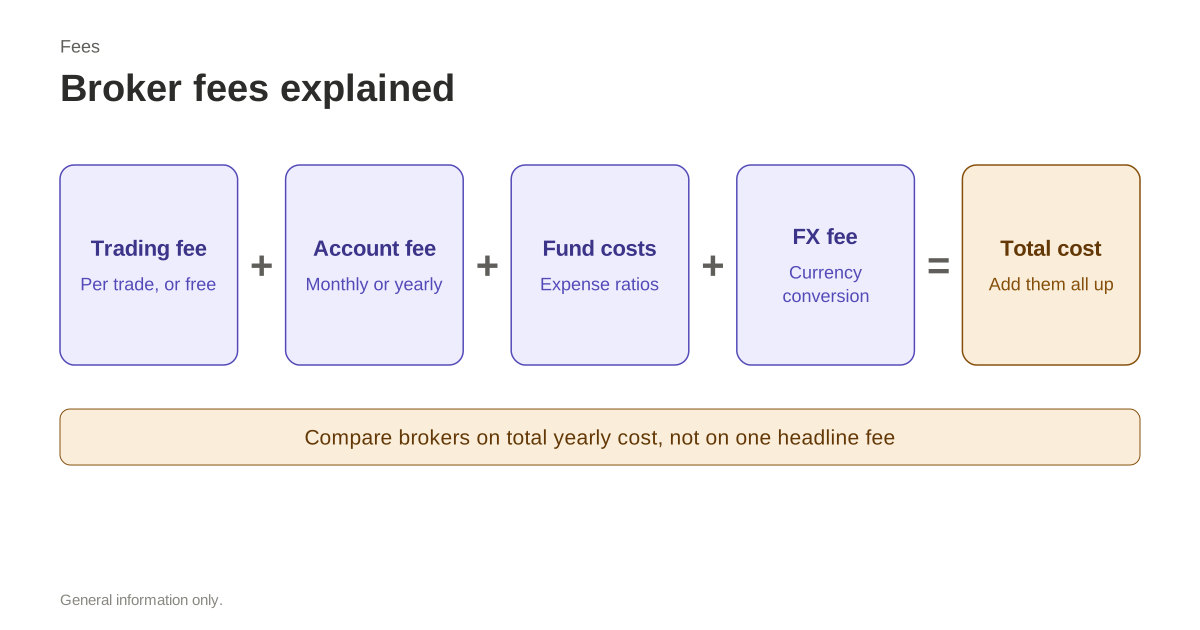
Investing through a broker involves more charges than most people expect. Some are obvious, such as the commission on a trade. Others are hidden inside the price you pay, or appear only when you withdraw money or leave the account. Understanding each charge makes it much easier to compare firms fairly.
The aim of this guide is to explain the common fees in plain language and show how they add up over a year. The exact amounts depend on the firm and the country, so always read the official fee schedule before you open an account.
Commission
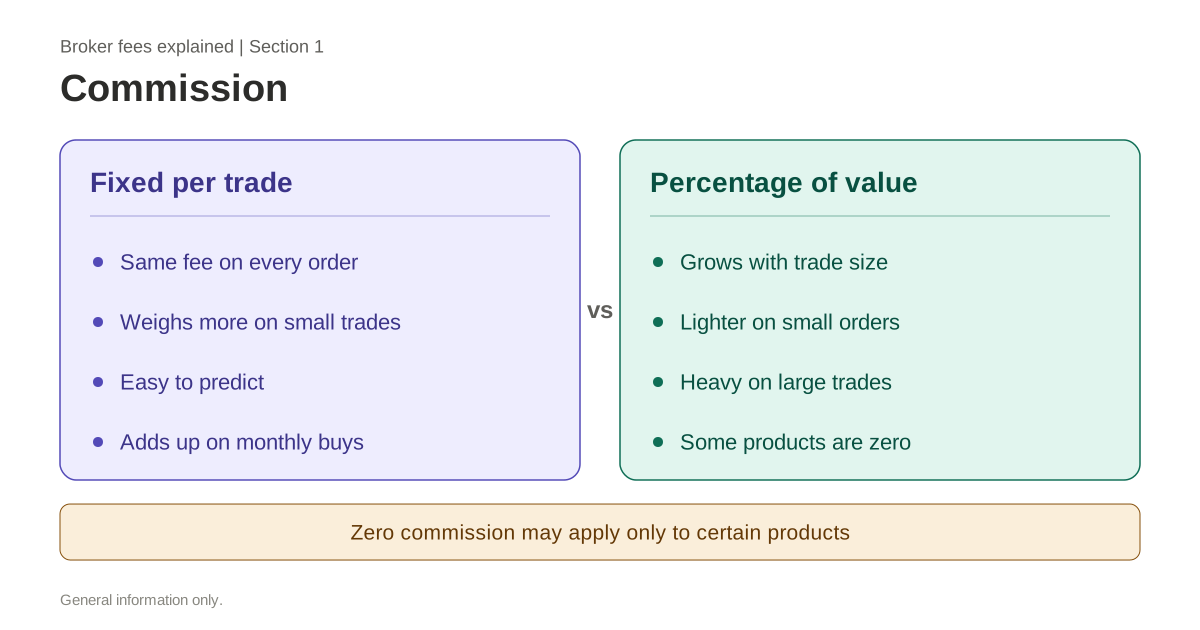
Commission is a fee charged for each buy or sell order. It can be a fixed amount per trade, a percentage of the value traded, or a mix of both. Some brokers advertise zero commission on certain products, but may charge on others, so check the rules for each type of investment you plan to buy.
If you invest small amounts often, a fixed commission per trade can weigh more heavily than a percentage. A fee that looks tiny on one order can add up quickly over a year of monthly purchases.
Spread
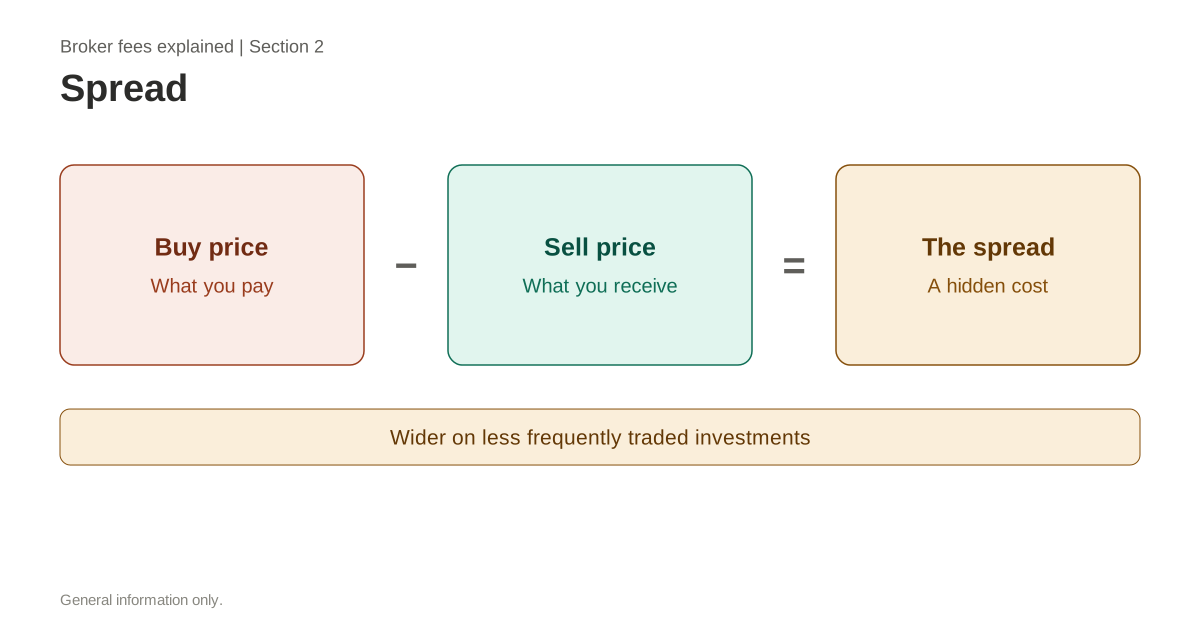
The spread is the gap between the price at which you can buy an investment and the price at which you can sell it. Brokers do not always show it as a separate charge, but you pay it every time you trade. Wide spreads are more common on less frequently traded investments, and they can be a large cost for short-term trading.
When comparing platforms, look at the spread for the specific investments you intend to buy, not only at the headline commission.
Currency conversion
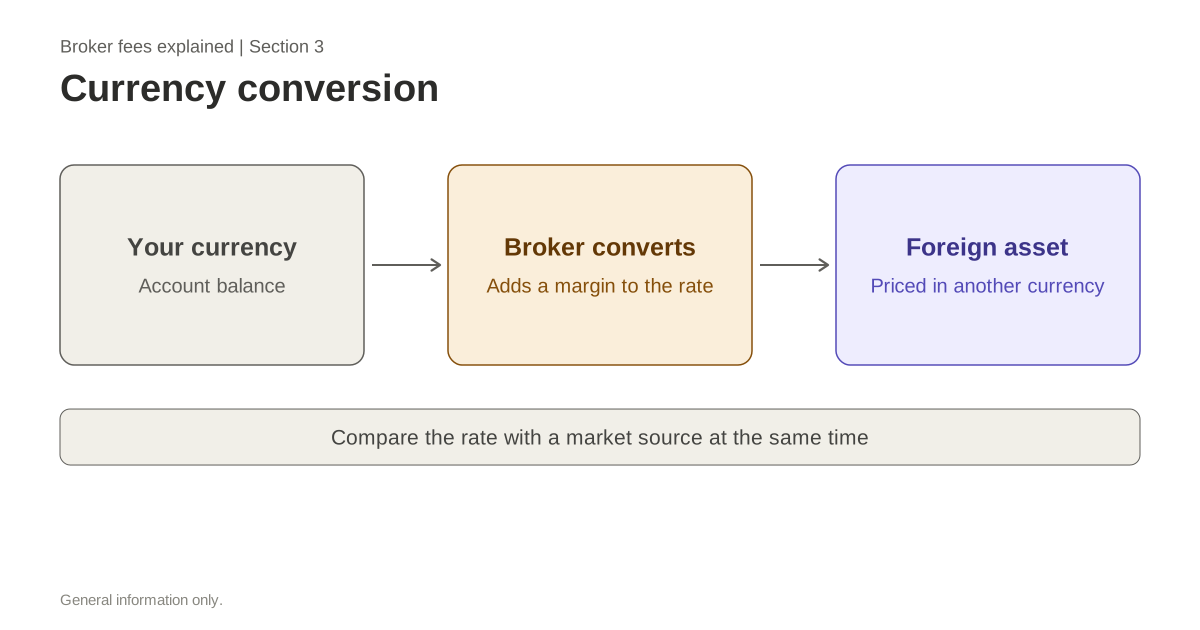
If you buy an investment priced in a different currency from your account, the broker converts the money. The conversion charge is often a percentage added to the exchange rate the broker offers. It can be substantial, particularly for small amounts or frequent trades, and it is easy to miss because it is not shown as a fee line.
Some brokers offer multi-currency accounts that reduce conversion costs. Ask how the conversion is priced and compare it with the rate on a reputable market source at the same time.
Account and custody fees
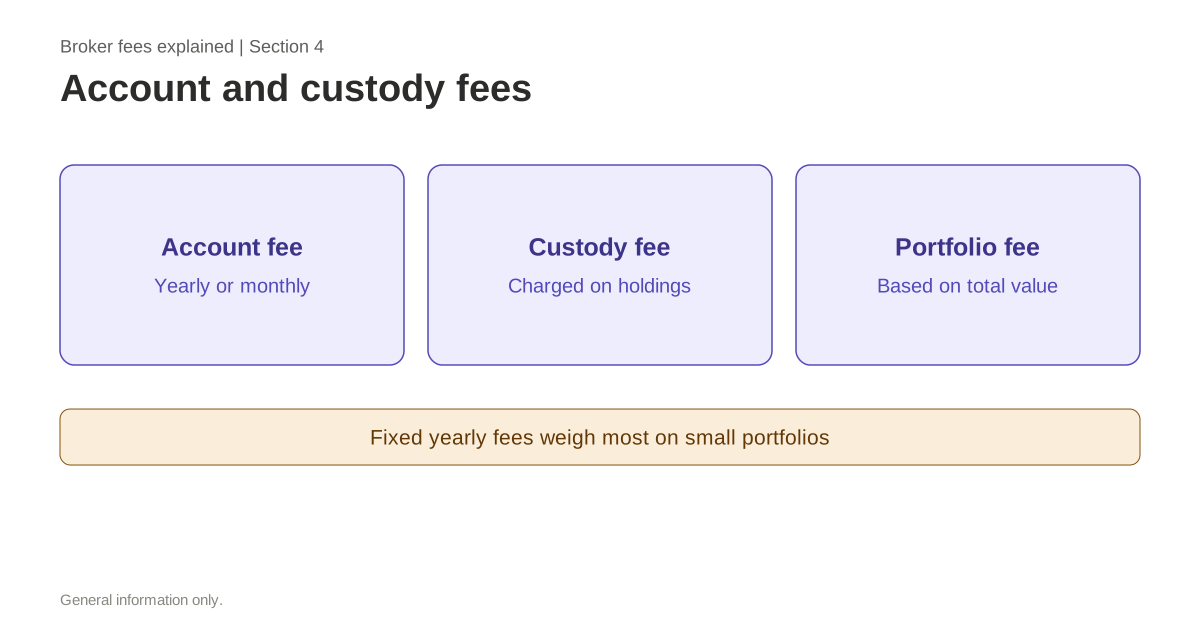
Some brokers charge a yearly fee for holding an account, a fee for holding investments, or a fee based on the value of the portfolio. Custody fees are common in certain markets, and they are charged whether or not you trade. For a small portfolio, a fixed yearly charge can be a large share of the value.
Check whether the fee is charged monthly, quarterly or yearly, and whether it has a minimum or maximum amount.
Inactivity and withdrawal fees
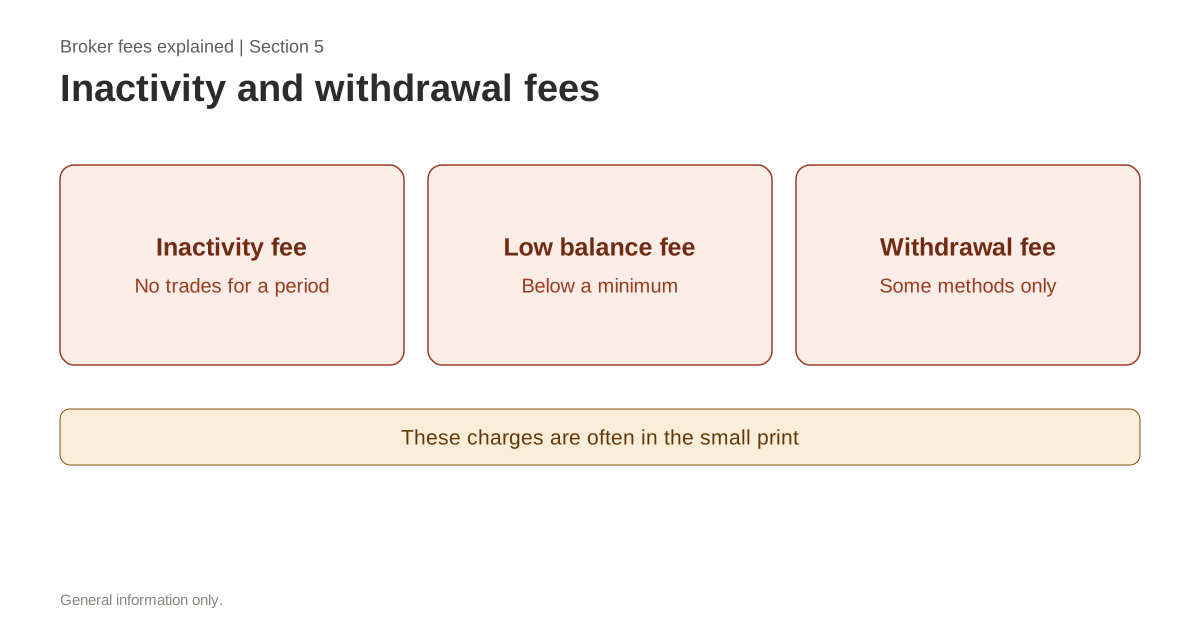
Some firms charge if you do not trade for a set period, or if your balance is below a minimum. Others charge to withdraw money, sometimes only for certain methods such as a bank transfer. These charges are often in the small print, so read the full list before you deposit.
Fund charges
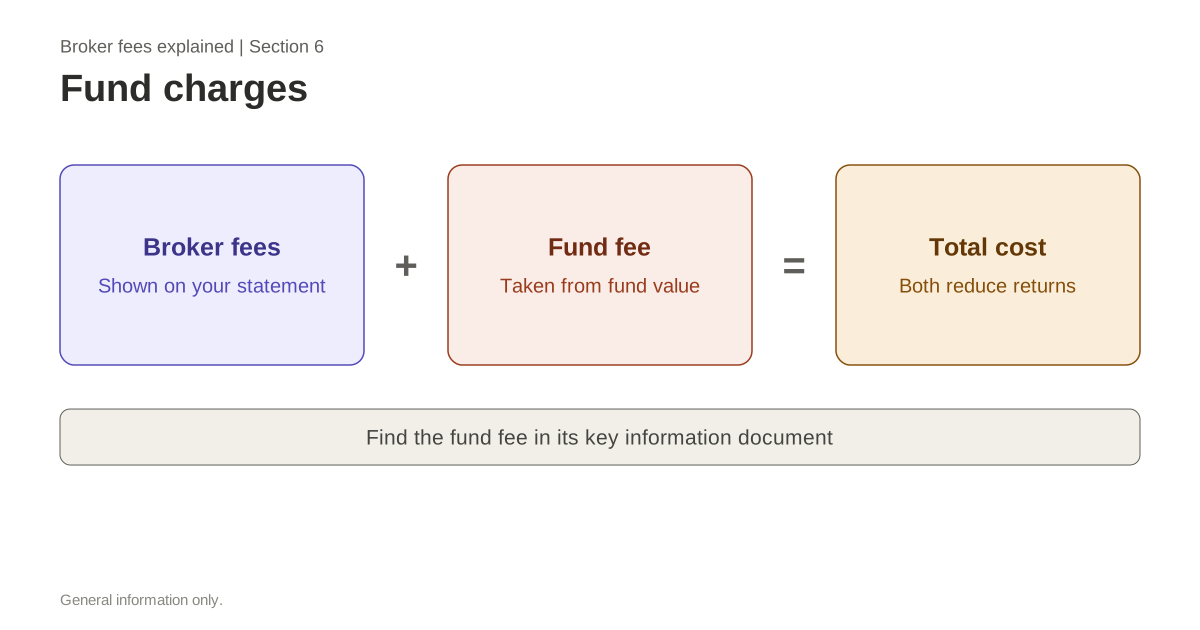
If you invest in funds, the broker's fees are only part of the cost. Funds charge their own annual fee, usually shown as an expense ratio or ongoing charge, which is taken from the fund's value. You will not see this on your broker statement, but it reduces your return every year. Look up the fund's key information document or its annual report to find the figure.
Adding up the total
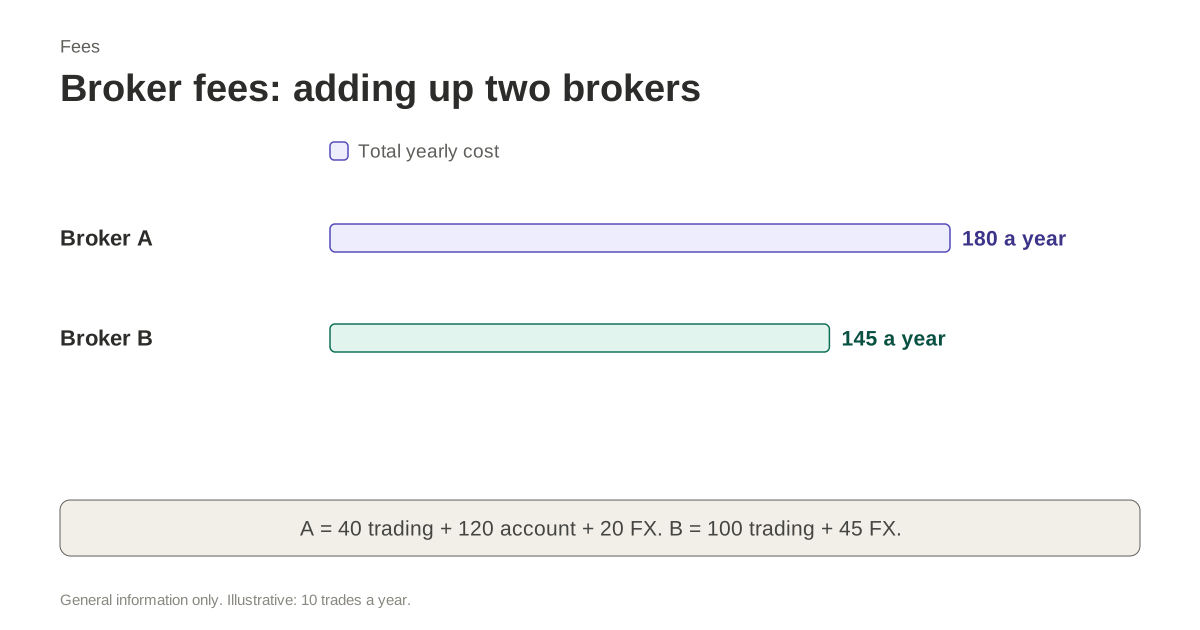
To compare brokers fairly, make a simple table for a typical year. List the number of trades, the typical value of each trade, the expected currency conversions and any yearly or inactivity charges. Multiply and add to get a total yearly cost for each firm. Include the expense ratio of any fund you plan to hold.
Repeat the exercise with a different amount or trading pattern. A broker that is cheapest for a few large trades may be expensive for many small monthly purchases, and the reverse is also true.
Read the full fee schedule
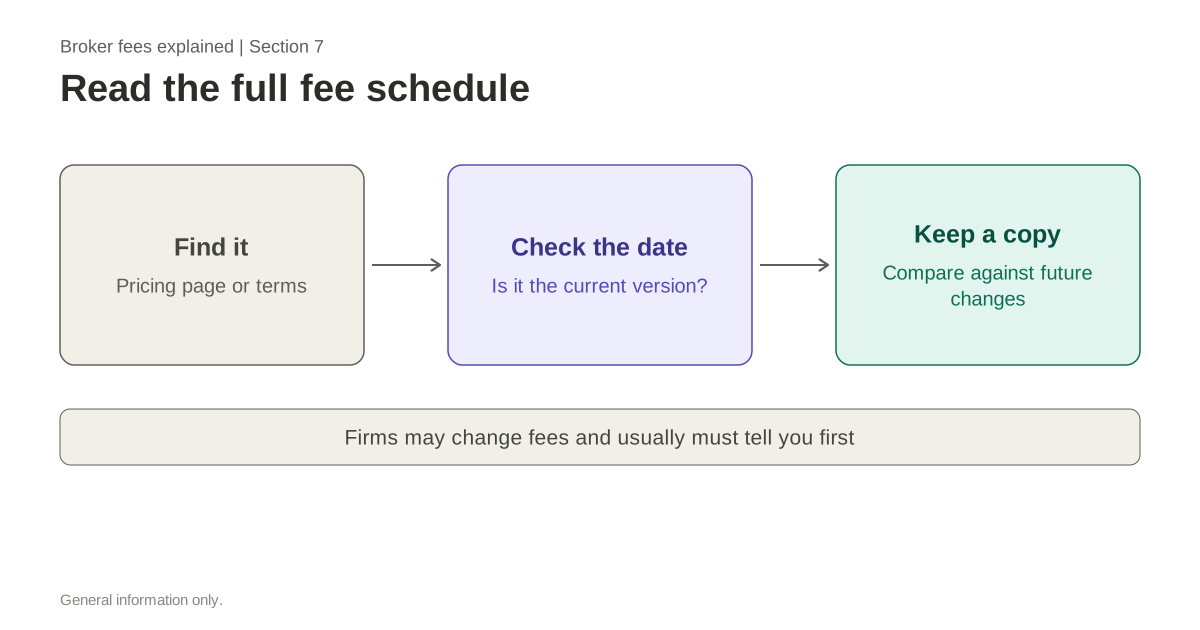
Every regulated firm must publish its charges. The schedule is the document that matters most, because it is where the exact numbers appear. Keep a copy, and check it again if the firm announces changes. Fees can change, and a firm may need to tell you in advance.
A worked example
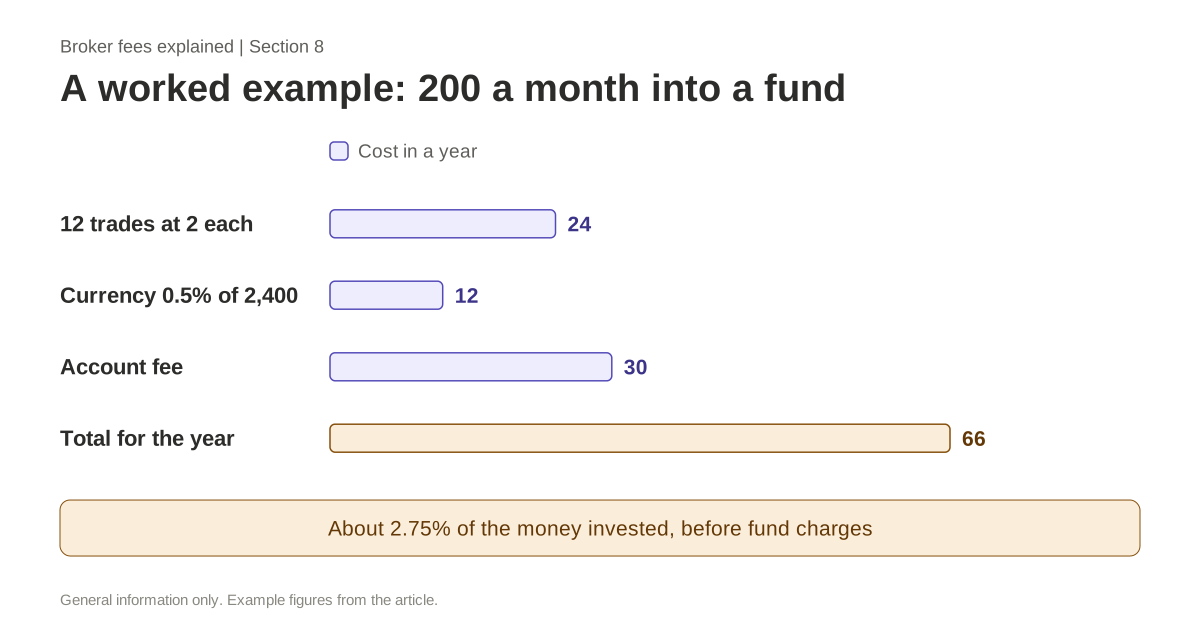
Suppose you invest 200 a month into an index fund through a platform that charges a fixed fee of 2 per trade, a currency conversion charge of 0.5% on each purchase, and an annual account fee of 30. Over a year you make twelve trades, so the trading fees are 24. The conversion charges total about 12, since 0.5% of 2,400 is 12. The account fee adds 30, bringing the total to about 66 for the year.
That is roughly 2.75% of the money invested, before any fund charges. A platform with a different structure, such as a small percentage fee and no account charge, could cost more or less depending on the amounts you invest. The example shows why you should work out your own figures rather than relying on the headline commission.
Hidden costs in the price
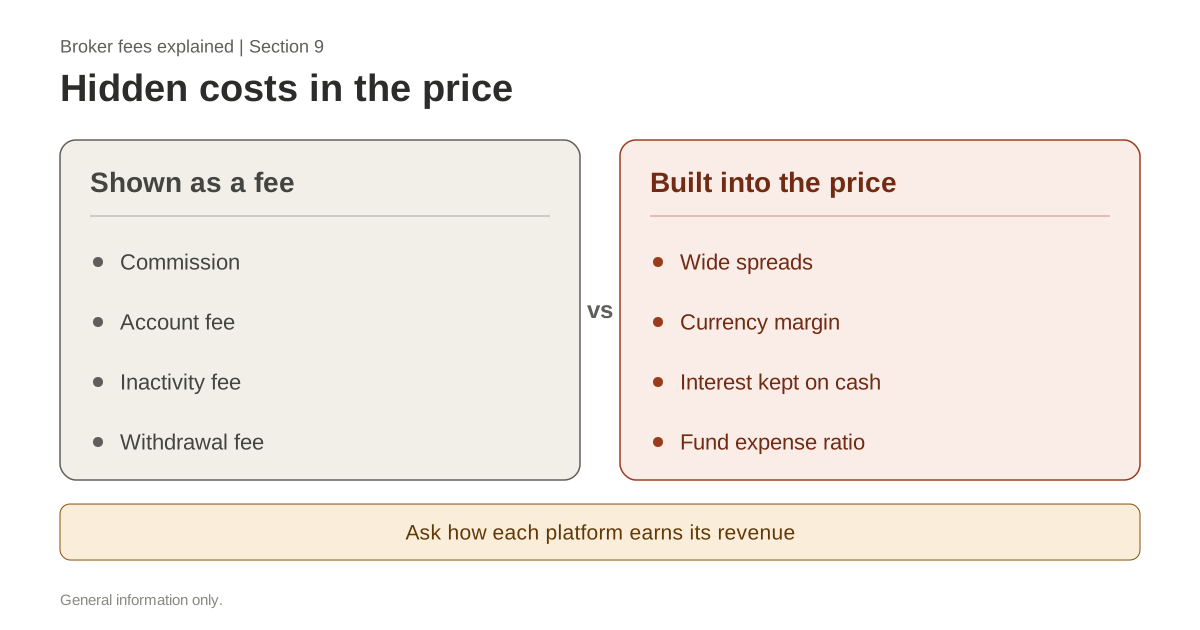
Some costs never appear as a separate line on your statement. A wide spread means you receive a lower price when you sell than the price you paid when you bought, which is a cost even if no fee is shown. Some platforms also earn money from holding your cash or from the interest on it, and this can affect how much you earn on uninvested balances.
When you compare platforms, ask how each one earns its revenue. A firm that is paid by commission may have different incentives from one that charges a flat fee. Understanding the business model helps you judge whether the cheapest-looking option is truly the lowest-cost one for you.
The bottom line
Fees are one of the few parts of investing you can measure before you start. A clear understanding of commission, spreads, currency costs, account charges and fund fees gives you a realistic view of what your investing will cost, and helps you choose a platform that suits your plan.
Frequently asked questions
What is the biggest hidden broker fee?
For many investors, the currency conversion charge and the spread are the largest hidden costs. Both are built into the price rather than shown as a separate line, so they are easy to overlook.
Are fund fees the same as broker fees?
No. Broker fees are charged by the platform for trading and holding your account. Fund fees are charged by the fund itself and reduce its value, so you pay them even if you buy through a free platform.
Can I avoid fees by trading less?
Trading less reduces commission and spread costs, but it does not remove account or fund fees. Long-term investors often pay less overall because they trade rarely and hold low-cost funds.
Where can I find a broker's fees?
The official fee schedule is published on the broker's website, usually in the account terms or a pricing page. Check that you are reading the current version.