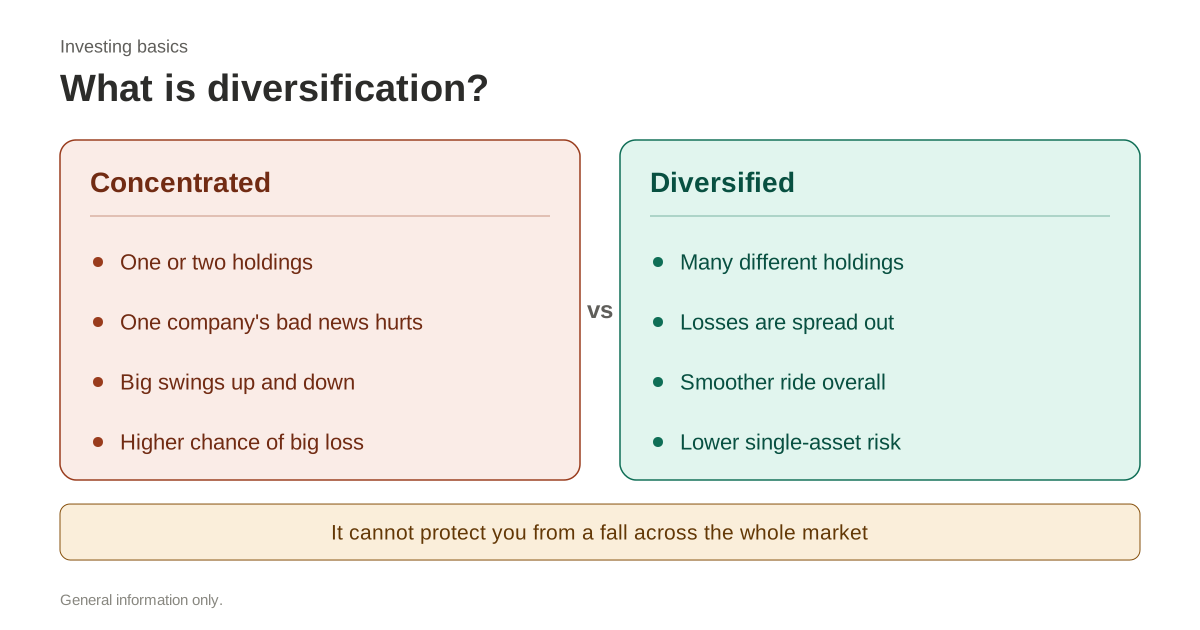
Diversification means spreading your money across several investments so that the poor performance of one does not sink your whole portfolio. It is one of the oldest principles in investing, and it is often described as the only free lunch in finance. It does not remove risk, but it can reduce the impact of any single failure and make your results steadier over time.
This article explains how diversification works, the different ways to diversify, and the limits of the idea. Nothing here is a recommendation of any particular investment.
Why spreading risk helps
Every investment carries specific risks. A company can lose customers, a sector can fall out of favour, or a country's economy can slow. If all your money is in one company, a single bad event can cause a severe loss. If your money is spread across many companies, sectors and countries, the bad event affects only a part of your portfolio.
The key insight is that different investments do not always move in the same direction at the same time. When some are falling, others may be steady or rising. A portfolio built from holdings that respond differently to the same event tends to be less volatile than any single holding.
Different ways to diversify
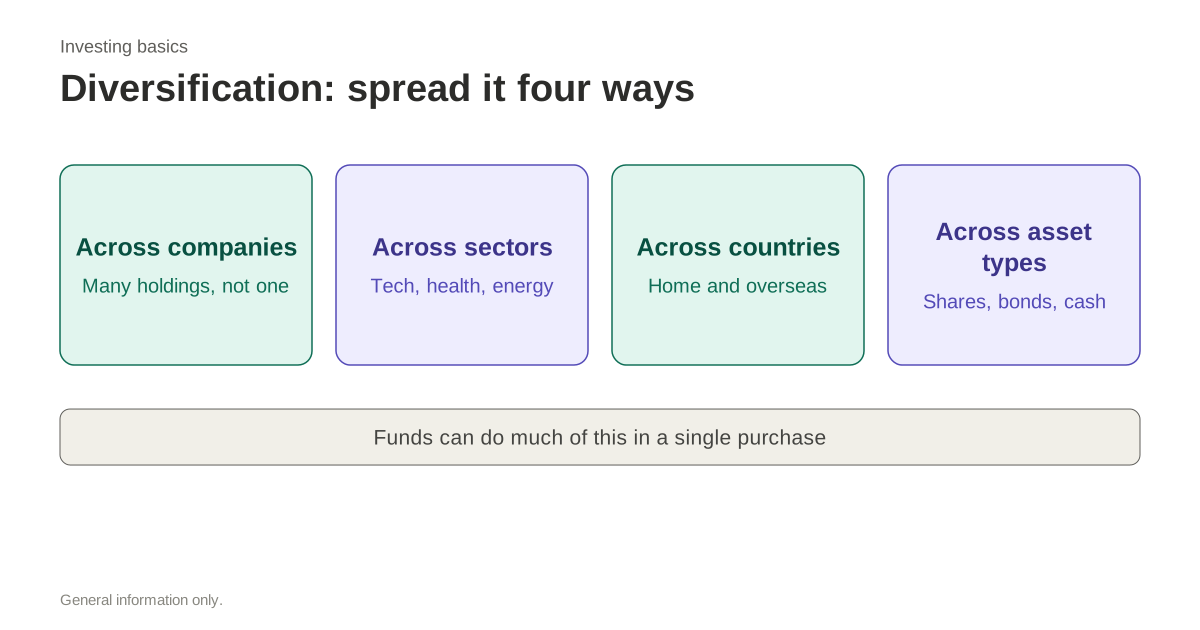
Diversification can happen across several dimensions. The most common is across asset classes, such as shares, bonds, cash and property. Within shares, you can diversify by company, by sector and by country. Within bonds, you can diversify by issuer, by maturity and by credit quality.
Currency is another dimension. Holding investments in more than one currency can reduce the risk that a single currency's movements dominate your results, although it adds its own volatility. Time is also a form of diversification, because investing regularly spreads your purchases across different market levels.
Diversification within a fund
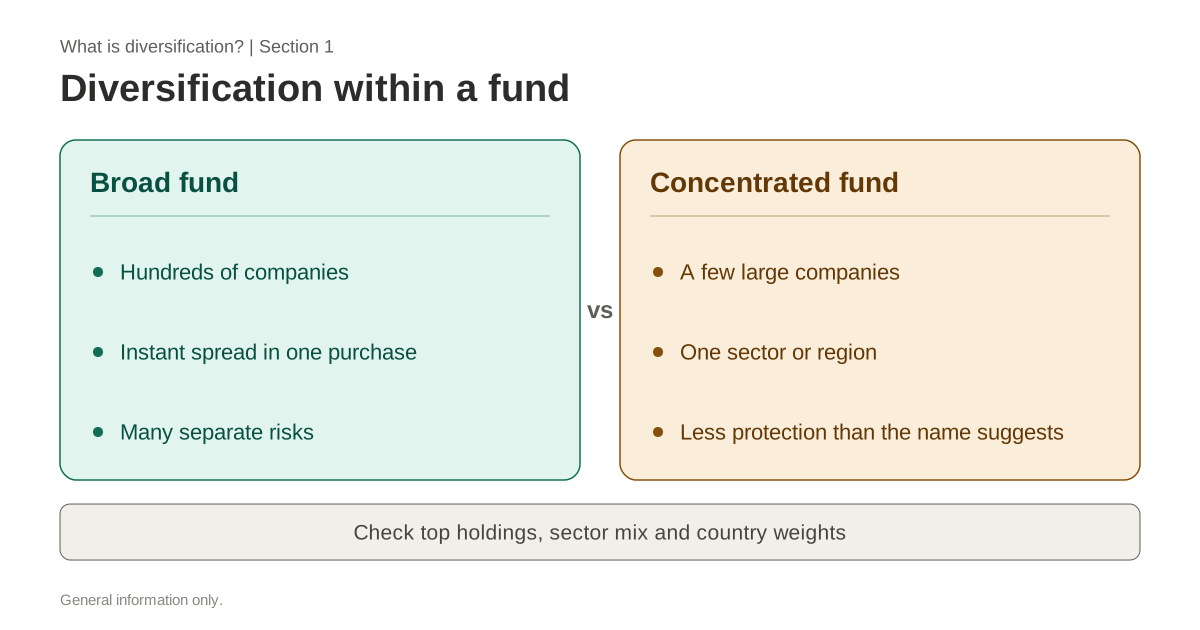
A single broad fund can provide a large amount of diversification in one purchase. An index fund covering hundreds of companies holds more individual risks than most people could manage by picking shares. This is one reason many investors start with funds rather than individual companies.
However, a fund is only as diversified as its holdings. A fund concentrated in a few large companies or a single sector offers less protection than its name might suggest. Look at the top holdings, the sector mix and the country weights before assuming a fund is broadly spread.
Correlation
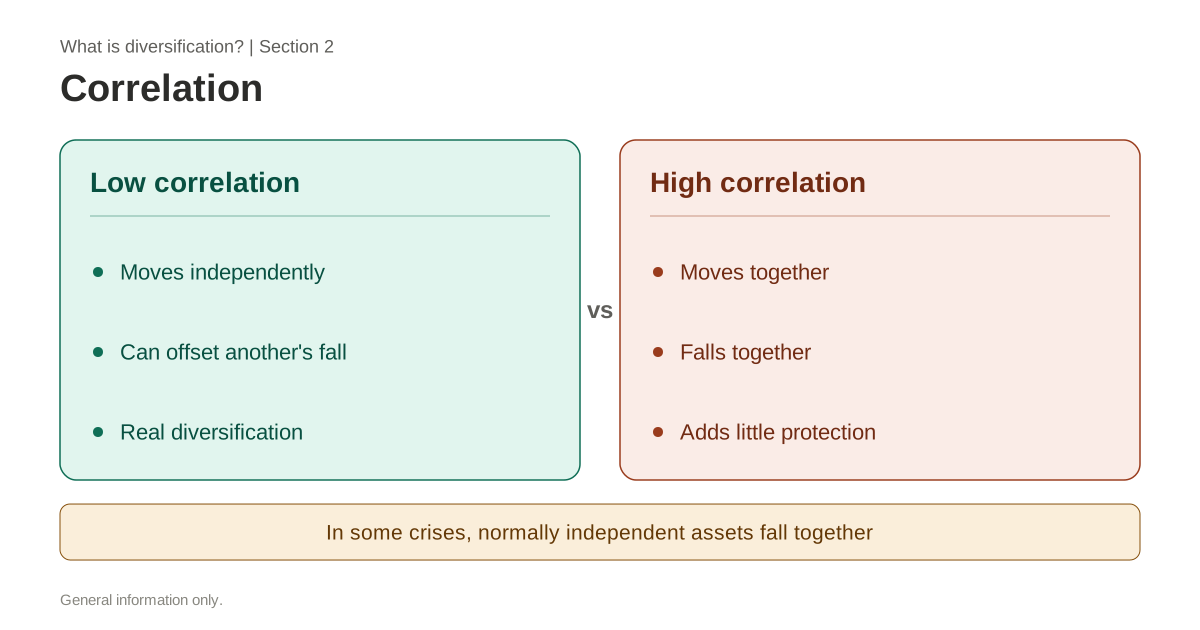
The benefit of diversification depends on correlation, which measures how closely two investments move together. Investments with low or negative correlation can offset each other's falls. Investments that are highly correlated tend to fall together, so owning several of them adds less protection than it seems.
Correlation can change over time. In some crises, assets that normally move independently fall together, because investors sell everything to raise cash. Diversification helps most in normal conditions, and it can disappoint at the moments it is most needed.
The limits of diversification
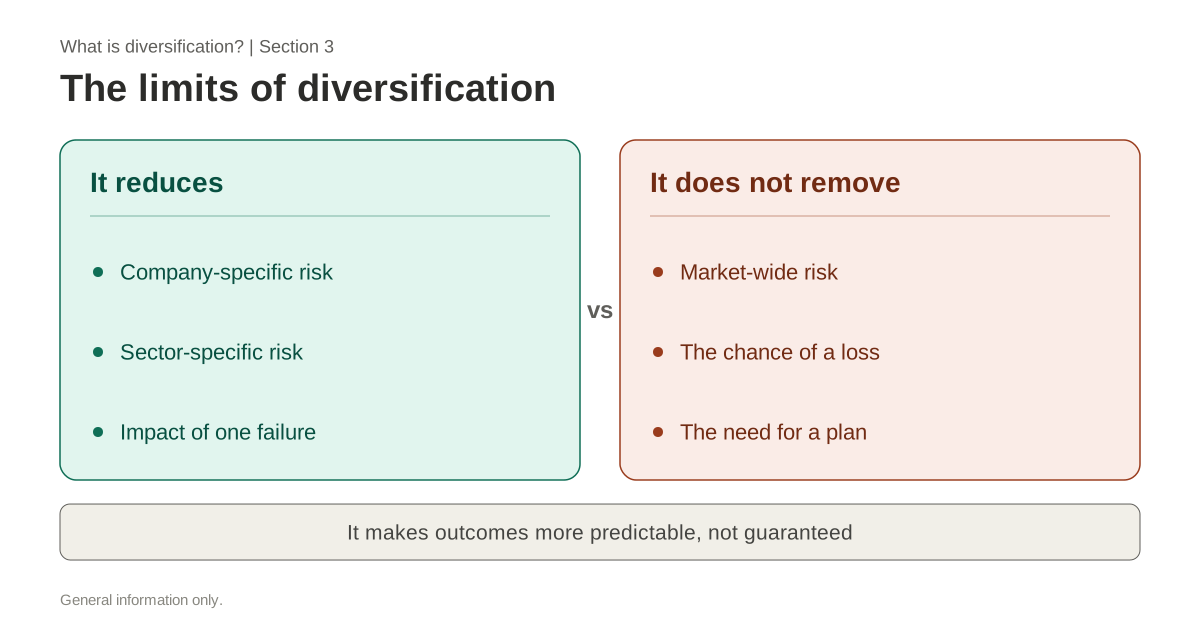
Diversification reduces specific risk, which is the risk tied to one company or sector. It does not remove market risk, which affects the whole market. If the broad market falls sharply, a diversified portfolio will also fall, though usually by less than a concentrated one.
Diversification also does not guarantee a profit. It makes outcomes more predictable, but it can also limit the gains from a single strong performer. The trade-off is intentional: you give up the chance of very large gains in exchange for a lower chance of severe losses.
Practical steps
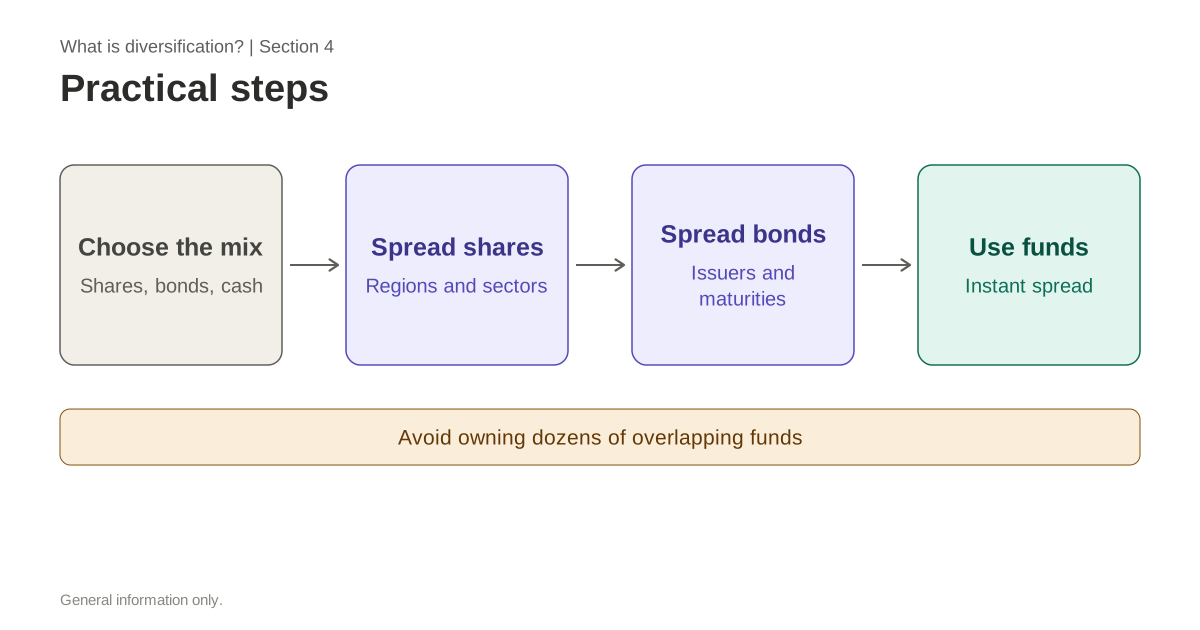
Start by deciding how much of your money belongs in shares, bonds and cash, based on your goals and time horizon. Then spread the share portion across regions and sectors, and the bond portion across issuers and maturities. Funds make this straightforward, because each one provides instant spread within its category.
Avoid over-diversifying. Owning dozens of overlapping funds does not add much protection, and it makes tracking your portfolio harder. A small number of clearly different holdings is often more effective than a long list of similar ones.
Check it regularly
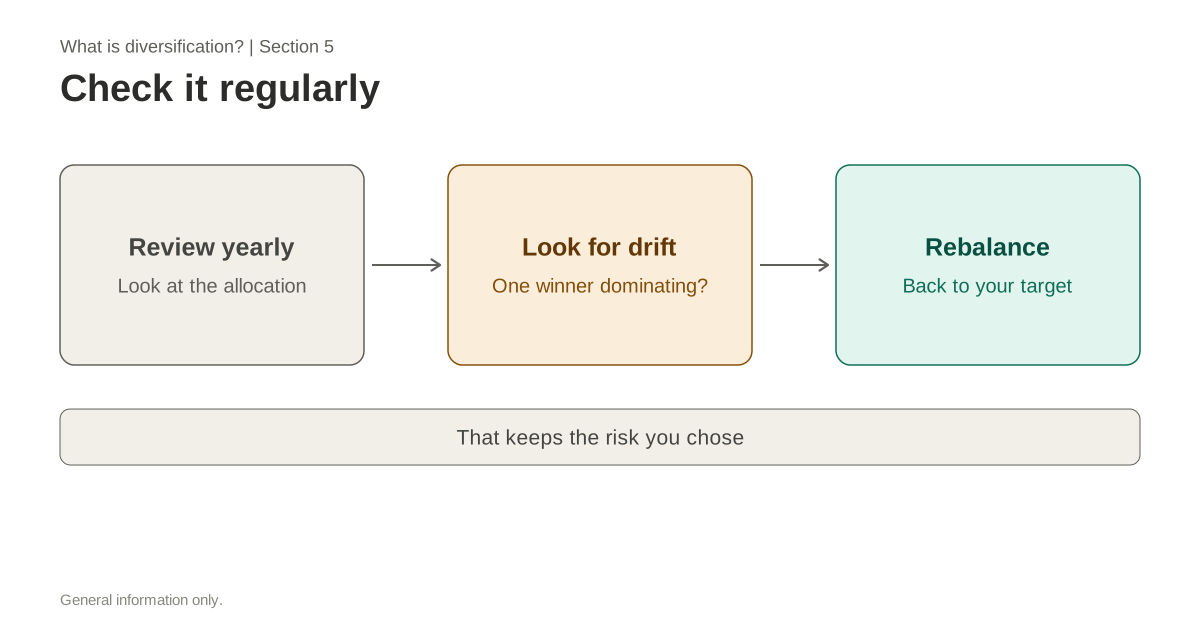
Diversification can drift as markets move. A portfolio that started balanced may become concentrated in one winning holding. Review the allocation at least once a year, and rebalance when a holding moves well away from its target. That keeps the risk you chose and prevents one investment from dominating your results.
Diversification and your own circumstances
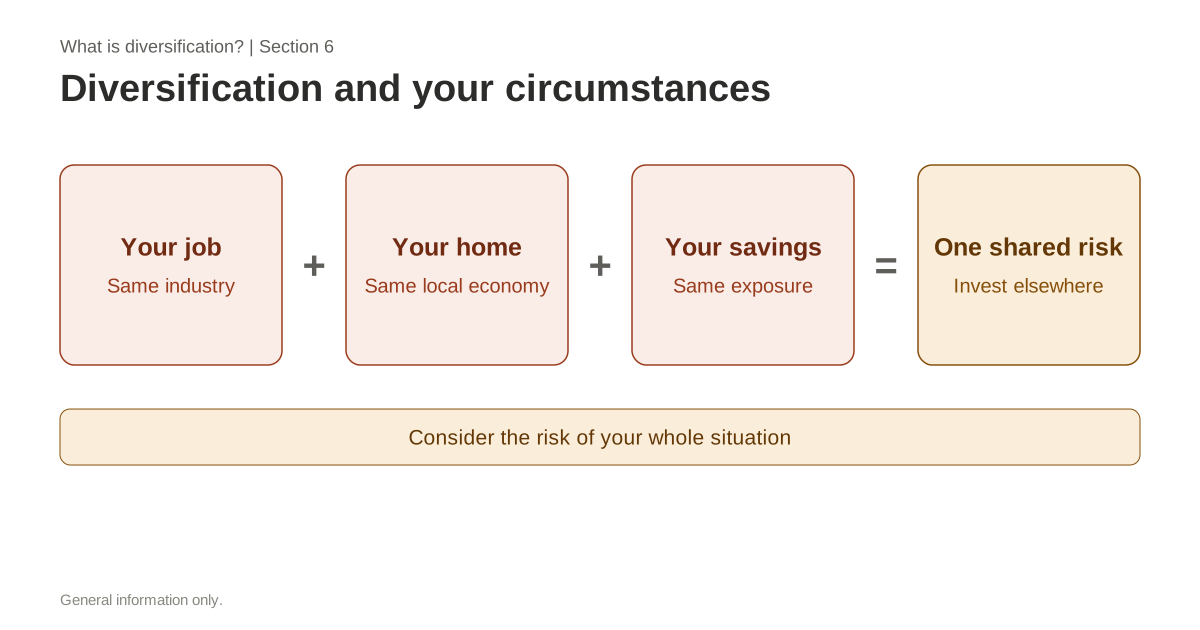
Diversification should also consider your personal position. If your job, home and savings are all tied to one industry or one local economy, your financial life is already concentrated in that risk. Holding investments that do not share that exposure can reduce the overall risk of your situation, not only the risk of your portfolio.
Keeping it simple
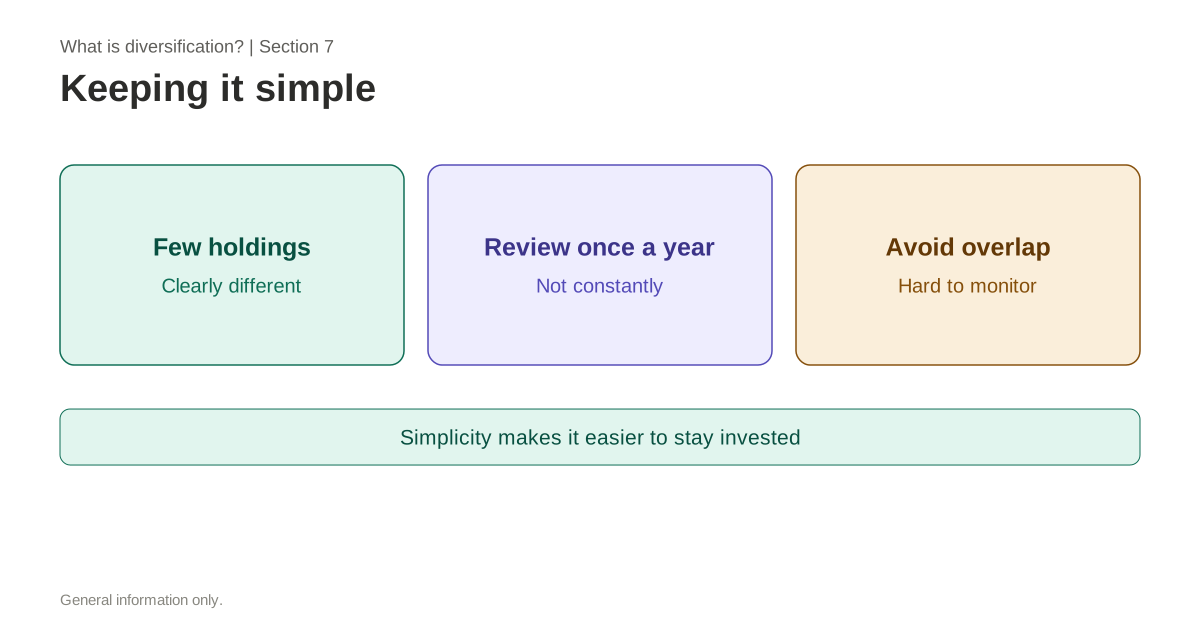
A diversified portfolio does not need to be complicated. A few clearly different holdings, reviewed once a year, often do the job better than a long list of overlapping products that is hard to monitor. Simplicity makes it easier to stay invested when markets are uncomfortable.
Diversification across time
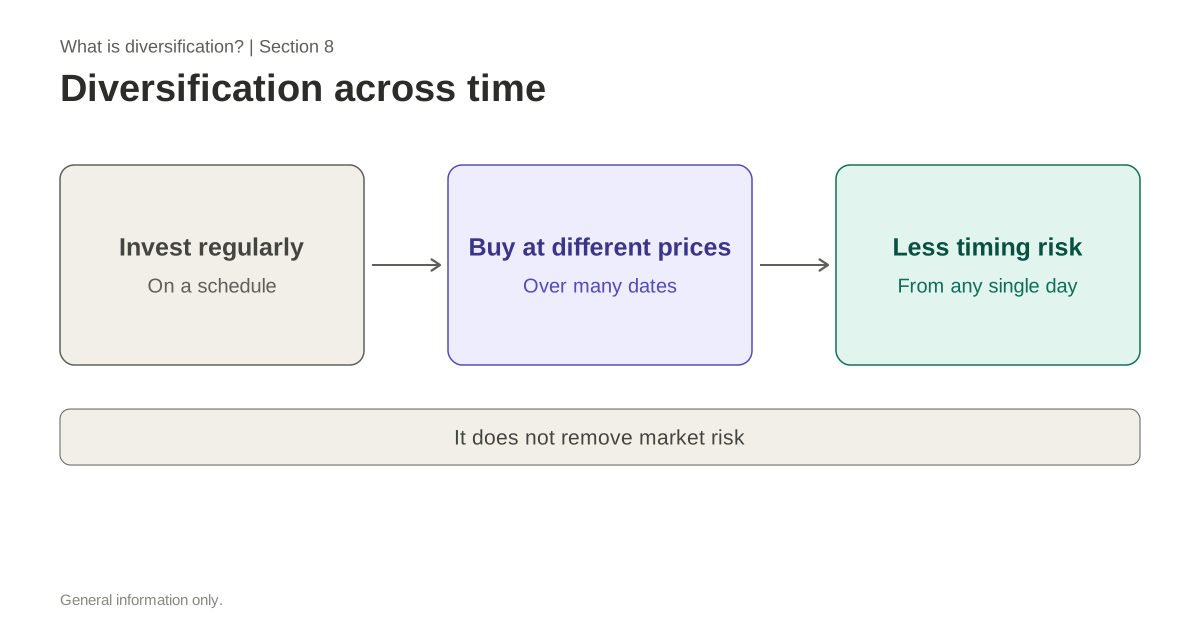
Spreading purchases over time is a form of diversification that many investors overlook. Investing regularly means you buy at different price levels, so you are not depending on the price on a single day. This does not remove market risk, but it reduces the impact of the timing of your first purchase.
A simple test of your portfolio
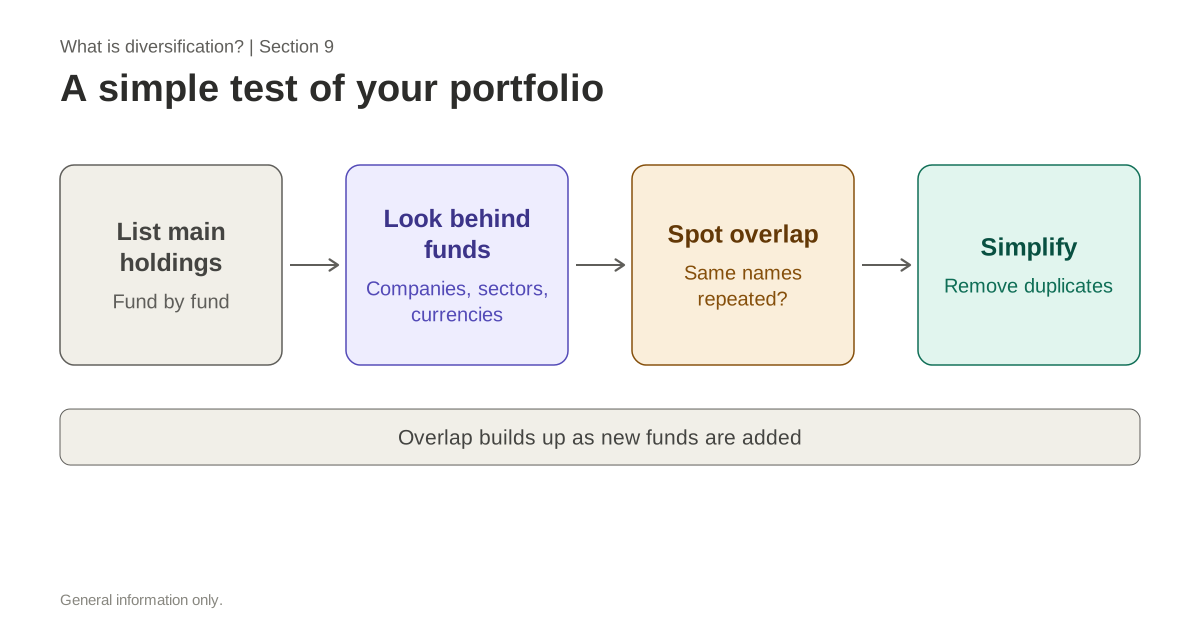
To check whether your holdings are really diversified, list the main companies, sectors, countries and currencies behind each fund. If the same few names appear in several places, your spread is narrower than it looks. A short review once a year can reveal overlap that builds up gradually as new funds are added.
The bottom line
Diversification spreads risk across investments that respond differently to events. It cannot remove market risk, and it does not guarantee a profit, but it makes your results less dependent on any single outcome. Build a mix that suits your goals, check that the holdings really are different, and keep it in balance over time.
Frequently asked questions
Does diversification guarantee I will not lose money?
No. It reduces the impact of problems affecting one company or sector, but it does not protect against a fall in the whole market. A diversified portfolio can still lose value.
How many investments do I need to be diversified?
The number matters less than how different the holdings are. A single broad fund can hold many companies, while several funds that track the same market add little extra protection.
What is correlation?
Correlation measures how closely two investments move together. Holdings with low correlation tend to offset each other's movements, which is what makes diversification effective.
Is owning international investments a form of diversification?
Yes. Investing across countries can reduce dependence on one economy and one currency, though international holdings add their own risks, including currency movements.