Asset allocation is the way you divide your money between different types of investment, such as shares, bonds, cash and property. It is one of the most important decisions in investing, because the mix largely determines how much your portfolio will fluctuate and how much it is likely to grow over time. Many studies suggest that allocation explains much more of a portfolio's behaviour than the choice of individual holdings.
This article explains what asset allocation is, how to think about it, and how to choose a mix that fits your goals. It is general information, not a recommendation of any particular split.
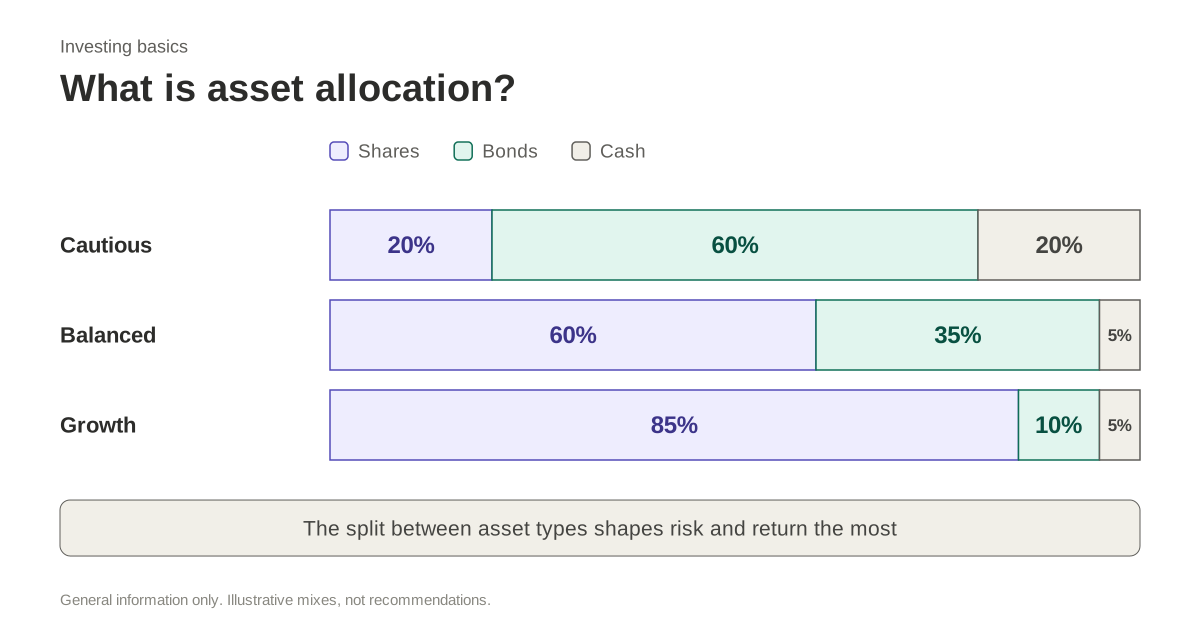
Why the mix matters
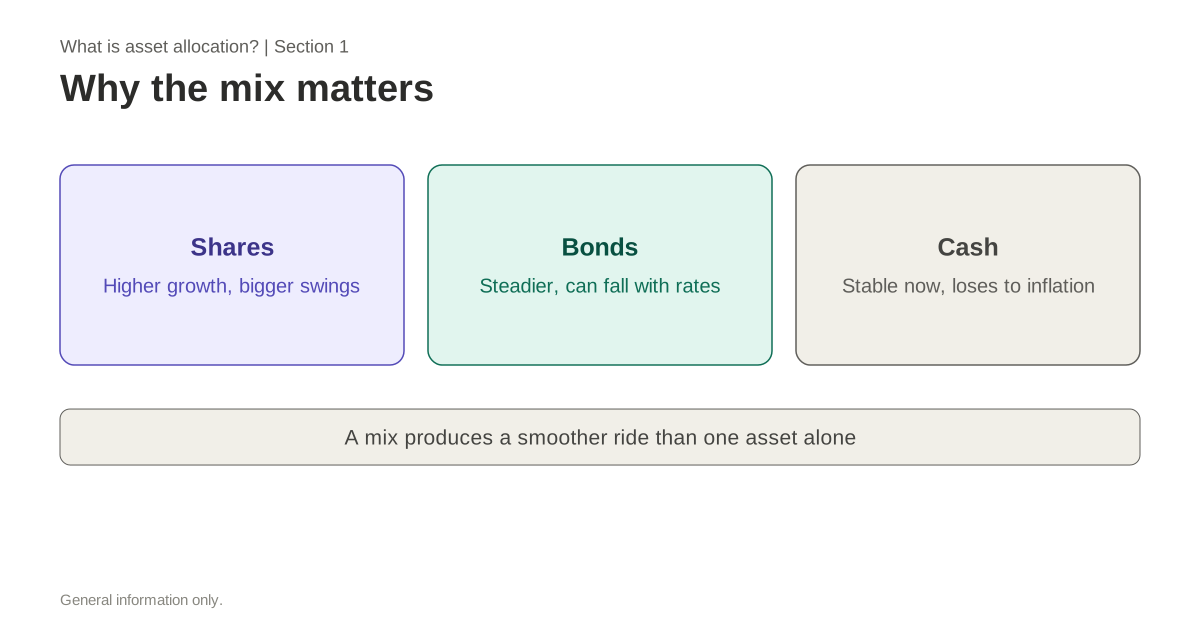
Different asset classes behave differently. Shares tend to offer higher long-term growth but larger swings. Bonds usually offer steadier income and smaller falls, though their prices can still drop when interest rates rise. Cash preserves capital in the short term but usually loses value to inflation over long periods.
A portfolio that holds only one type of asset takes on that asset's full risk. A mix of asset types can produce a smoother ride, because they do not always move together. The mix you choose sets the balance between growth and stability.
Setting a target
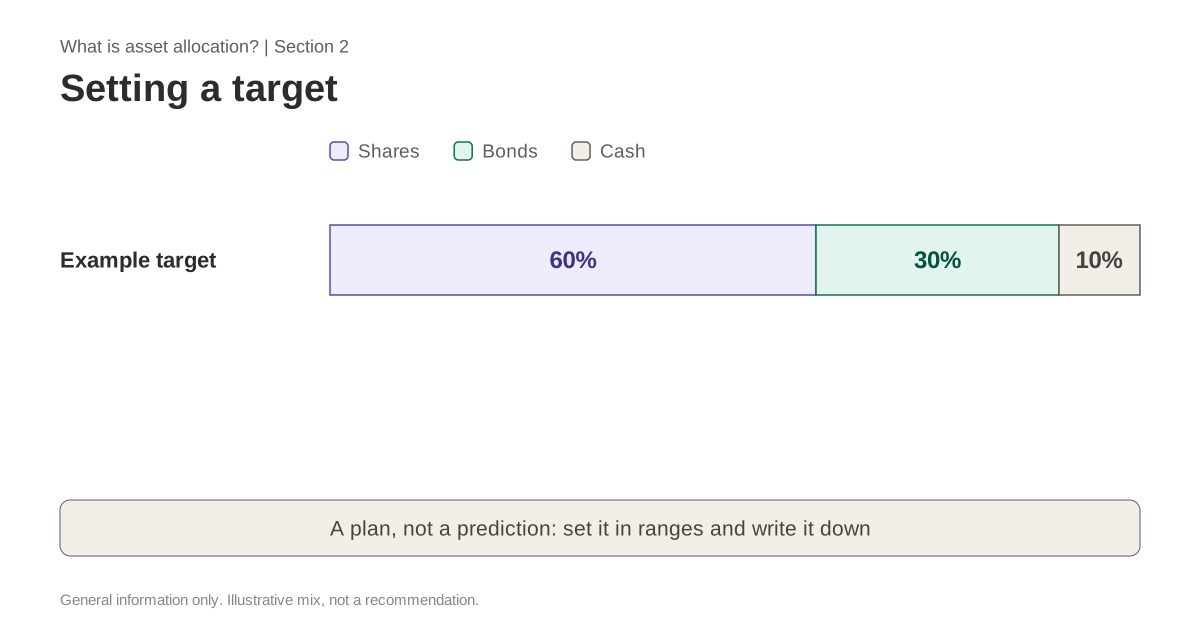
A target allocation is the mix you aim to hold over time, such as sixty per cent shares, thirty per cent bonds and ten per cent cash. The target reflects your goals, how long you can invest, and how much volatility you can tolerate. It is a plan, not a prediction, and it should be written down so you can refer to it during market swings.
Targets are usually set in broad ranges, rather than as exact figures. A range gives room for markets to move without requiring constant adjustment.
Time horizon
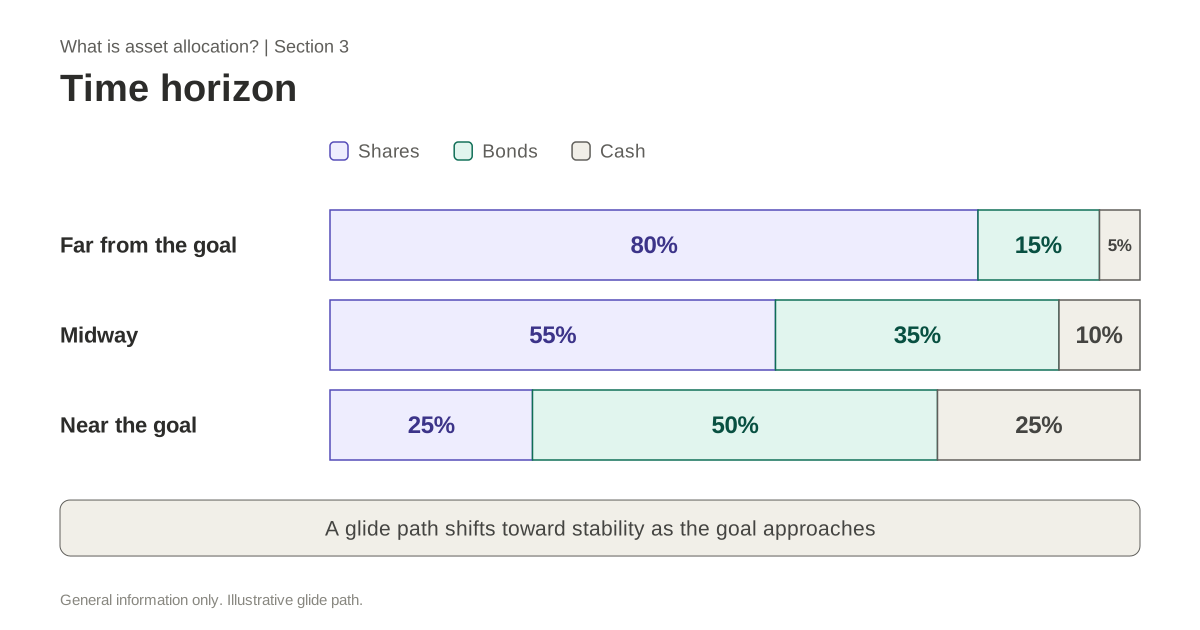
Your time horizon is the period before you need the money. A long horizon allows you to hold a larger share of growth assets, because you have time to recover from falls. A short horizon calls for more stable assets, because a fall close to the date you need the cash cannot be recovered easily.
Many people use a glide path, which gradually shifts the mix towards stability as a goal approaches. The principle is simple, even if the implementation takes care.
Risk capacity and tolerance
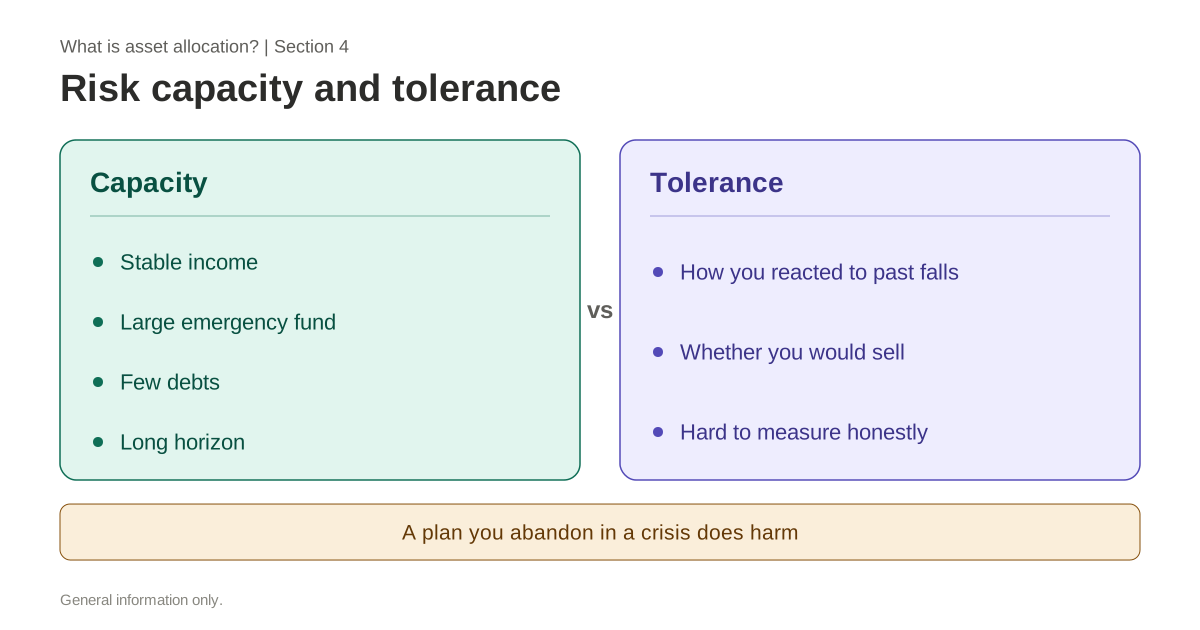
Allocation should also reflect your capacity to take risk, meaning how much loss your finances can absorb, and your tolerance, meaning how much loss you can accept emotionally. A stable income and a large emergency fund increase capacity. A volatile income or significant debt reduces it. Tolerance is harder to measure, so be honest about how you have reacted to past falls.
If your tolerance is lower than your capacity, your allocation should match the lower figure, because a plan you abandon in a crisis does harm.
Keep the allocation simple
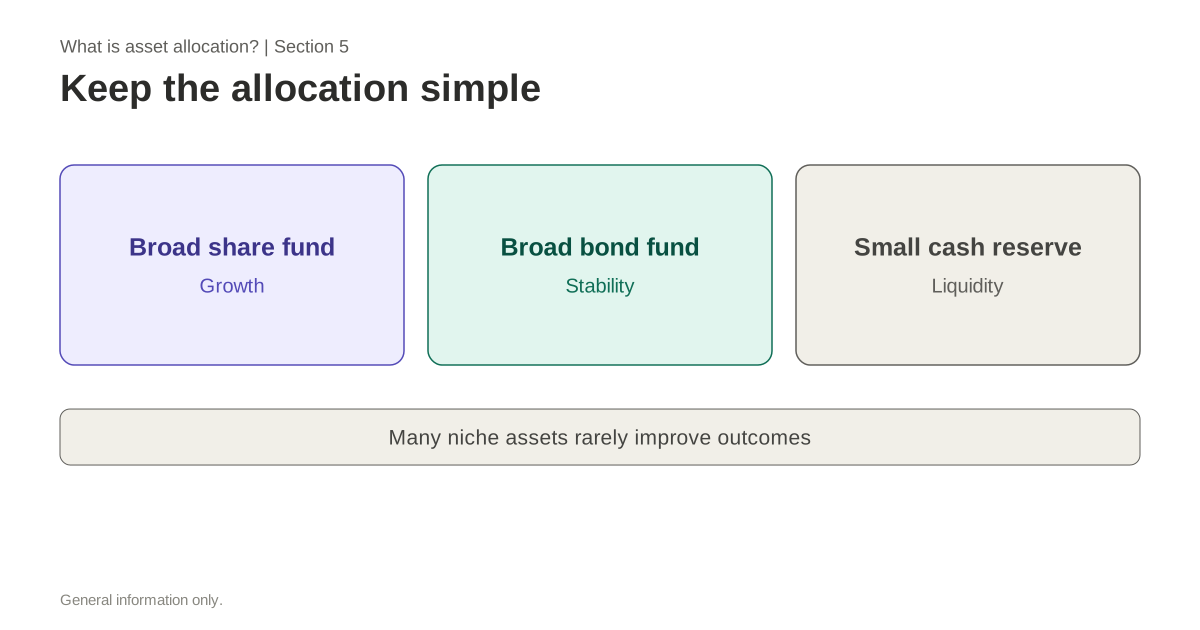
You do not need many asset classes to build a sound allocation. A few broad holdings covering shares and bonds, plus a small cash reserve, can provide a good structure. Adding many niche assets rarely improves outcomes and can make the portfolio harder to manage.
Consider the currency and region of your holdings too. Owning shares and bonds from more than one country spreads risk, though it adds currency movements to the results.
Implementing the plan
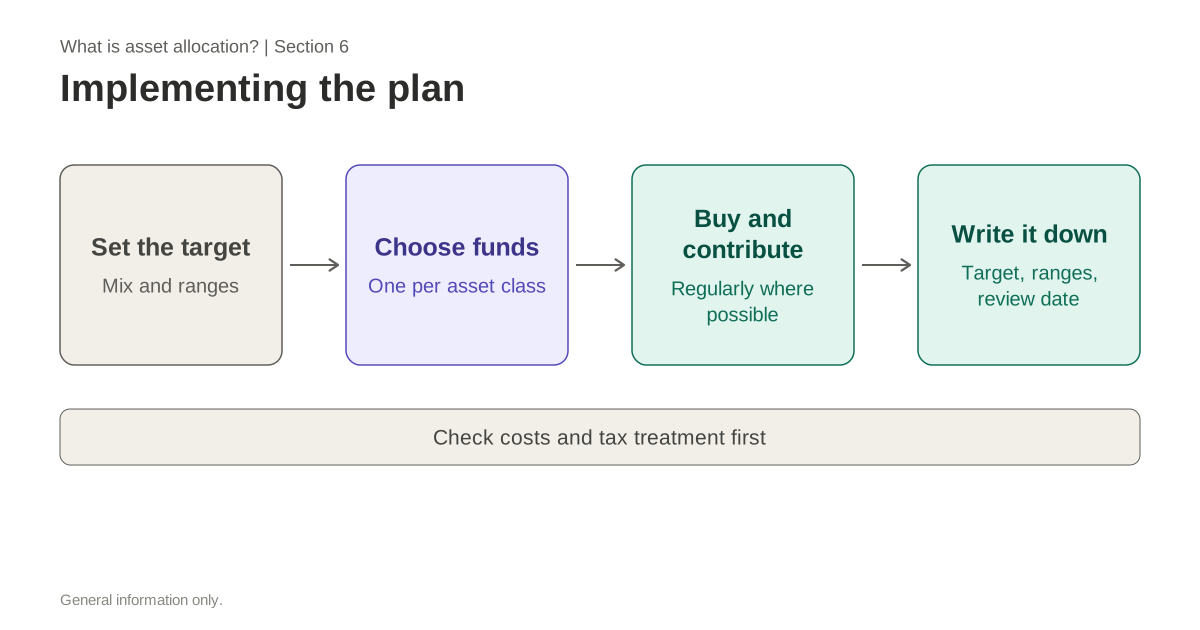
Once the target is set, choose the funds or investments that will cover each asset class. Buy in the amounts needed to reach the target, using regular contributions where possible. Costs and taxes matter, so check the expense ratio and the tax treatment of each holding before you invest.
Write down the plan, including the target, the acceptable ranges and the date you will next review it.
Review and adjust
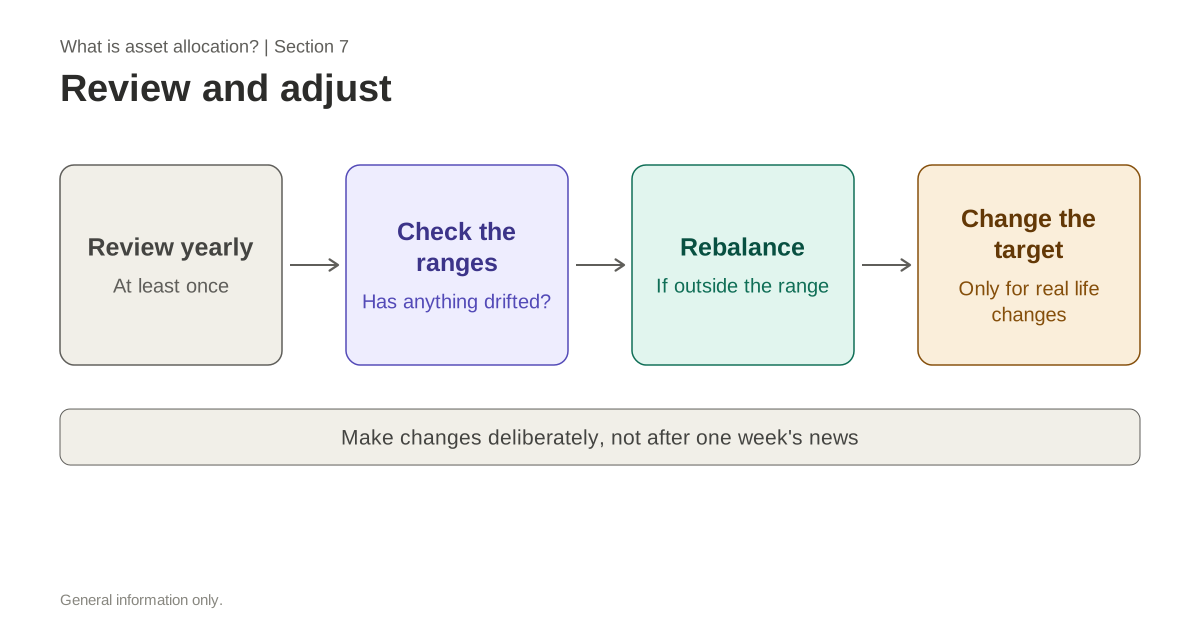
Markets move, so a portfolio drifts from its target over time. Review the mix at least once a year, and rebalance when an asset class moves outside its range. Life changes, such as a new job, a house purchase or a child, can also justify changing the target. Make changes deliberately, not in reaction to a single week's news.
Allocation across your whole life
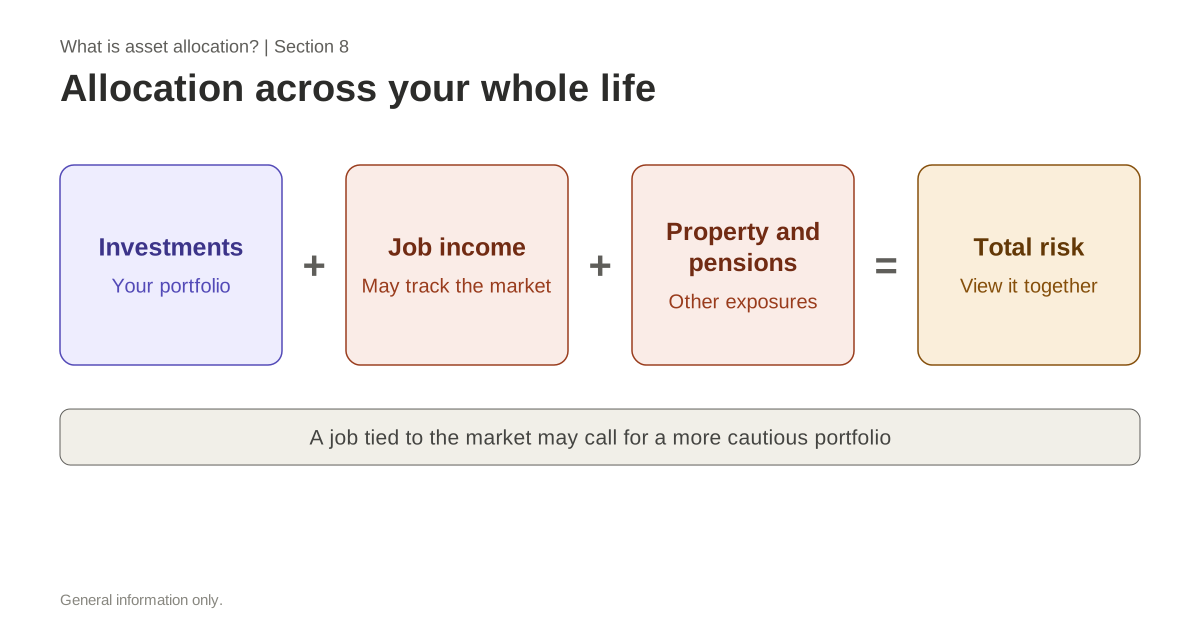
Your allocation should also consider assets outside your investment portfolio, such as property, your employment income and any pensions. If your income is already linked to the stock market through your job, you may want a more cautious portfolio to balance that exposure. Viewing all your assets together gives a more accurate picture of total risk.
Reviewing the mix each year
An annual review gives you a regular opportunity to check that the mix still matches your goals, your time horizon and your circumstances. Use the review to confirm the plan, not to chase performance. If nothing material has changed, the right decision may simply be to keep the allocation and continue saving.
Allocation in plain words
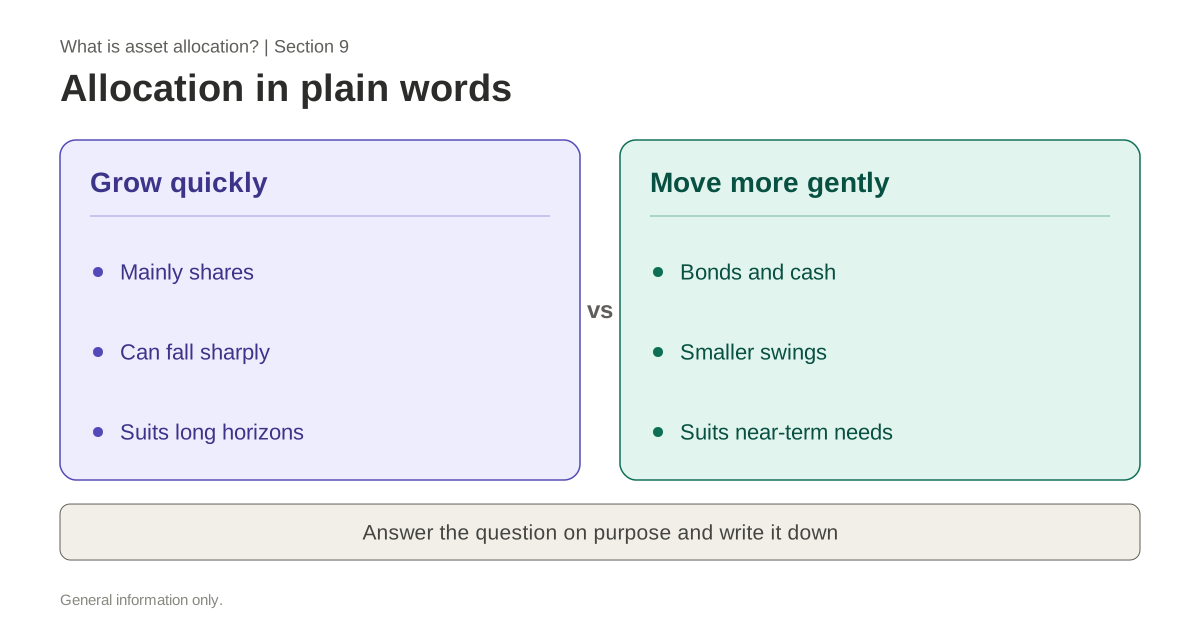
In plain terms, allocation answers one question: how much of your money is in things that can grow quickly but fall sharply, and how much is in things that move more gently. Answer that question on purpose, write the answer down, and it becomes far easier to stay with your plan.
Allocation and rebalancing
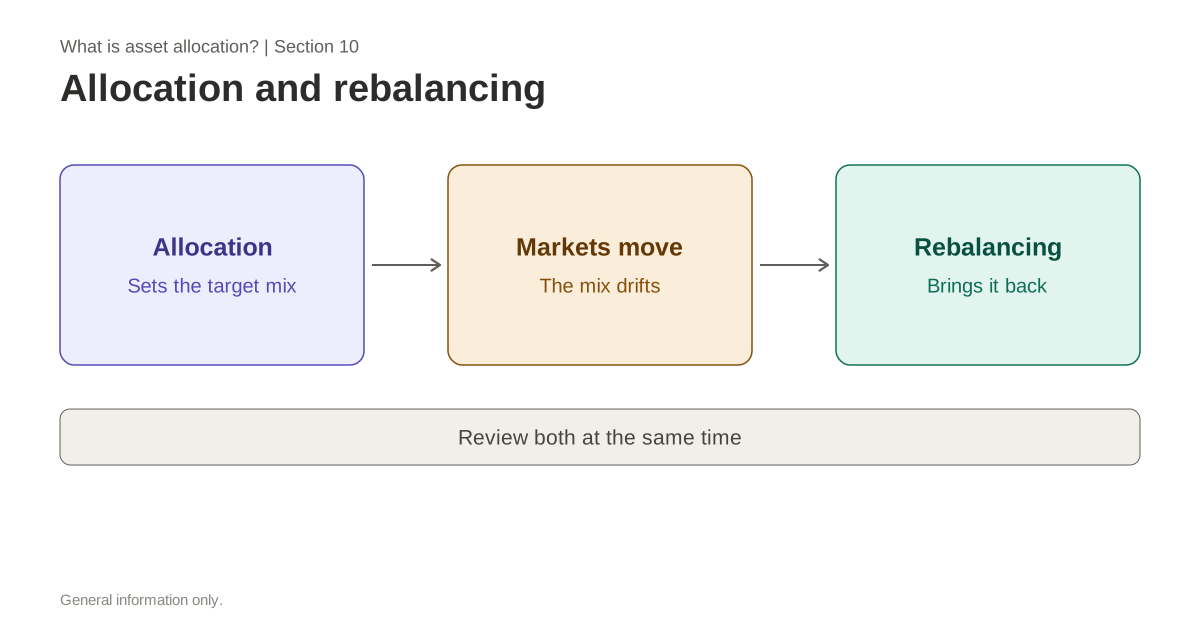
Allocation and rebalancing work together. The allocation sets the target mix, and rebalancing keeps the portfolio close to it. Without rebalancing, the mix drifts with markets, and the risk you carry can change without you noticing. Reviewing both at the same time gives a complete picture of your portfolio.
Common allocation mistakes
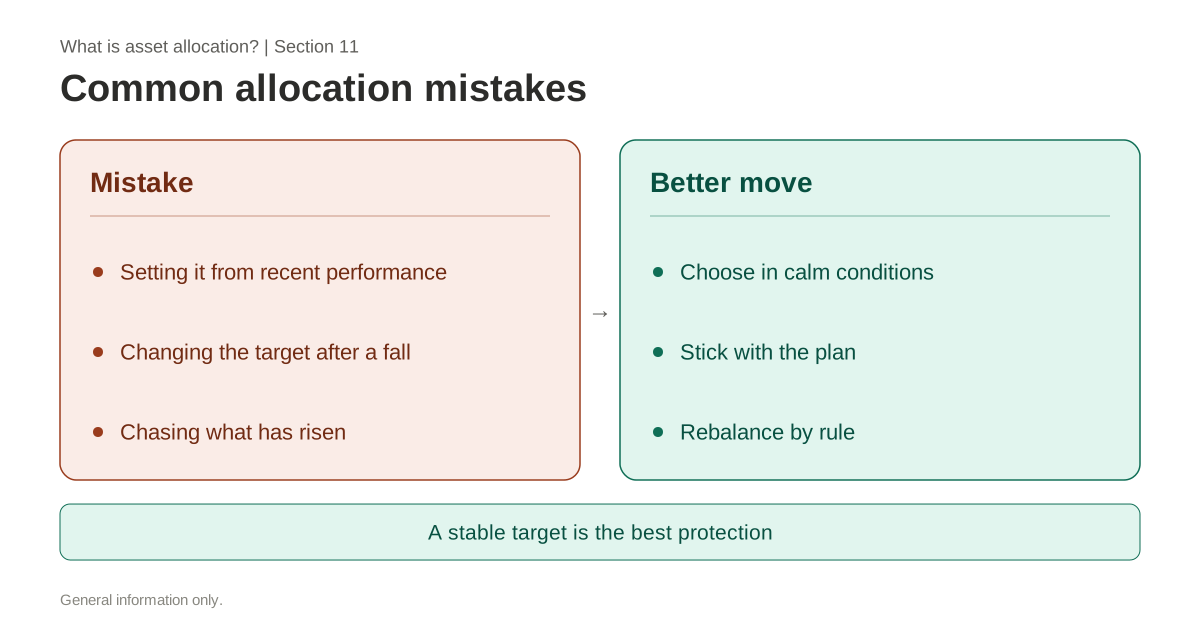
A frequent error is to set an allocation based on recent performance, buying more of what has risen and less of what has fallen. Another is to change the target after a fall, selling to reduce risk at the bottom of the market. A stable target chosen in calm conditions is the best protection against these decisions.
Allocation in plain words
In plain terms, allocation answers one question: how much of your money is in things that can grow quickly but fall sharply, and how much is in things that move more gently. Answer that question on purpose, write the answer down, and it becomes far easier to stay with your plan.
The bottom line
Asset allocation sets the basic risk and return profile of your investments. Choose a mix that fits your time horizon, capacity and tolerance, write it down, keep it simple, and review it on a regular schedule. A well-chosen allocation that you can hold through difficult periods is one of the most valuable tools an investor has.
Frequently asked questions
Is asset allocation more important than picking investments?
For many investors, the mix of asset types has a larger effect on risk and return than the choice of individual holdings. That is why it is usually the first decision to make.
What is a typical mix?
There is no universal mix. It depends on your goals, time horizon and tolerance for loss. Longer horizons often allow more growth assets, while shorter ones usually call for more stability.
How often should I change my allocation?
Review it at least once a year and after major life changes. Avoid changing it in response to short-term market moves, which can lead to buying high and selling low.
Does allocation include cash?
Yes. A cash reserve, such as an emergency fund, is part of the overall allocation. Cash provides stability and liquidity, but it can lose value to inflation over long periods.