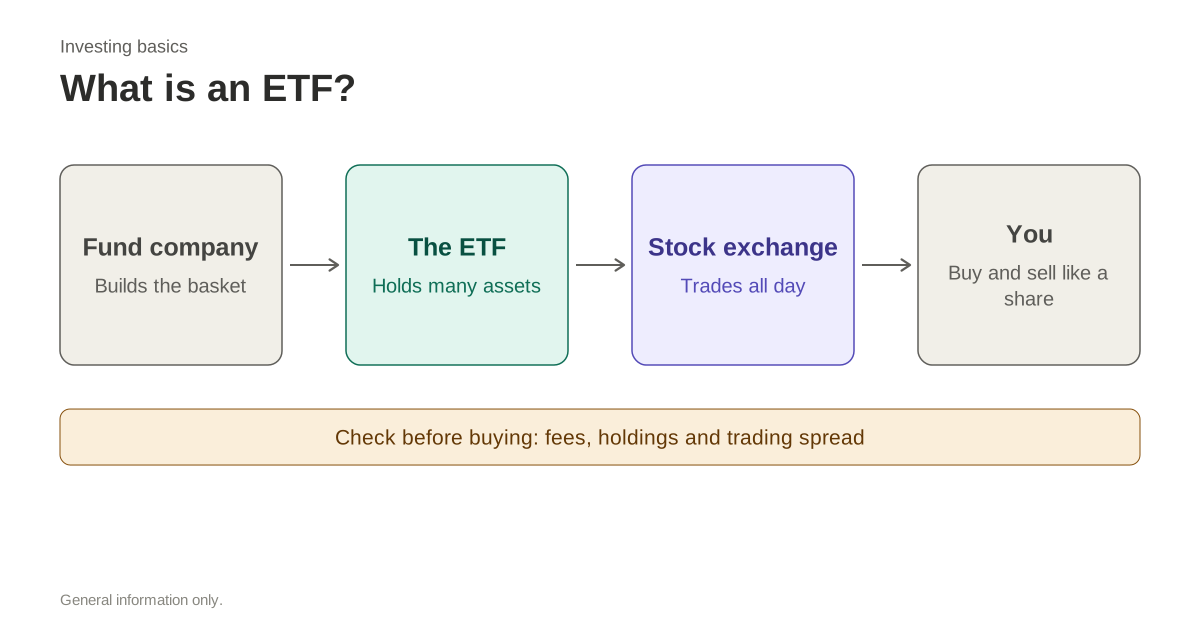
An exchange-traded fund, usually called an ETF, is an investment that holds a basket of assets and trades on a stock exchange like a single share. Most ETFs aim to follow an index, such as a broad national market index or a group of companies in one industry. Because they are easy to buy and sell during the trading day, ETFs have become one of the most common ways for individuals to invest.
This article explains what an ETF is, how it differs from other funds, and what to check before you buy. It is general information, not a recommendation of any particular fund.
How an ETF works
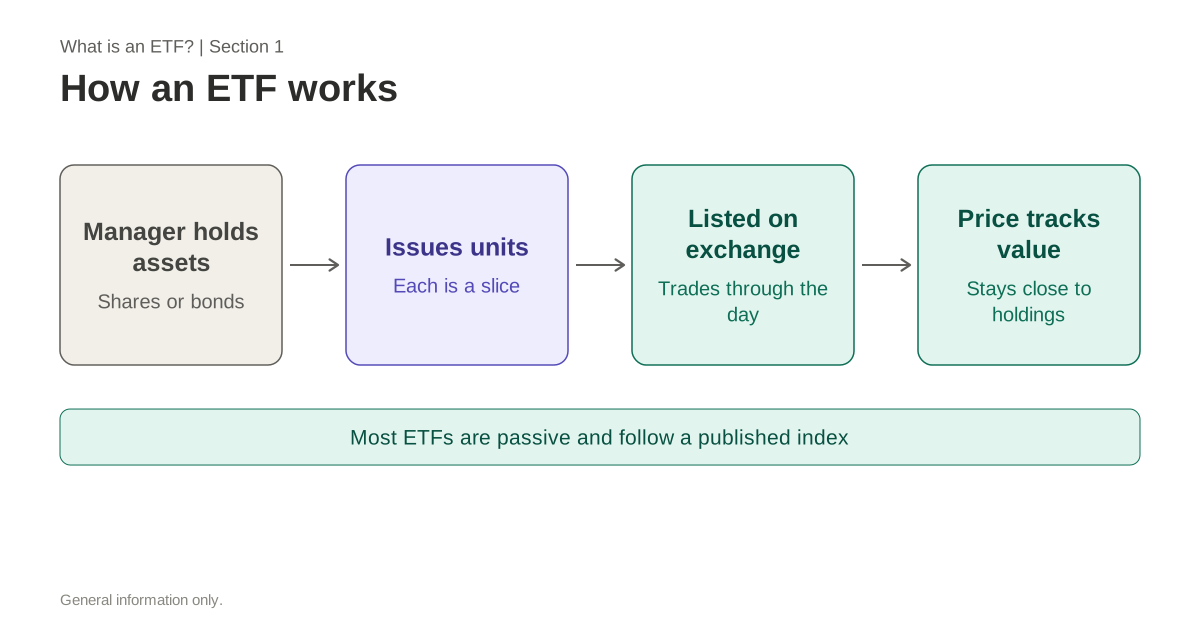
An ETF is created by a fund manager who holds the underlying assets, such as shares or bonds, and issues units that represent a share of that portfolio. The units are listed on an exchange, so you can buy and sell them through a broker just as you would a company's shares. The price moves during the day as people trade, and it usually stays close to the value of the assets it holds.
Most ETFs are passive. They follow a published index using a set of rules, rather than a manager picking individual holdings. This is why they tend to have lower costs than actively managed funds, although costs differ widely between products.
Why people use ETFs
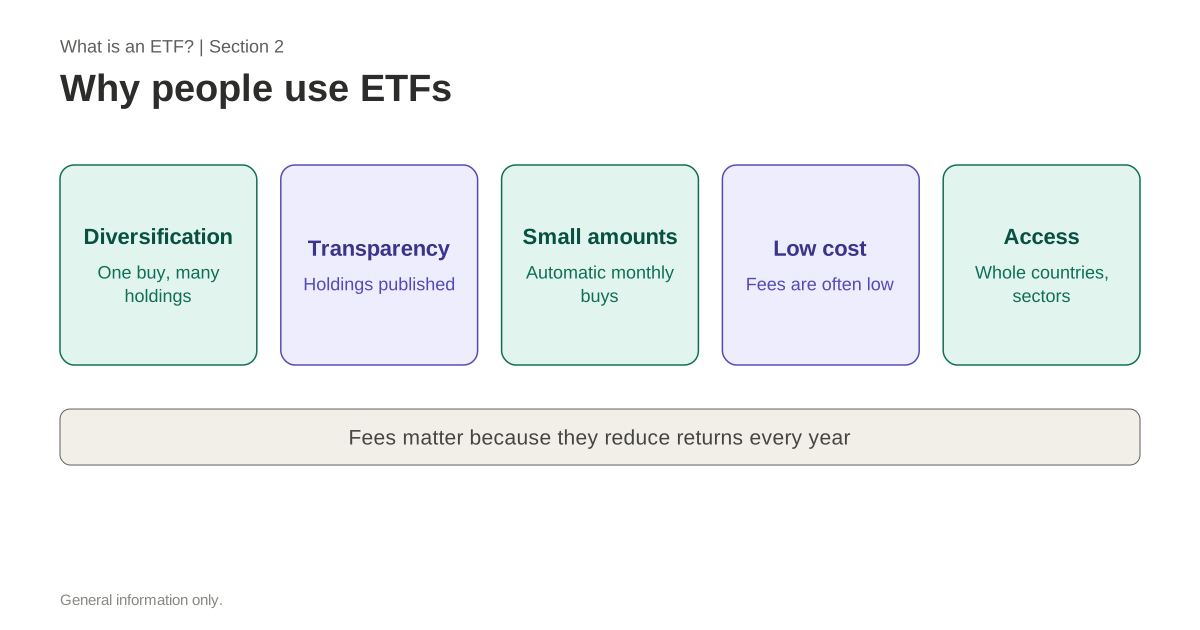
ETFs offer several features that appeal to investors. They give instant diversification, because one purchase can spread your money across hundreds or thousands of holdings. They are usually transparent, since most publish their holdings regularly. They can be bought in small amounts, and many brokers allow automatic monthly purchases.
Their costs are often low, which matters because fees reduce returns every year. They also let you invest in areas that would be hard to reach by buying individual shares, such as a whole country's market or a sector such as healthcare.
ETFs and mutual funds
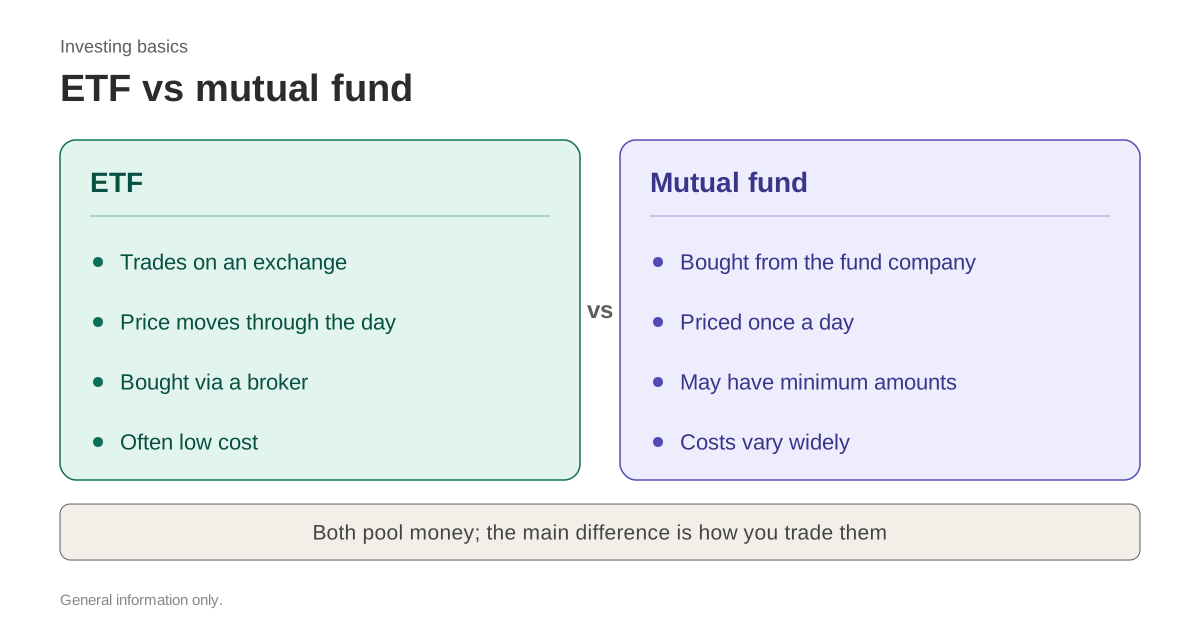
A mutual fund is also a pooled investment, but it is usually bought and sold directly with the fund company at a price set once a day. An ETF trades on an exchange throughout the day. Many ETFs and mutual funds track the same index, so the difference often lies in how you buy them, the minimum investment and the costs.
Check the rules of each product. Some funds have minimum investments, and some ETFs charge a broker commission each time you trade, which can make frequent small purchases expensive.
Risks to understand
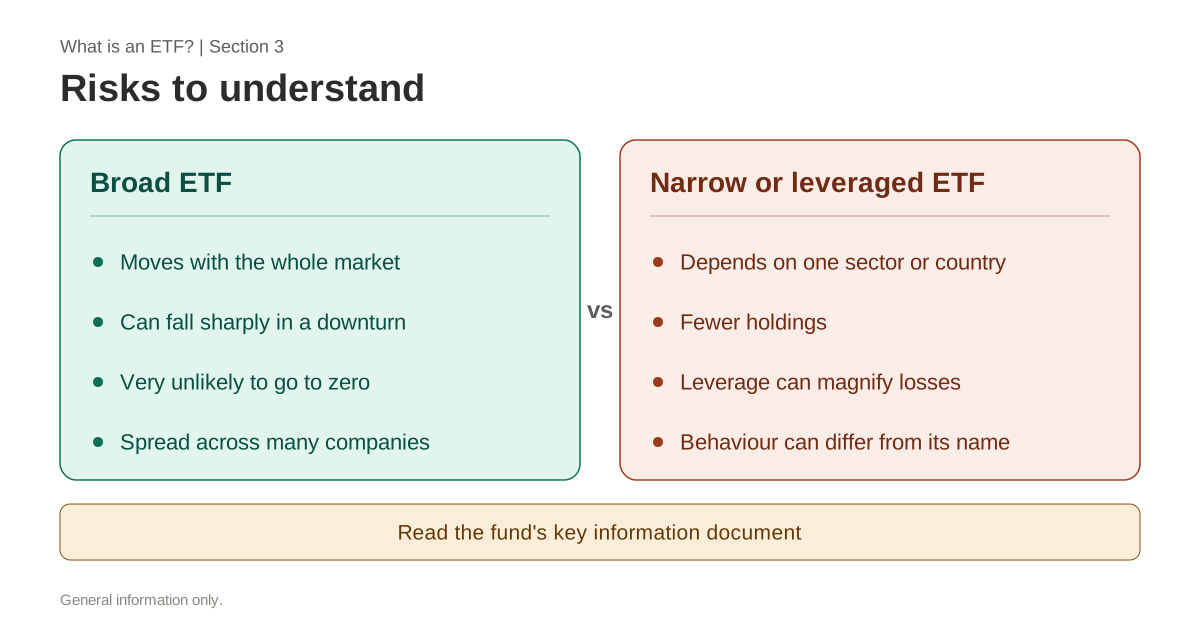
An ETF is still an investment, and its value can fall as well as rise. A fund that tracks a broad index will move with that market, so it can lose a large share of its value in a downturn. A narrow fund, such as one focused on a single sector or country, can carry more risk because it holds fewer companies and depends on one area of the economy.
Some ETFs use derivatives or borrowing to amplify their returns. These products are more complex, and their behaviour over long periods can differ from what the name suggests. Read the fund's key information document, which should explain its strategy and risks.
What to check before buying
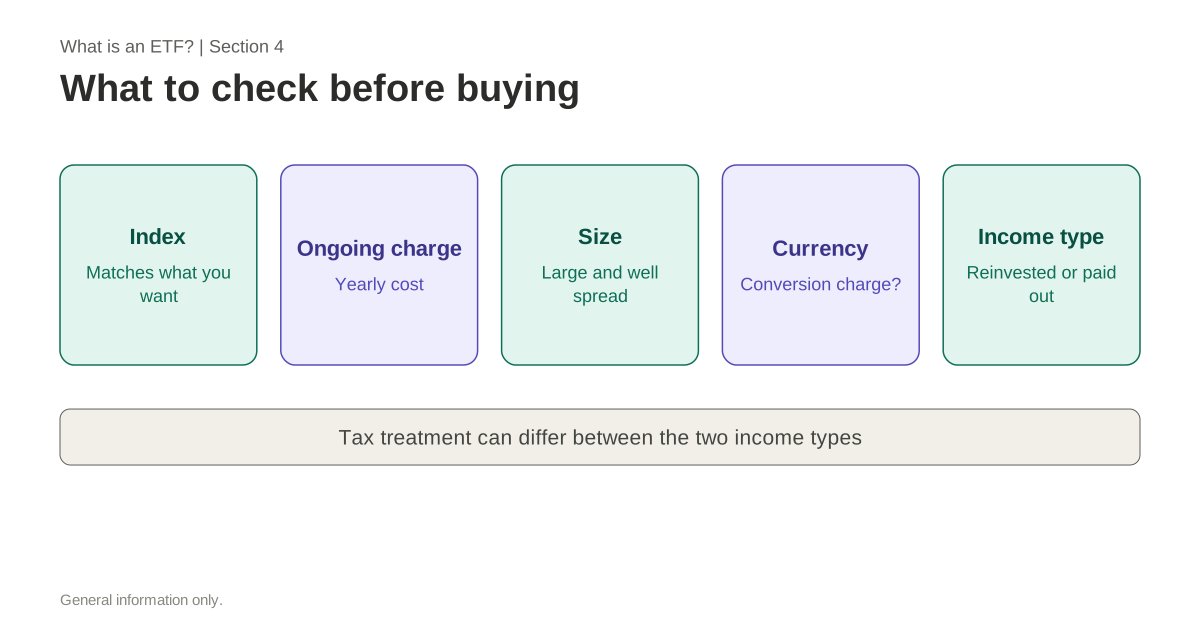
Start with the index or strategy the fund follows, and check that it matches what you want to own. Look at the ongoing charge, which is the yearly cost taken from the fund. Check how many holdings it has and where they are, and whether the fund is large enough to be stable. Confirm the currency of the units and whether you will pay a conversion charge to buy them.
Also check whether the fund is accumulating or distributing. An accumulating fund reinvests income within the fund. A distributing fund pays out income, which you may need to reinvest yourself. Tax treatment can differ between these two types depending on your country.
Using ETFs in a plan
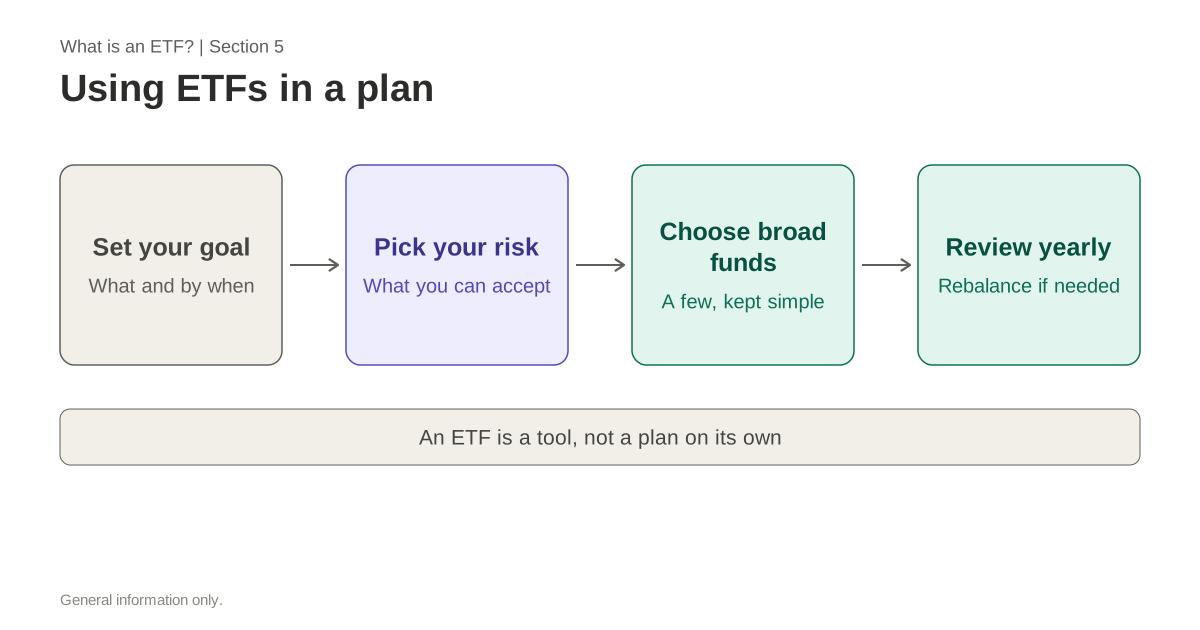
An ETF is a tool, not a plan on its own. Decide what you want to invest for, how long you can leave the money invested, and how much risk you can accept. Then choose funds that fit that mix. Many people hold a small number of broad funds for simplicity, and they add to the holdings regularly rather than trying to time the market.
Review your holdings once or twice a year, and check that the mix still reflects your goals. The article on rebalancing explains how to bring a portfolio back to its target after the markets have moved.
How an ETF is priced
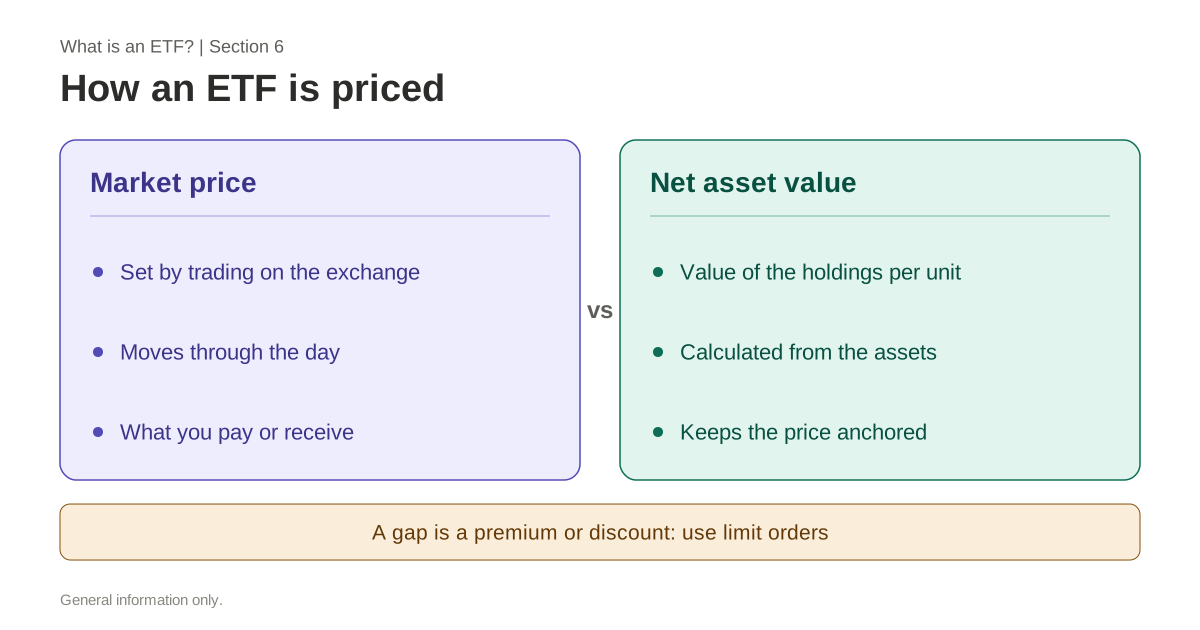
An ETF has two prices that matter: the market price at which its units trade, and the net asset value, which is the value of the underlying holdings per unit. The two usually stay close together because traders can buy and sell units to keep the market price aligned with the value of the holdings. When they drift apart, the difference is called a premium or a discount.
For most broad funds that trade in large volumes, the gap is small. For funds that hold less liquid assets, such as certain bonds or small companies, the gap can be wider, especially during volatile periods. Check the trading volume and the spread before placing an order, and consider using a limit order so you control the price you pay.
Tracking difference and tracking error
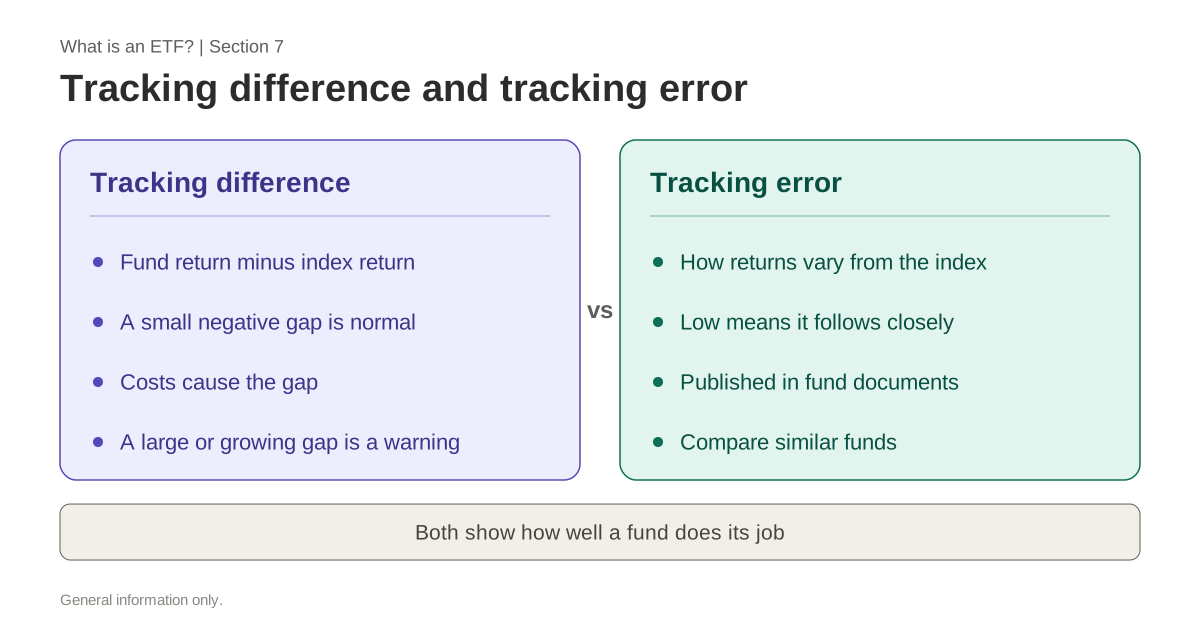
Two terms help you judge how well an ETF does its job. The tracking difference is the gap between the fund's return and the return of the index it follows over a period. A small negative difference is normal, because the ongoing charge and trading costs reduce the return. A large or growing gap is a warning sign.
Tracking error measures how much the fund's returns vary from the index's returns over time. A low tracking error means the fund follows its index closely. Both figures are published in the fund's documents, and comparing them across similar funds can reveal which one manages its job more efficiently.
The bottom line
An ETF is a simple, flexible way to hold a basket of investments that trades like a share. Its low cost and wide diversification make it useful for many investors, but it carries the same market risks as the assets it holds. Understand what it tracks, what it costs and how it fits your plan before you invest.
Frequently asked questions
Is an ETF safer than a single share?
It is usually less risky than holding one company's shares, because it spreads your money across many holdings. It can still lose value in a market downturn, so it is not free of risk.
Do ETFs pay dividends?
Many ETFs pass on the dividends or interest they receive. Some reinvest the income, and others pay it out to holders. Check the fund's policy and the tax treatment in your country.
What is the ongoing charge?
It is the yearly cost of running the fund, expressed as a percentage of its value and taken from the fund's assets. It reduces your return each year, so compare it between similar funds.
Can I lose all my money in an ETF?
A broad fund that holds many companies is very unlikely to lose all its value, but it can fall sharply. A narrow or leveraged fund carries greater risk, and losses can be larger.