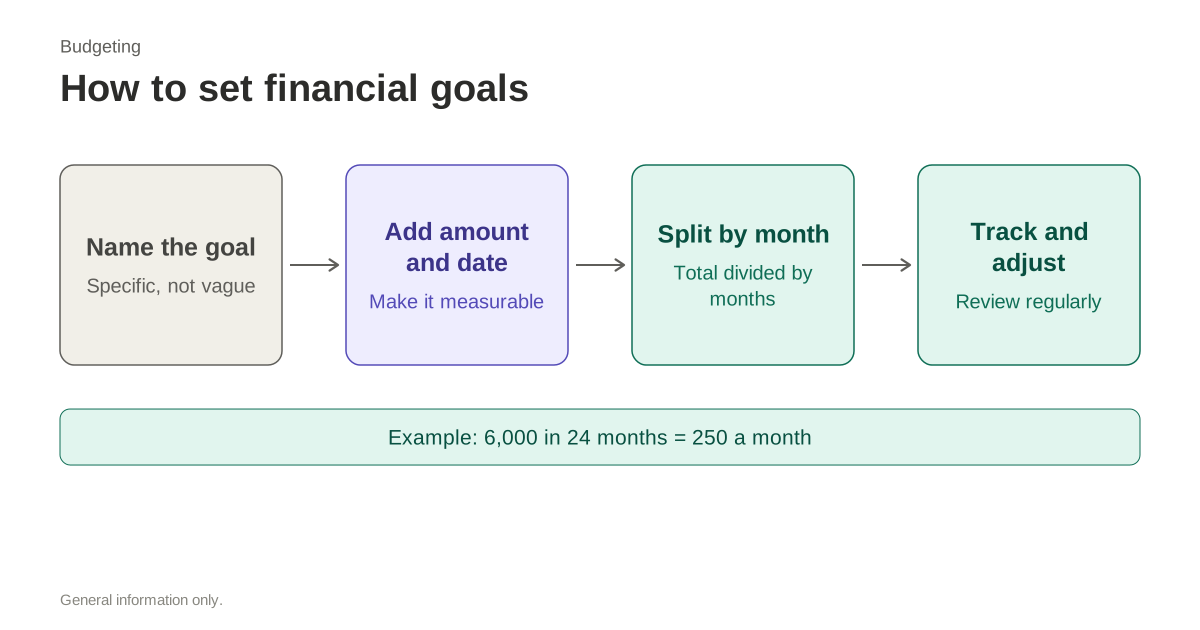
Most people have financial wishes: a deposit for a home, a holiday, a debt-free life, a comfortable retirement. Wishes become plans only when they are specific, dated and linked to a monthly action. Without that structure, savings tend to leak away on ordinary spending, and progress is hard to see. A clear goal gives your money a job and gives you a reason to keep going when the temptation to spend appears.
This article explains a simple method for setting financial goals, prioritising them and tracking progress. It applies in any country and at any income level.
Make the goal specific
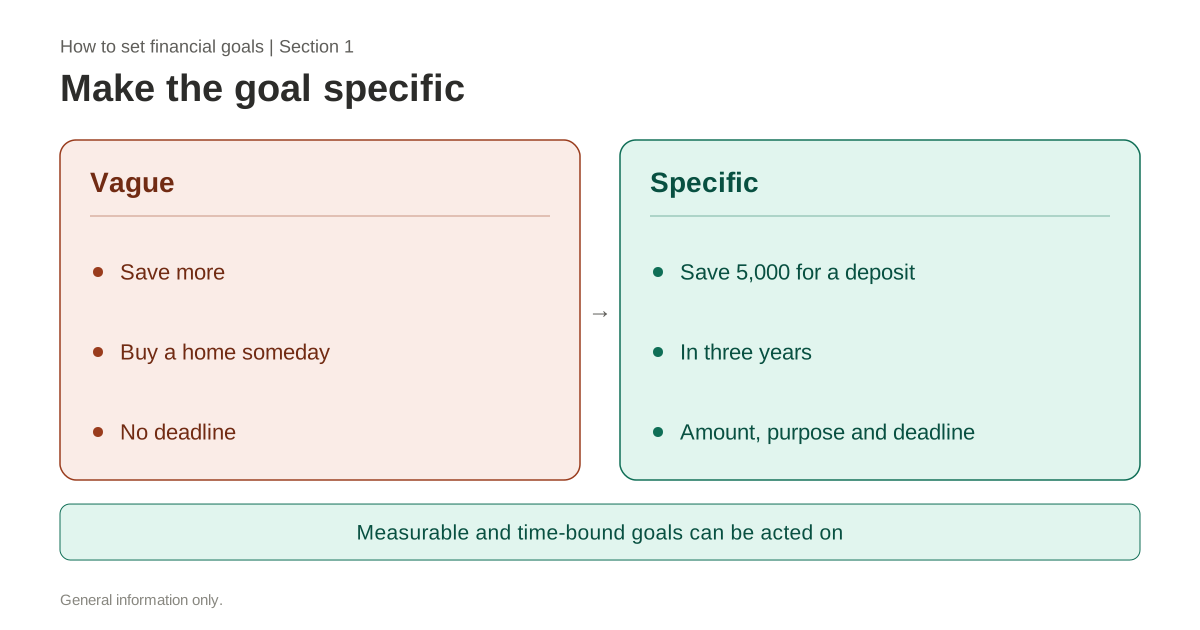
A goal such as "save more" is hard to act on. A goal such as "save 5,000 for a home deposit in three years" is measurable and time-bound. Write down the amount, the purpose and the deadline. If the goal is not yet precise, estimate it, and refine the figure as you learn more.
Consider whether the goal is worth the cost. A large goal may require years of saving or a change in lifestyle, and it is better to know that before committing.
Work out the monthly amount
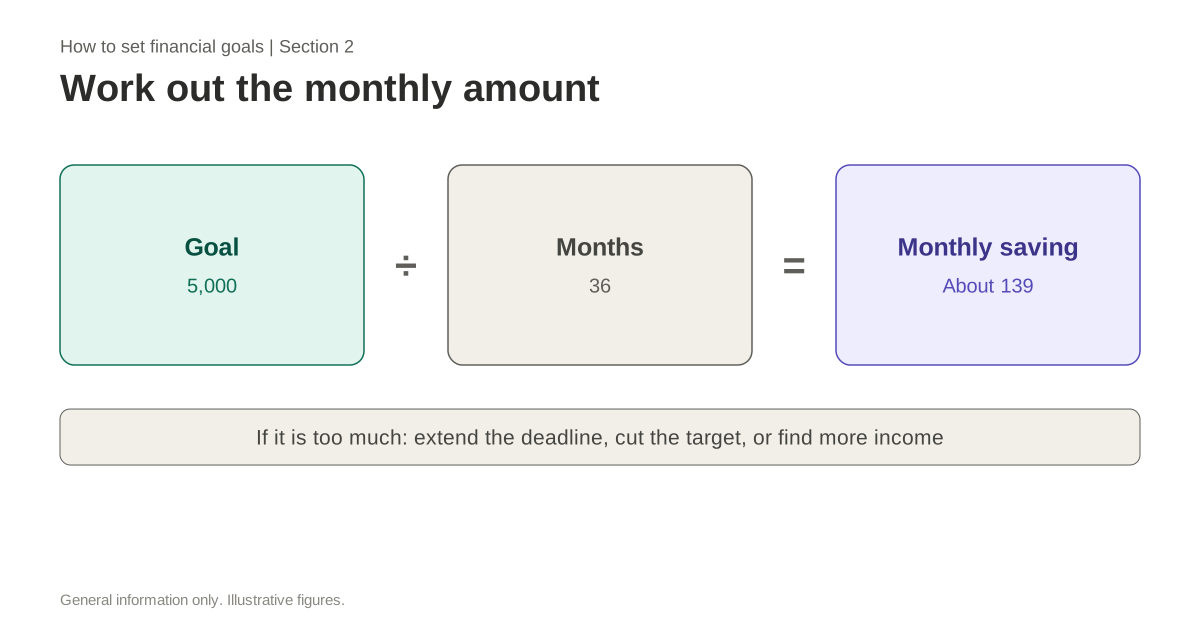
Divide the total by the number of months until the deadline. If you need 5,000 in 36 months, you must save about 139 a month. Add a margin for interest earned or for costs you have not yet counted. This turns the goal into a monthly action that you can automate.
If the monthly amount is more than you can afford, you have three choices: extend the deadline, reduce the target, or find more income or savings. Most realistic plans use a mix of these.
Prioritise your goals
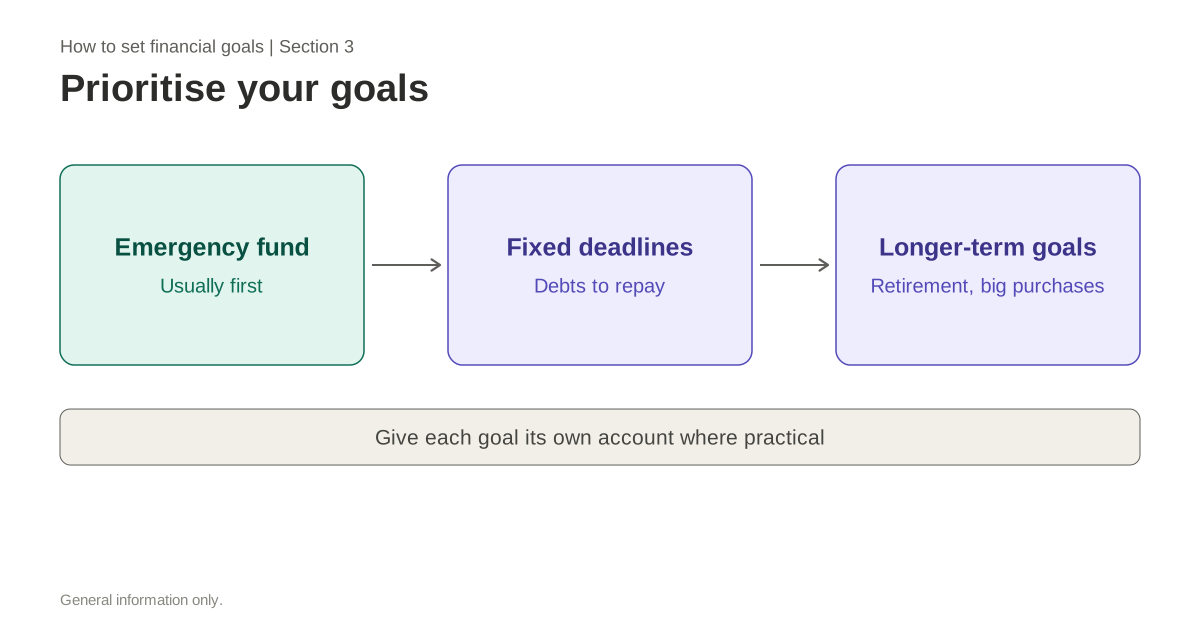
Few people can pursue every goal at once. Rank your goals by importance and by urgency. An emergency fund usually comes first, followed by goals with a deadline that cannot move, such as a debt that must be repaid. Then consider longer-term goals, such as retirement or a major purchase.
Give each goal a separate account or label where practical. Separate accounts make progress visible, and they make it harder to spend money meant for something else.
Build the plan into your budget
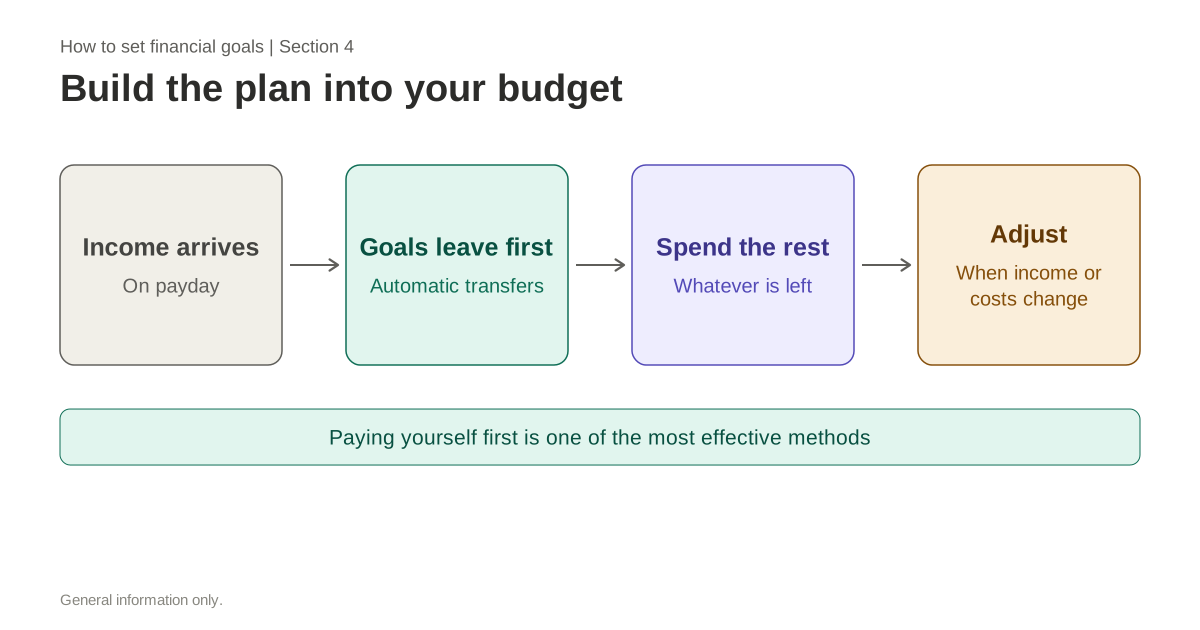
Once the monthly amounts are set, include them in your budget before you allocate money to spending. Paying yourself first, as the budgeting article describes, is one of the most effective ways to make a goal happen. The money leaves your account on payday and is not available to spend.
Review the budget when your income or costs change. A plan that worked last year may need adjusting now, and that is normal.
Track progress
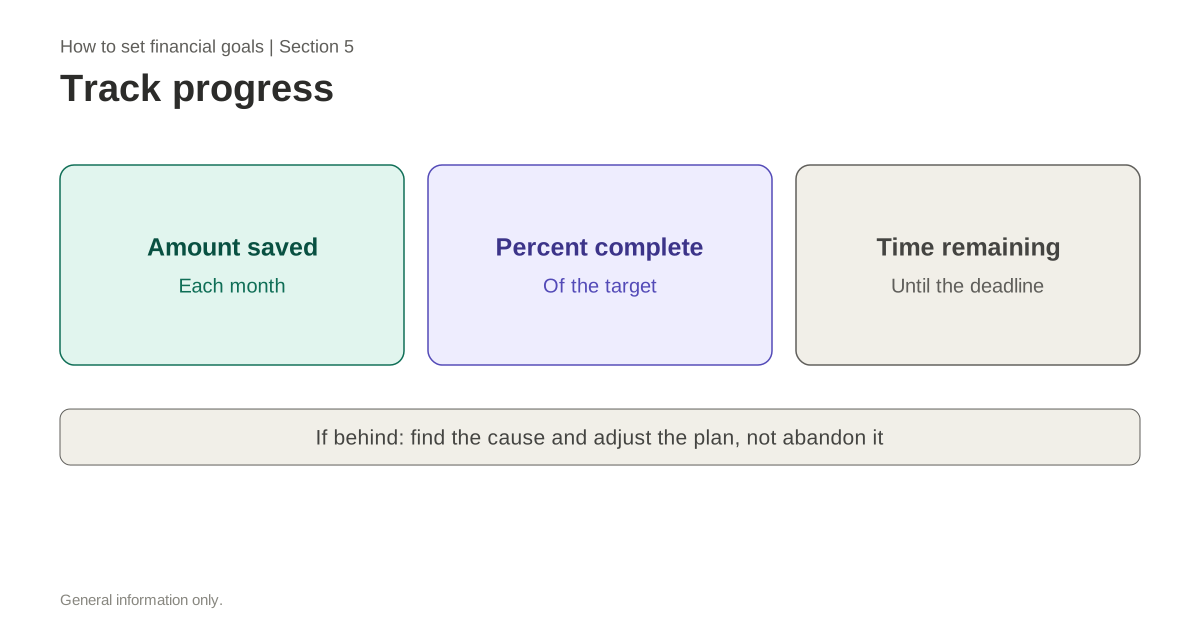
Check each goal at least once a month. Record the amount saved, the percentage completed and the time remaining. A simple chart or table is enough. Seeing the progress grow reinforces the habit, and it helps you notice when a goal is falling behind.
If a goal is behind, look for the cause. Is the monthly amount too high? Has a cost increased? Is a new goal competing for the same money? Adjust the plan rather than abandoning it.
Use milestones
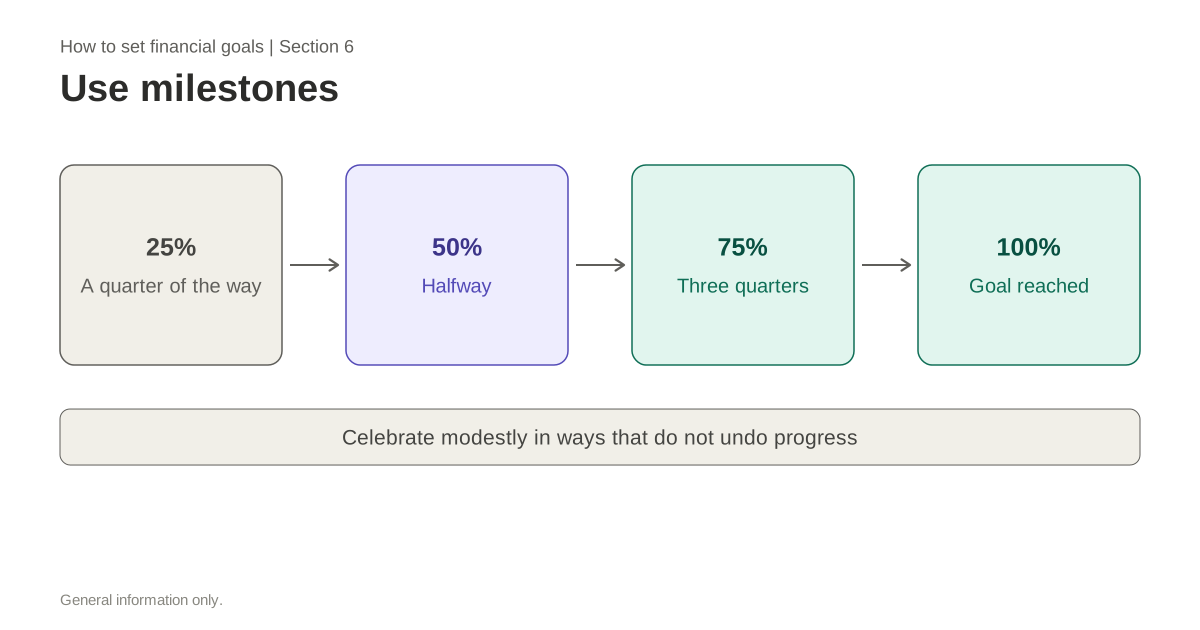
Break a large goal into milestones, such as a quarter of the target, half and three quarters. Celebrate each one in a way that does not undo your progress, such as a modest treat. Milestones make a long goal feel closer and help maintain motivation over several years.
Review regularly
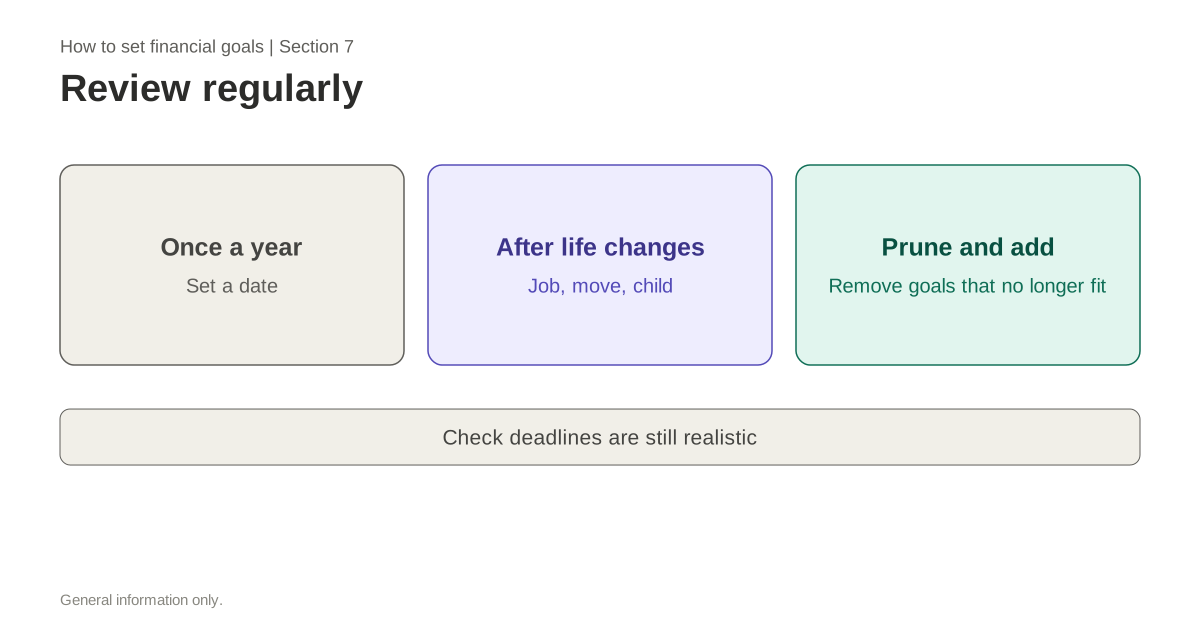
Set a date to review your goals each year, and after any major life change, such as a new job, a move, a relationship change or the arrival of a child. Check whether the goals still matter, whether the deadlines are realistic and whether the priorities have shifted. Remove goals that no longer fit, and add new ones carefully.
Common mistakes
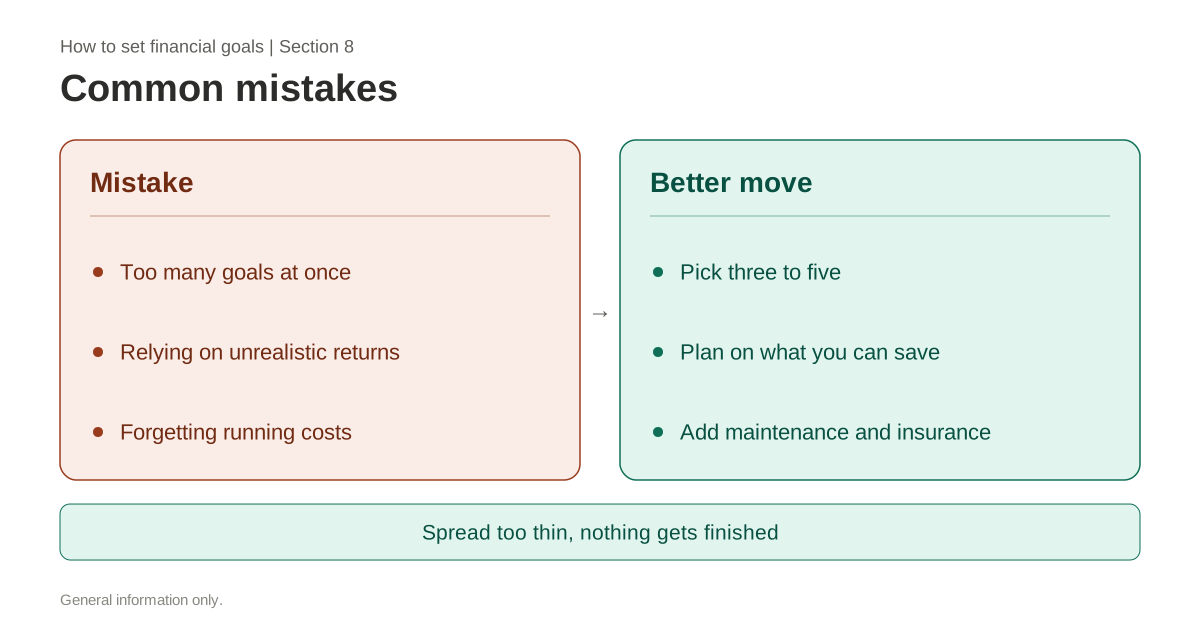
A common mistake is to set too many goals at once, which spreads money thinly and leads to slow progress on all of them. Another is to set goals that depend on unrealistic returns, rather than the savings you can actually make. A third is to forget the costs that come with a goal, such as maintenance for a home or insurance for a car.
Goals and motivation
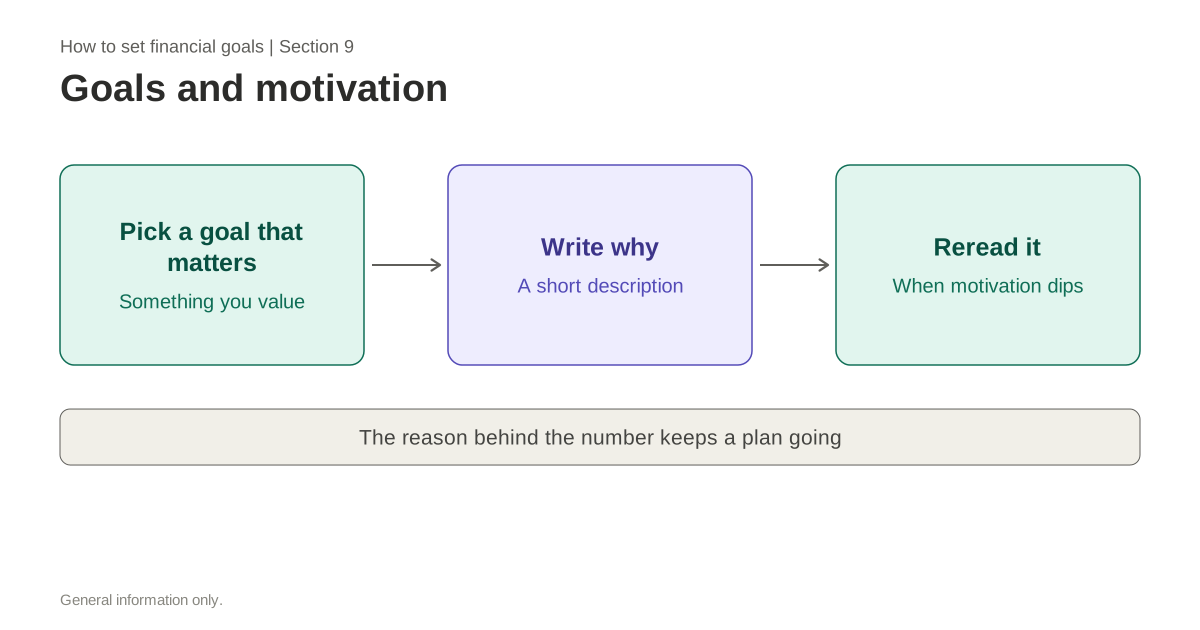
Goals work best when they connect to something you value. A savings target for a trip or a home is easier to sustain when you can picture the outcome. Write a short description of why each goal matters to you, and read it when your motivation dips. The reason behind the number often keeps a plan going longer than the number alone.
Celebrating progress
Reaching a milestone deserves recognition. Mark it in a way that supports the plan, such as reviewing the progress with someone who encourages you, or setting the next milestone. Recognition reinforces the habit, which is what carries most goals to completion.
One goal at a time
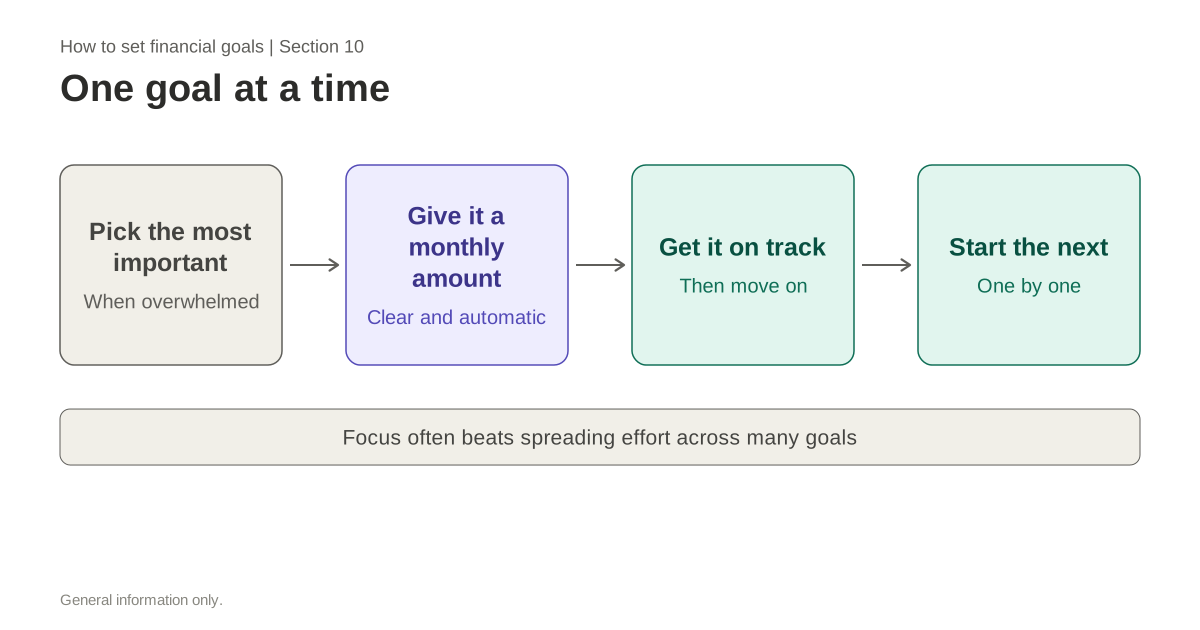
When you feel overwhelmed by several goals, pick the most important one and give it a clear monthly amount. Once that goal is on track, move to the next. Focusing on one goal at a time often produces faster results than spreading effort across many.
Goals for different life stages
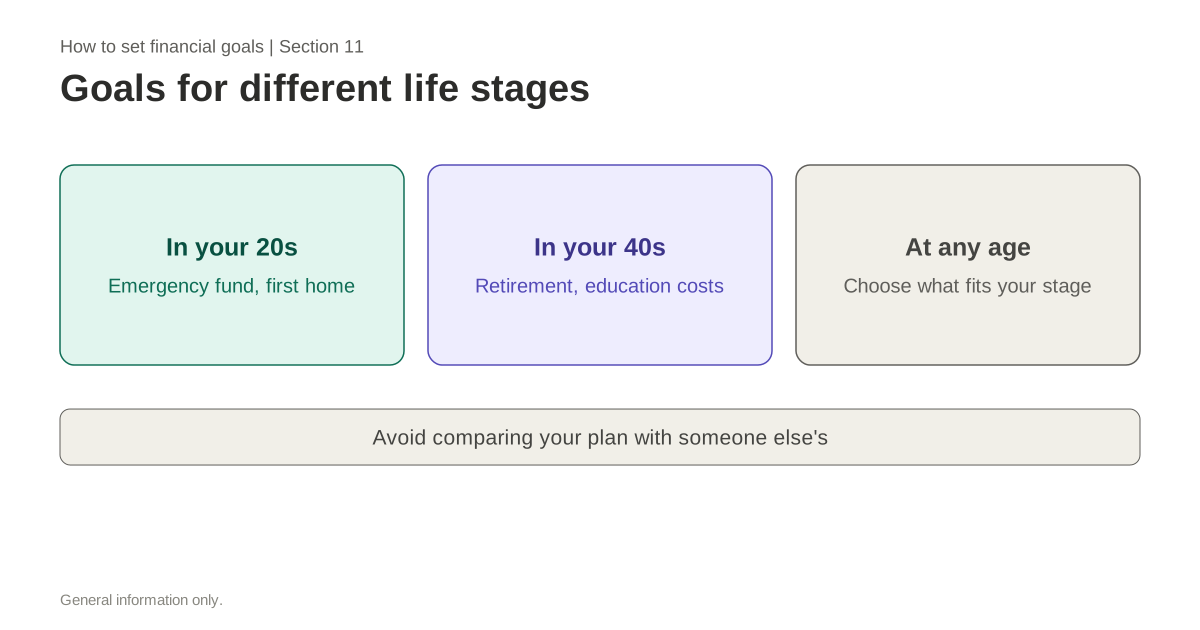
Goals change as your life changes. A person in their twenties may focus on an emergency fund and a first home, while someone in their forties may prioritise retirement and education costs. Thinking about the goals that matter at your stage of life helps you choose sensible priorities and avoid comparing your plan with someone else's.
Writing the plan down
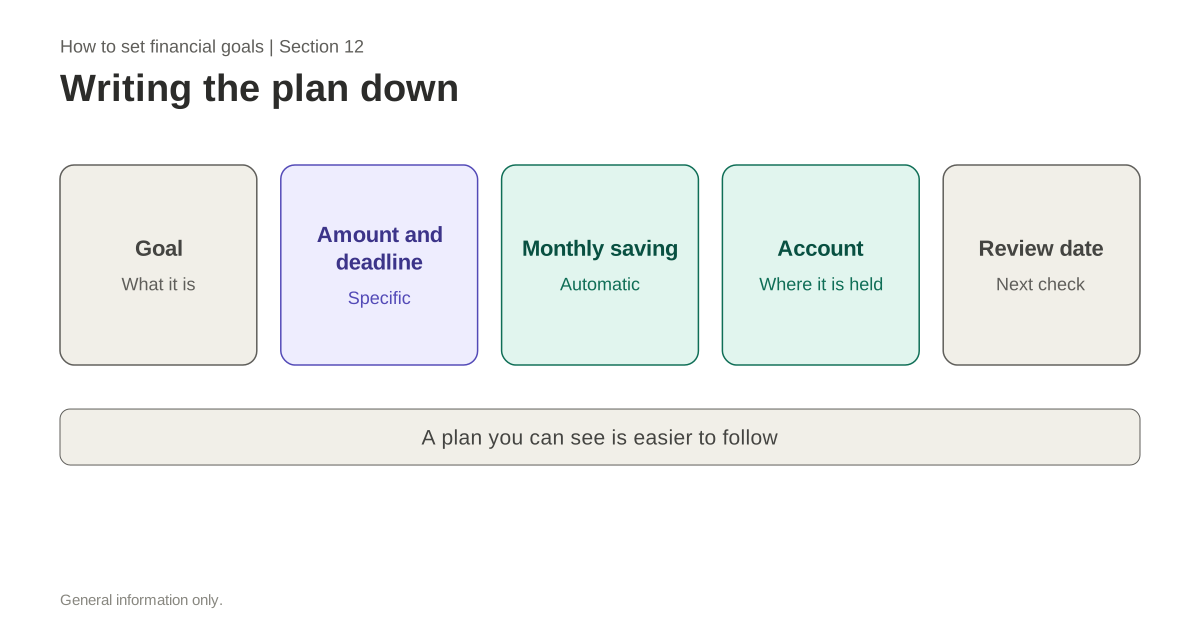
A written plan turns intentions into commitments. Include each goal, the amount, the deadline, the monthly saving, the account where the money is held and the date of your next review. A plan you can see is easier to follow, and it makes it obvious when something needs adjusting.
One goal at a time
When you feel overwhelmed by several goals, pick the most important one and give it a clear monthly amount. Once that goal is on track, move to the next. Focusing on one goal at a time often produces faster results than spreading effort across many.
The bottom line
A financial goal becomes real when it is specific, dated, costed and built into a monthly plan. Prioritise your goals, separate the money where you can, track progress and review the plan each year. A clear goal, with a clear monthly action, is far more likely to be reached than a wish.
Frequently asked questions
How many financial goals should I have?
A few is usually enough, often three to five at a time. Too many spread your money too thin, so prioritise and work on the most important first.
Should I set goals if my income is irregular?
Yes, but plan around the lowest reasonable monthly income, and put any extra income towards goals in a set order. This keeps progress steady in lean months.
What if I miss a monthly target?
One missed month is not a failure. Adjust the plan, recover the shortfall if you can, and check whether the target was realistic. The aim is steady progress over time.
Where should I keep money for a short-term goal?
Money needed within a few years is usually best kept in low-risk, accessible savings rather than in investments that could fall at the wrong moment.