A mortgage is a loan secured on property. You borrow money to buy a home, and the lender holds a legal claim on the property until the loan is repaid. If you cannot keep up the payments, the lender can take steps to recover the debt, which may include selling the property. Because the loan is secured in this way, mortgages usually have lower interest rates than unsecured borrowing, but they involve a long commitment.
This article explains how mortgages are structured, how repayments work, and what to look at before you agree to one. Rules and products differ widely between countries, so treat this as a general introduction and check the details with a lender and a qualified adviser.
The basic structure
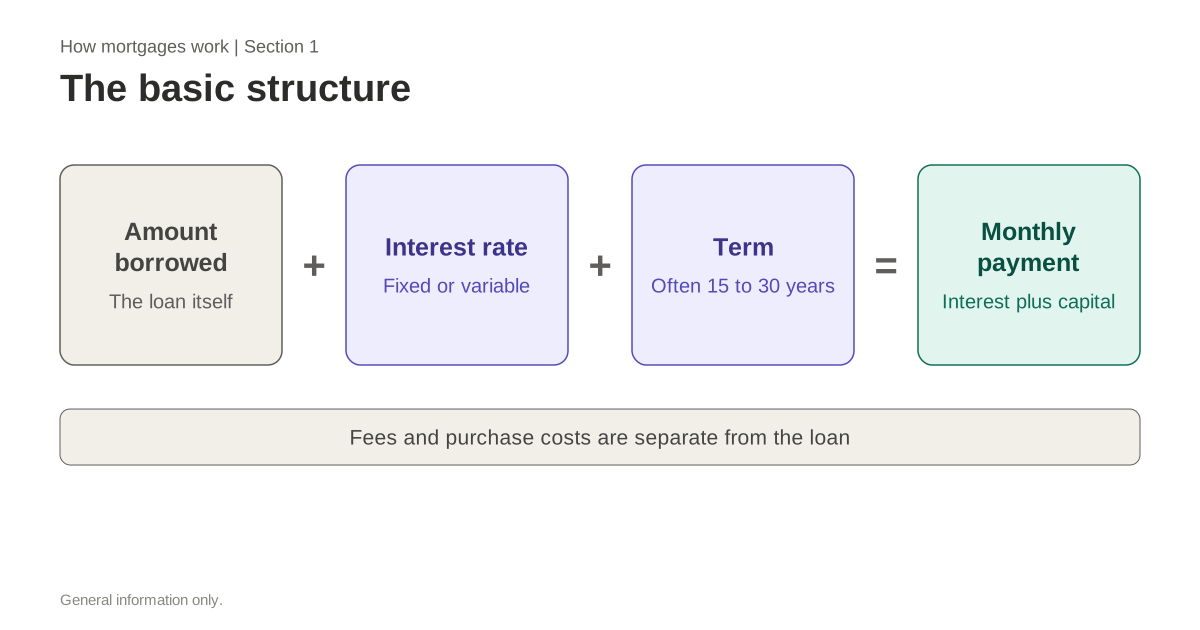
A mortgage has three main parts: the amount you borrow, the interest rate and the term. The term is the length of time you have to repay, which is often between fifteen and thirty years, though this varies. You also pay the fees charged by the lender and the costs of the purchase, which are separate from the loan.
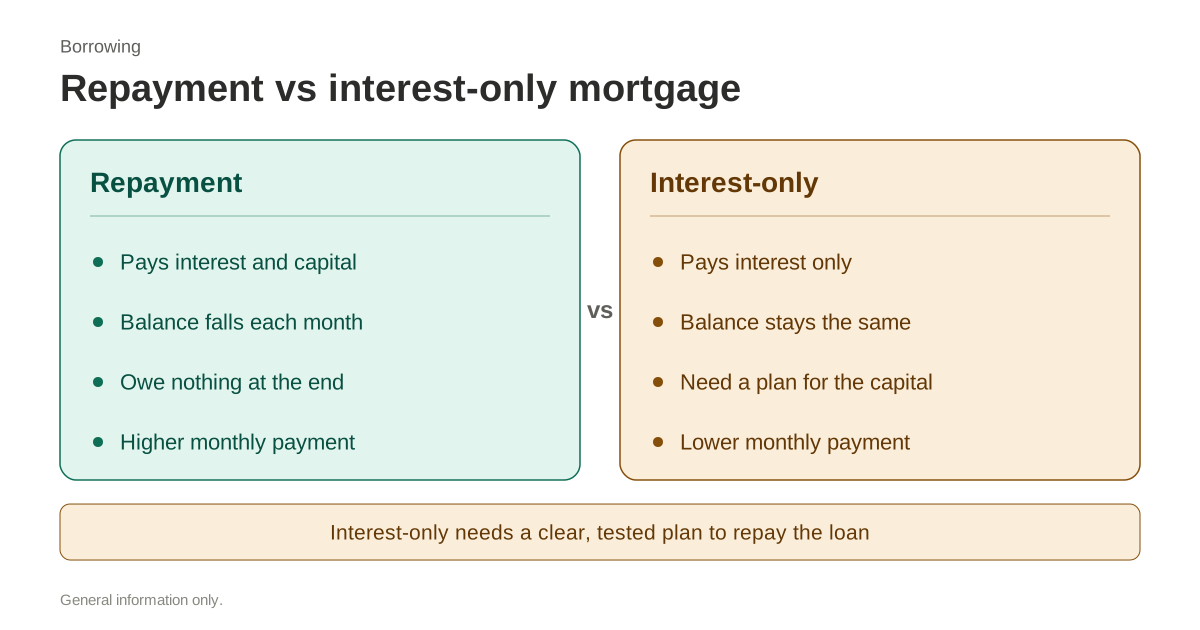
Most mortgages are repayment mortgages, where each monthly payment covers both interest and part of the amount borrowed. By the end of the term, the loan is fully repaid. Some products are interest-only, where the payments cover only the interest, and the amount borrowed remains due at the end. Interest-only loans carry significant risk and need a clear plan for repaying the capital.
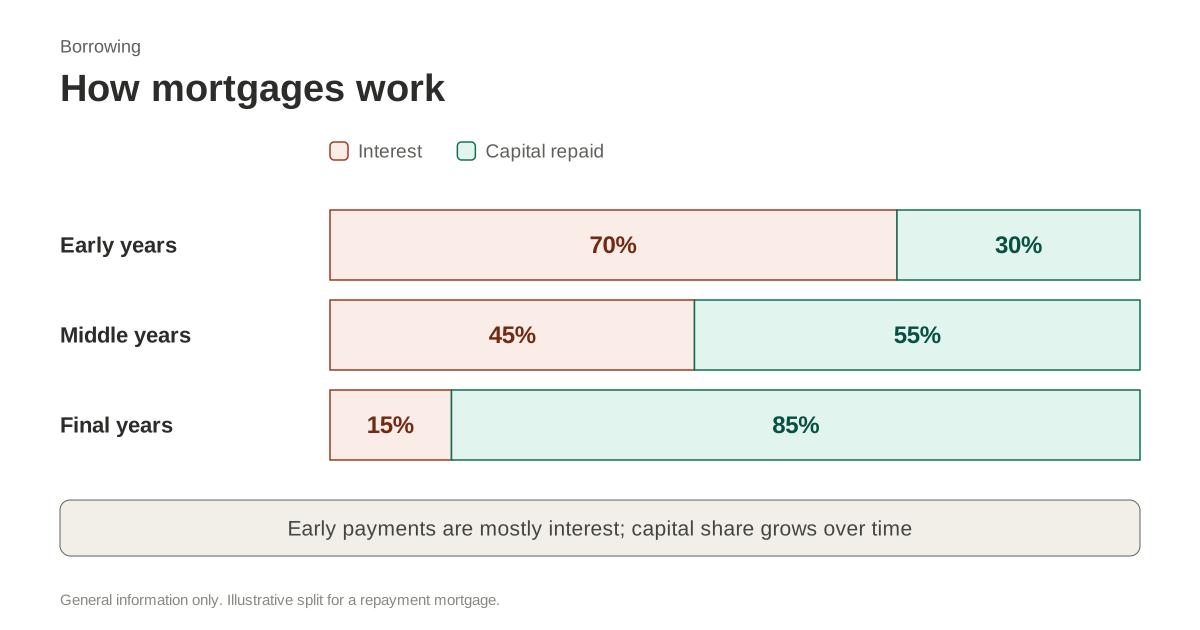
How repayments are split
In a repayment mortgage, the early payments are mostly interest, because the interest is calculated on the large outstanding balance. As the balance falls, the share of each payment that goes to interest declines, and more goes to reducing the amount you owe. This is why the balance falls slowly in the early years and faster later on.
Understanding this pattern helps you see the value of overpayments. Paying extra early reduces the balance that interest is charged on, which can cut the total interest and shorten the term.
Deposits and loan-to-value
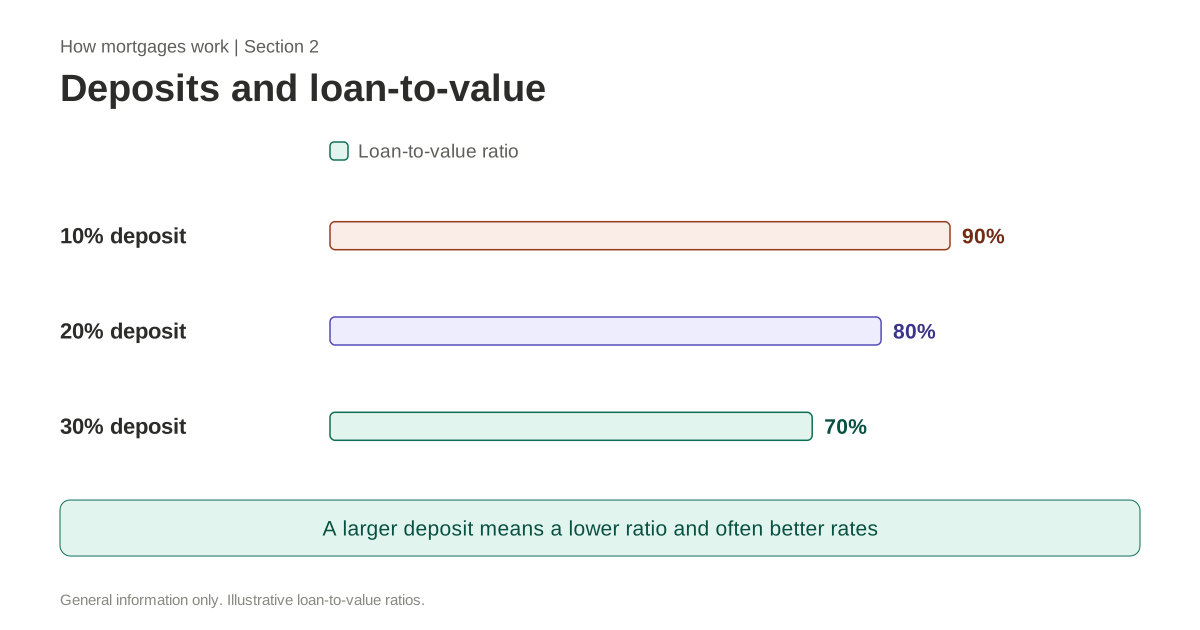
Lenders usually require a deposit, which is the part of the purchase price you pay from your own money. The loan-to-value ratio is the amount you borrow as a share of the property's value. A larger deposit means a lower ratio, which often gives access to better rates.
If your deposit is small, the lender may charge a higher rate or require mortgage insurance. Check the rules in your country, because some countries require a minimum deposit and others offer government-backed schemes.
Fixed and variable rates
Mortgage rates can be fixed for a period or variable throughout. A fixed rate gives certainty for the agreed period, while a variable rate moves with market conditions. Many products combine both, with a fixed period followed by a variable rate. The article on fixed and variable rate loans covers the trade-offs in more detail.
The costs beyond interest
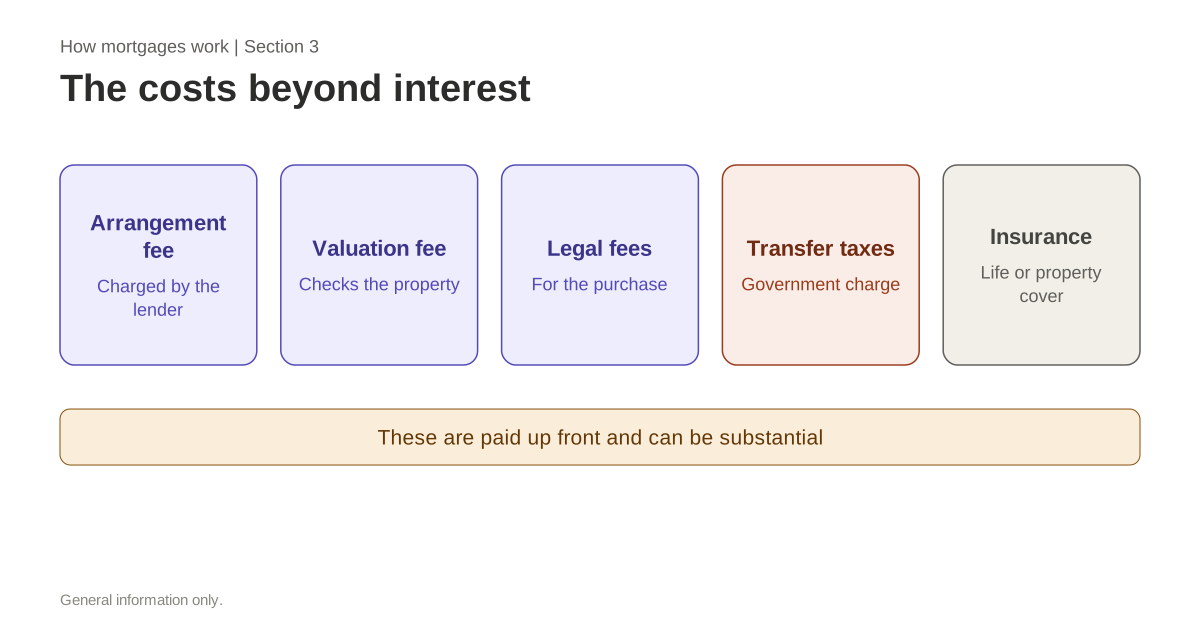
Buying a home involves costs in addition to the loan. There may be arrangement fees, valuation fees, legal fees, transfer taxes and insurance. Some lenders also require life or property insurance as a condition of the loan. Add these costs to your planning, because they are paid up front and can be substantial.
Early repayment and overpayments
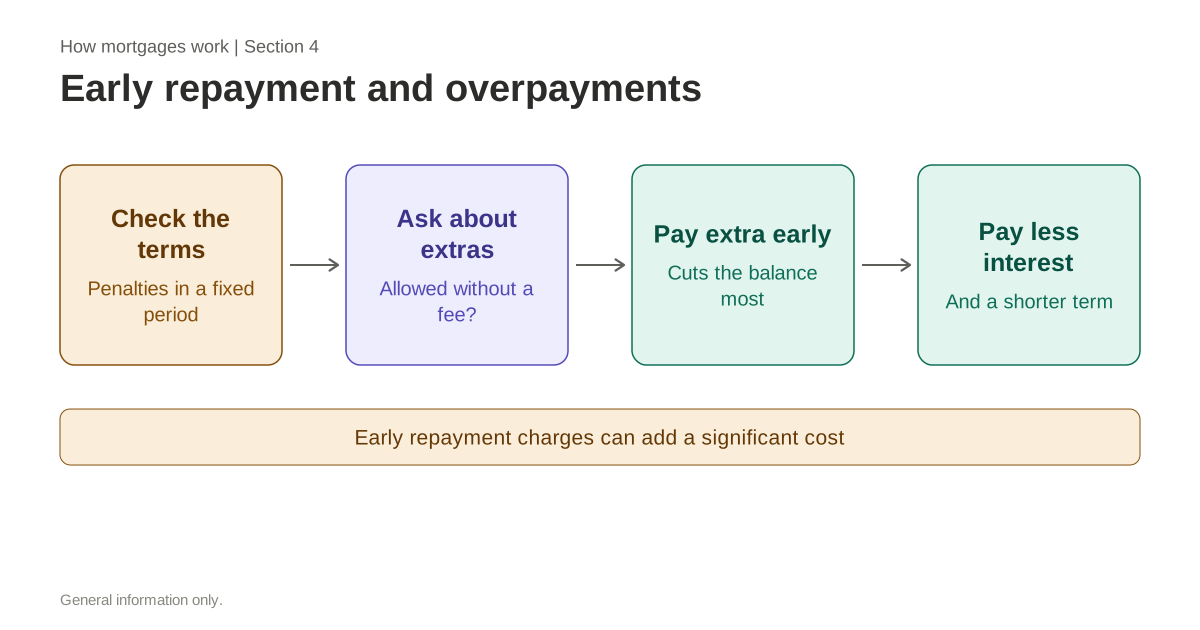
Many mortgages allow you to repay part or all of the balance early, but some charge a fee, particularly during a fixed-rate period. Check the terms before you sign, and ask whether overpayments are allowed without penalty. Making regular overpayments can significantly reduce the total interest, but only if the lender allows it.
If you plan to move or refinance during the fixed period, check whether early repayment charges apply, because they can add a significant cost.
Affordability
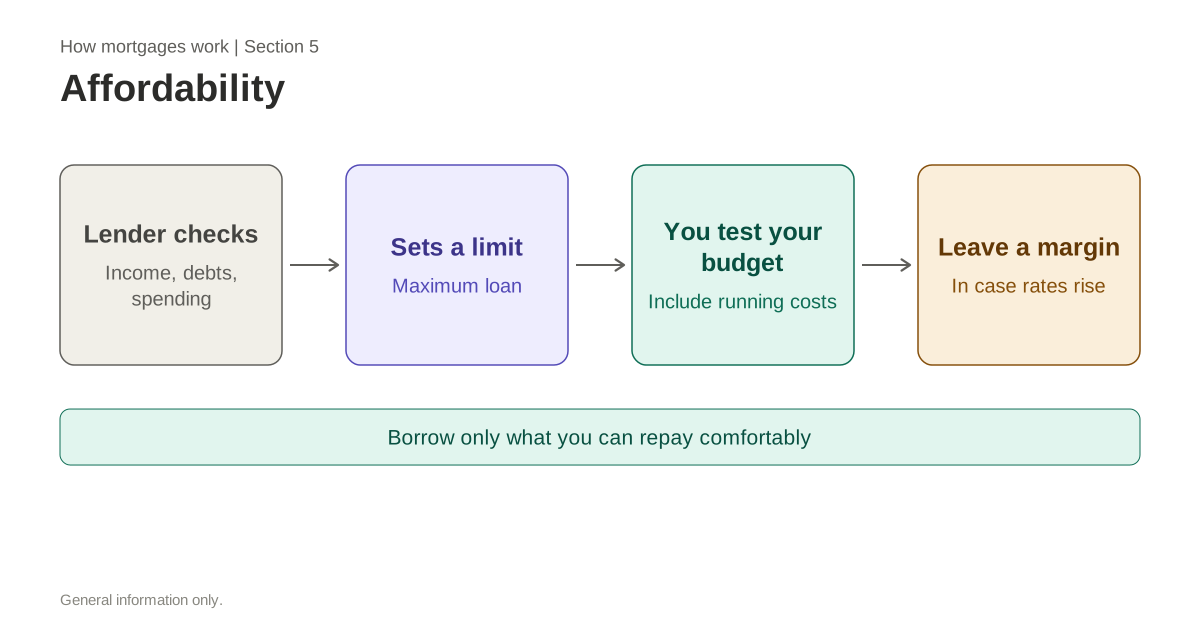
Lenders assess whether you can afford the repayments, usually by looking at your income, your existing debts and your spending. The result of this check may limit how much you can borrow. Even if you qualify for a larger loan, it is wise to borrow only what you can repay comfortably, including the costs of owning a home such as maintenance, insurance and property taxes.
Test your budget with a rise in the interest rate. A mortgage that is comfortable today may feel tight if rates rise, so leave room in your finances for that possibility.
Read the offer carefully
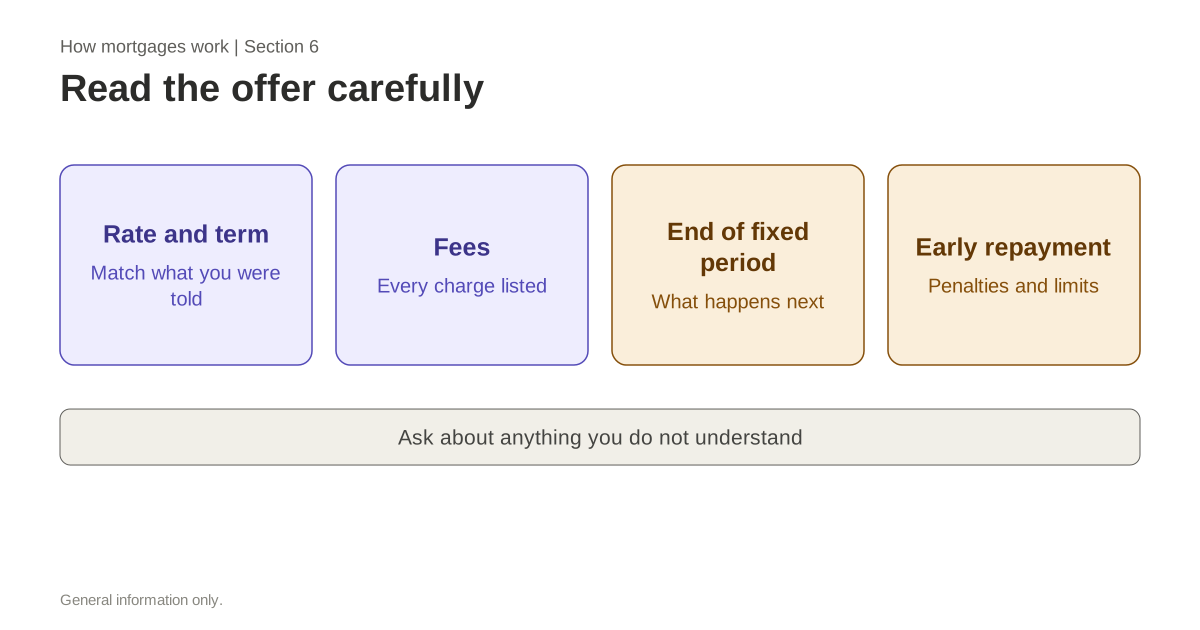
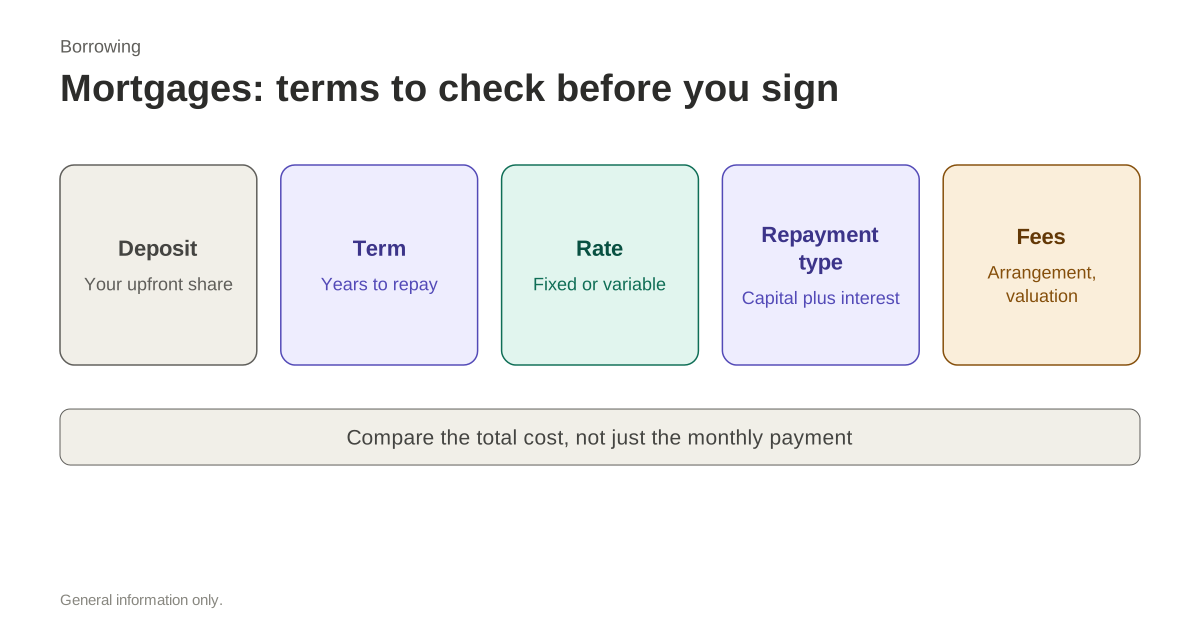
Before you accept, read the offer document. It sets out the rate, the term, the monthly payment, the fees and the conditions. Check what happens at the end of any fixed period, the penalties for early repayment, and the obligations for insurance and maintenance. Ask questions about anything you do not understand, and take independent advice if you are unsure.
Questions to ask before you apply
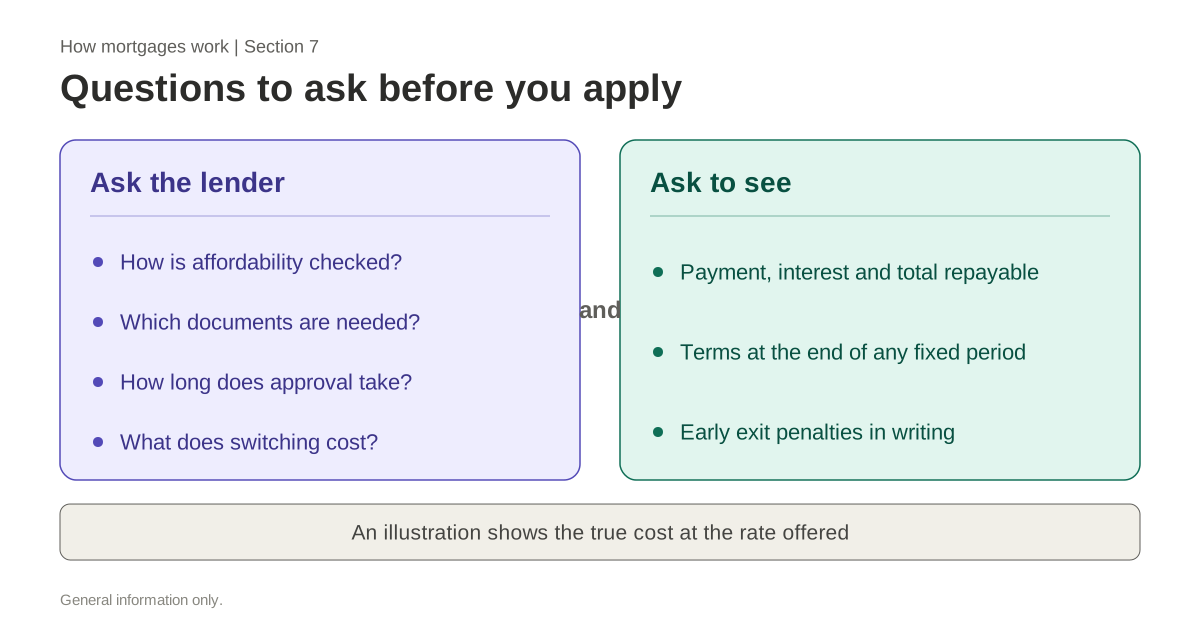
Before you apply, ask how the lender calculates the affordability check, which documents you will need, and how long the approval process takes. Ask for an illustration showing the monthly payment, the total interest and the total repayable at the rate offered. Ask what happens at the end of any fixed period and what the lender charges to switch products.
It is also wise to ask about the cost of leaving early. Some mortgages include a penalty if you repay during the first few years, and that penalty can be significant if you need to sell or move. Knowing the answer in advance lets you plan for the possibility of change.
Overpayments and the total cost
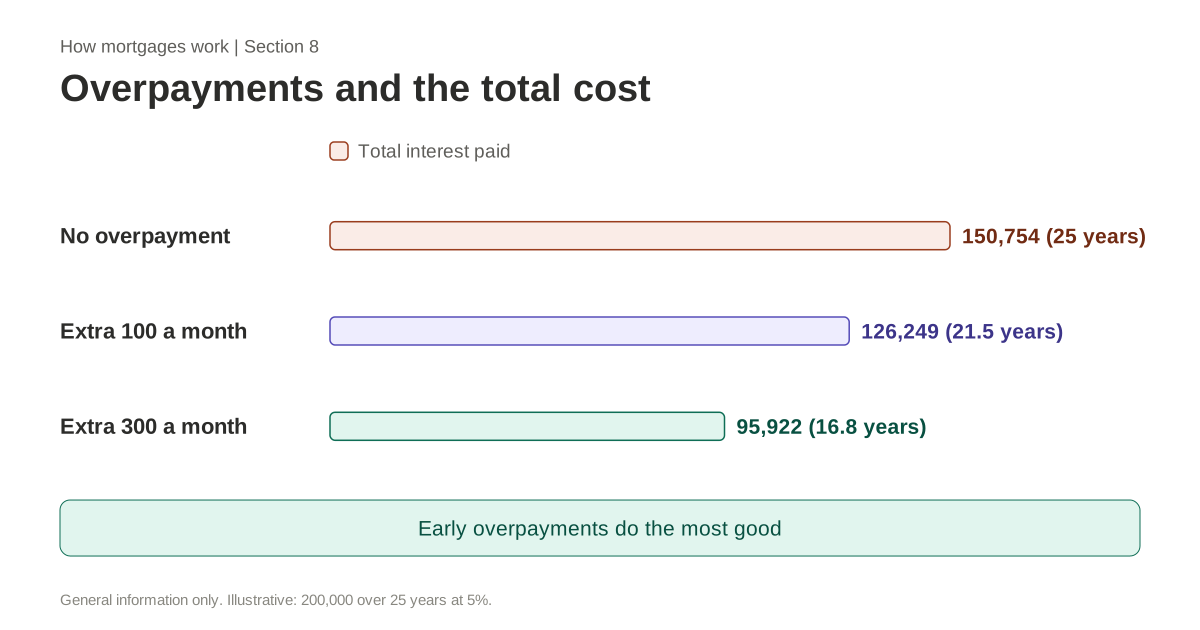
Making extra payments on a mortgage can reduce both the interest and the term, but the effect depends on when you pay and whether the lender allows it. Early overpayments do the most good, because they reduce a large balance on which interest is charged for many years. A small regular overpayment can shorten the term by several years over a long mortgage, which is worth checking with a calculator before you decide.
Compare the total cost of the mortgage with and without overpayments, not only the monthly payment. Lower payments may feel comfortable, but the total interest over the full term is what determines the real cost of the loan.
The bottom line
A mortgage lets you buy a home without paying the full price upfront, but it is a long commitment with significant costs. Understand how repayments are split, check the total cost including fees, and make sure the payment fits your budget even if rates move. Careful planning at the start is the best protection against difficulty later.
Frequently asked questions
What is the difference between a repayment and an interest-only mortgage?
A repayment mortgage pays off the balance by the end of the term. An interest-only mortgage covers just the interest, so the full amount borrowed remains due at the end and needs a separate repayment plan.
Why do early mortgage payments mostly go to interest?
Interest is calculated on the outstanding balance, which is largest at the start. As the balance falls, a bigger share of each payment reduces the capital.
Can I repay my mortgage early?
Often yes, but some lenders charge a fee, especially during a fixed-rate period. Check the terms and ask whether overpayments are allowed without penalty.
How much deposit do I need?
It depends on the country and the lender. A larger deposit usually gives access to better rates, and some countries set minimum requirements or offer government schemes. Check the rules where you live.