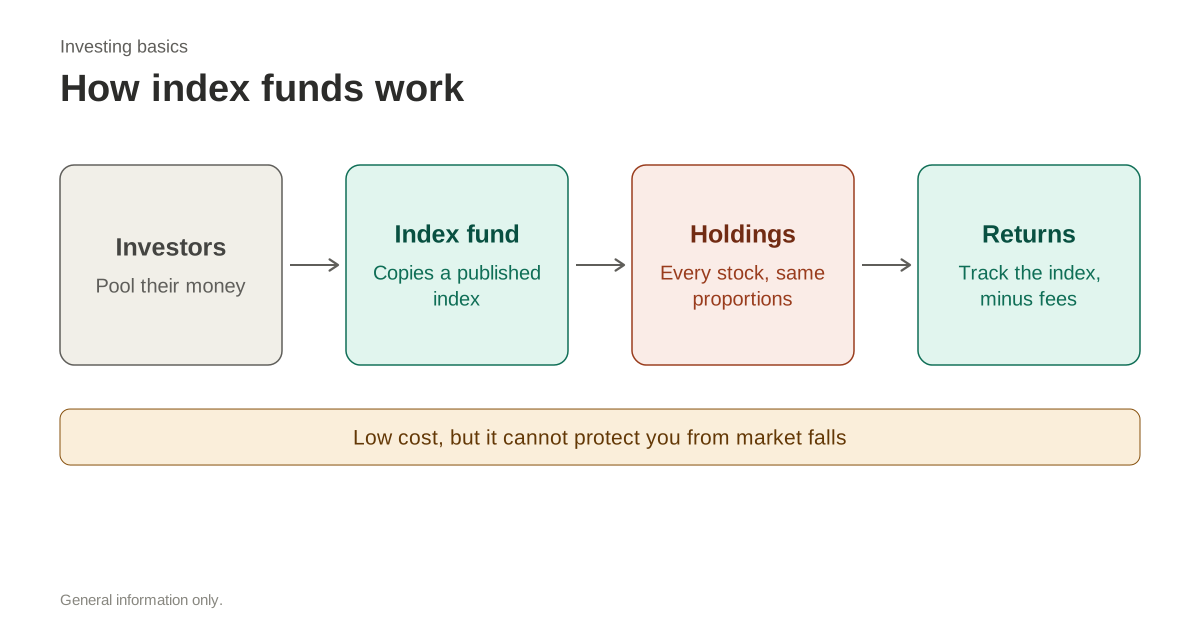
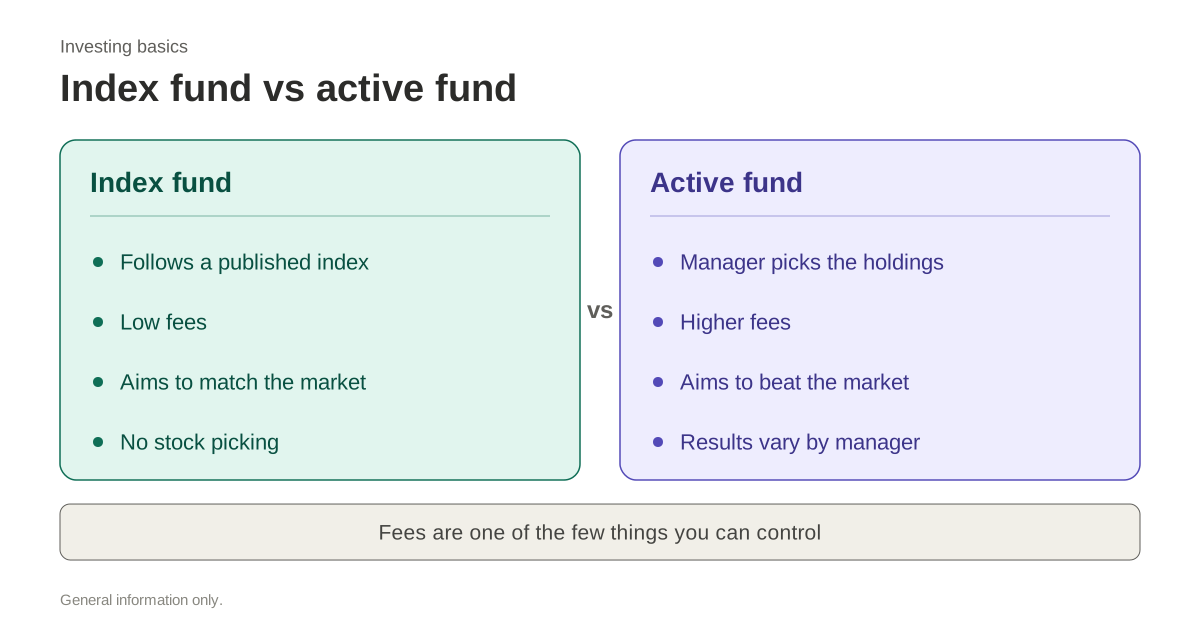
An index fund is a fund that aims to match the performance of a market index, such as a broad list of large companies in one country or a wider set of companies around the world. Rather than trying to beat the market by picking individual shares, the fund holds the same companies as the index, in roughly the same proportions. Because the rules are simple and do not require constant research, index funds are one of the most widely used tools for long-term investing.
This article explains how index funds are built, why they are popular, and what risks they still carry. It is general information, and it does not recommend a particular fund or provider.

What an index is
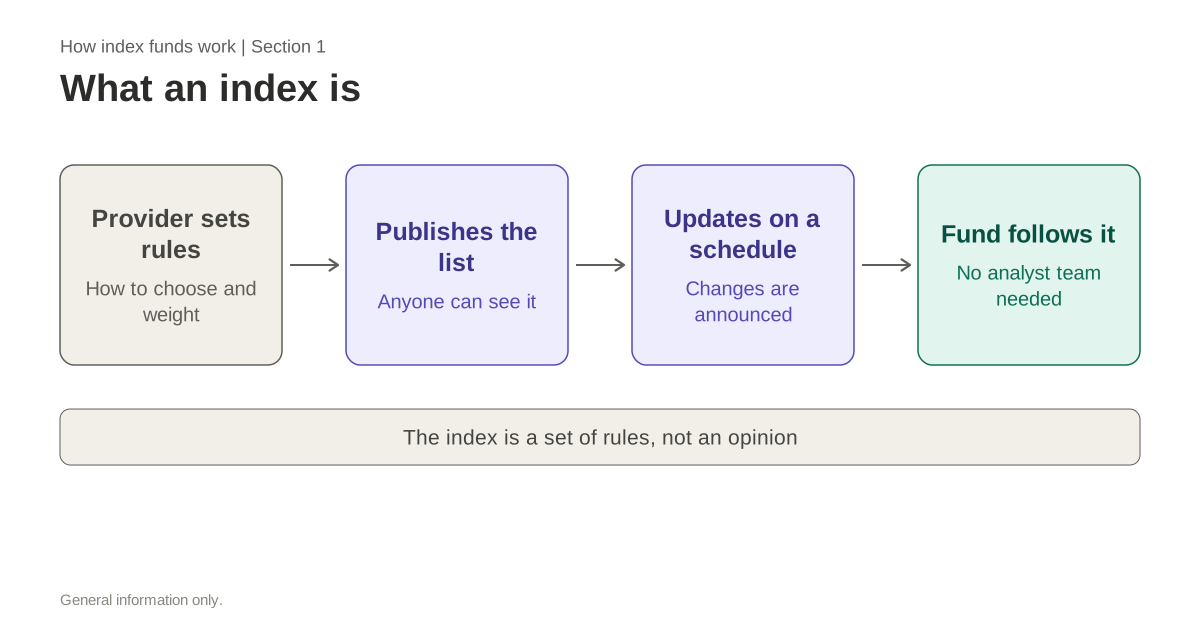
An index is a published list of investments, with rules for how they are chosen and weighted. A market index might include the largest companies on an exchange, weighted by their market value. Some indexes cover bonds, property or commodities. Index providers publish the rules and the constituents, so anyone can see what the index holds at any time.
Because the index is a set of rules rather than an opinion, a fund that follows it does not need a team of analysts to decide what to buy. Changes to the index are made by the provider on a schedule, and the fund follows them.

How the fund follows the index
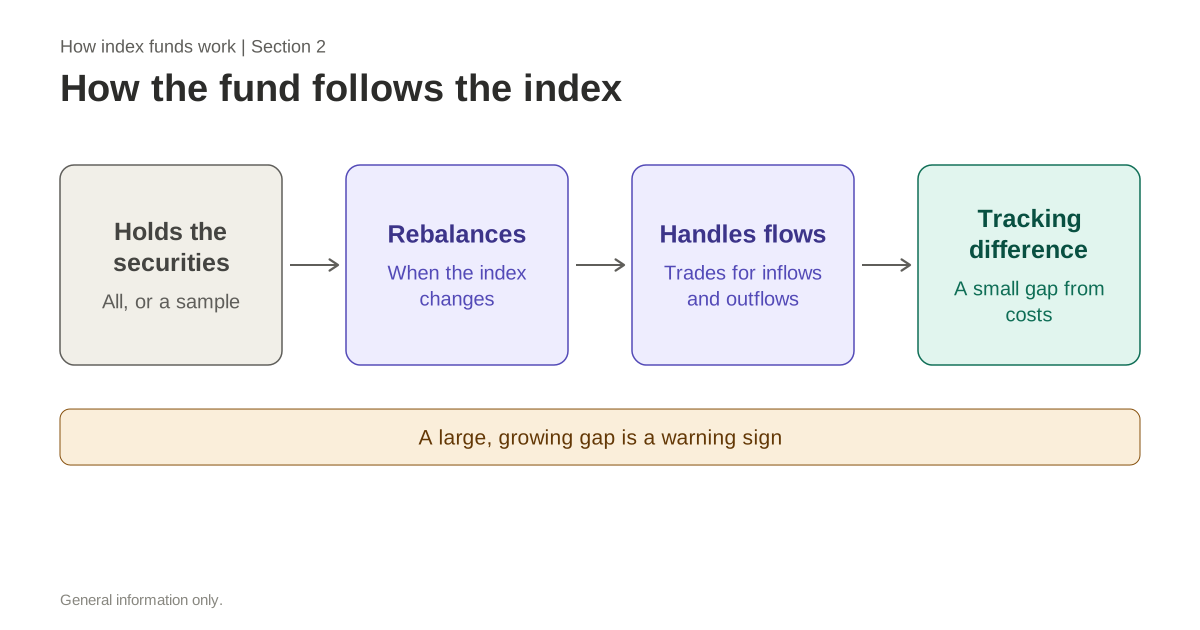
The fund holds the securities in the index, either all of them or a representative sample when holding every one is impractical. It rebalances periodically to match changes to the index, such as a company being added or removed. Large inflows and outflows are handled through trading, and the fund's costs are part of the ongoing charge.
The gap between the fund's return and the index's return is known as the tracking difference. It is usually small, and it reflects the fund's costs and trading. A consistently large gap suggests the fund is not managing its task efficiently.
Why people use them
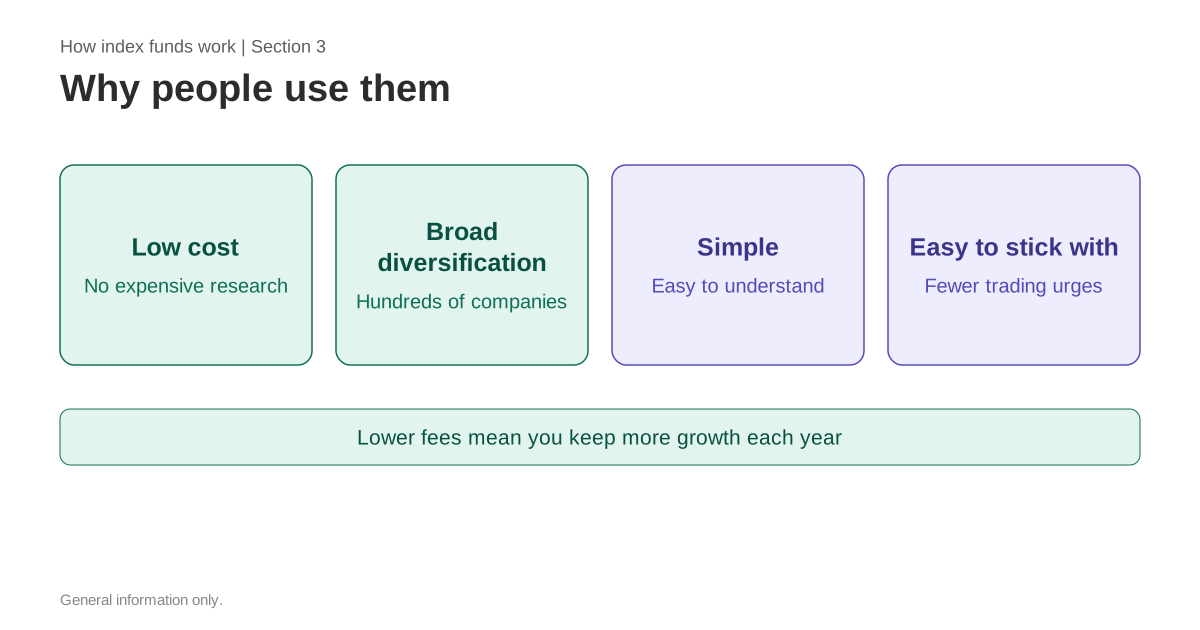
The main appeal of index funds is low cost. Because they do not need expensive research, their charges are typically lower than those of actively managed funds. Over long periods, that difference can matter a great deal, since fees reduce the growth you keep each year.
Index funds also provide broad diversification. A single fund can hold hundreds or thousands of companies, which reduces the impact of any one company's failure. They are simple to understand, and many investors find it easier to stick to a plan built around them than to trade in and out of individual shares.
The limits
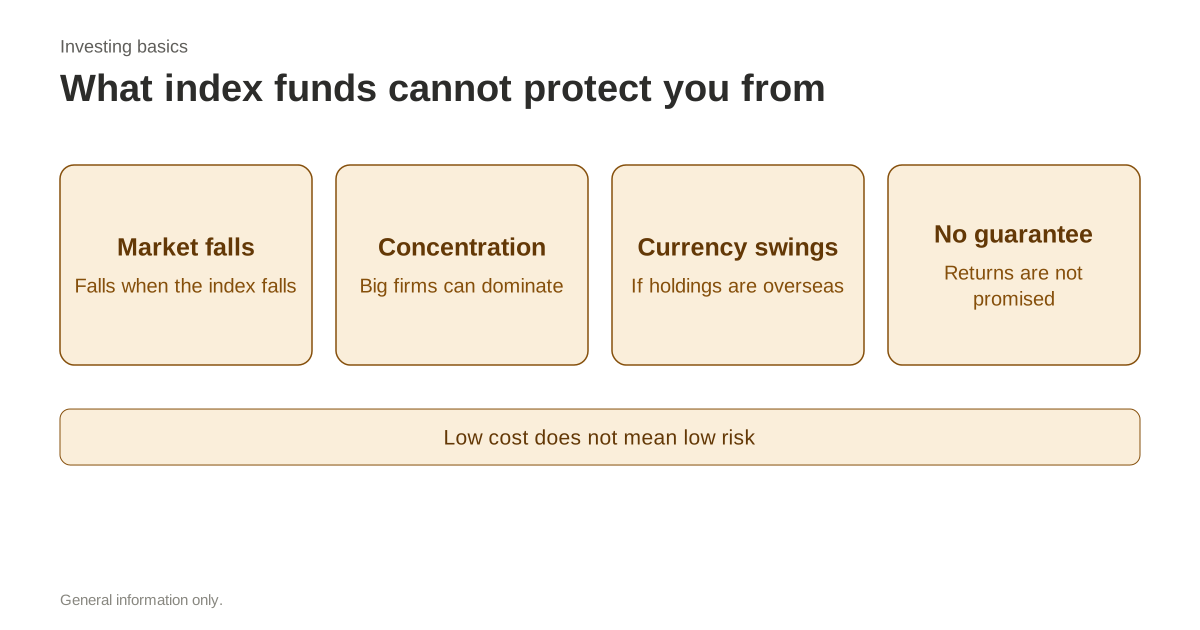
An index fund cannot protect you from market falls. If the index drops, the fund drops with it, and the loss can be large in a downturn. A fund that tracks a narrow index, such as a single country or sector, carries more concentrated risk than one tracking a broad market.
The fund also gives you the market return, not a better one. Some active managers do outperform in particular periods, but it is hard to know in advance which ones will do so. Index funds accept the market's return in exchange for low costs and simplicity.
Choosing an index fund
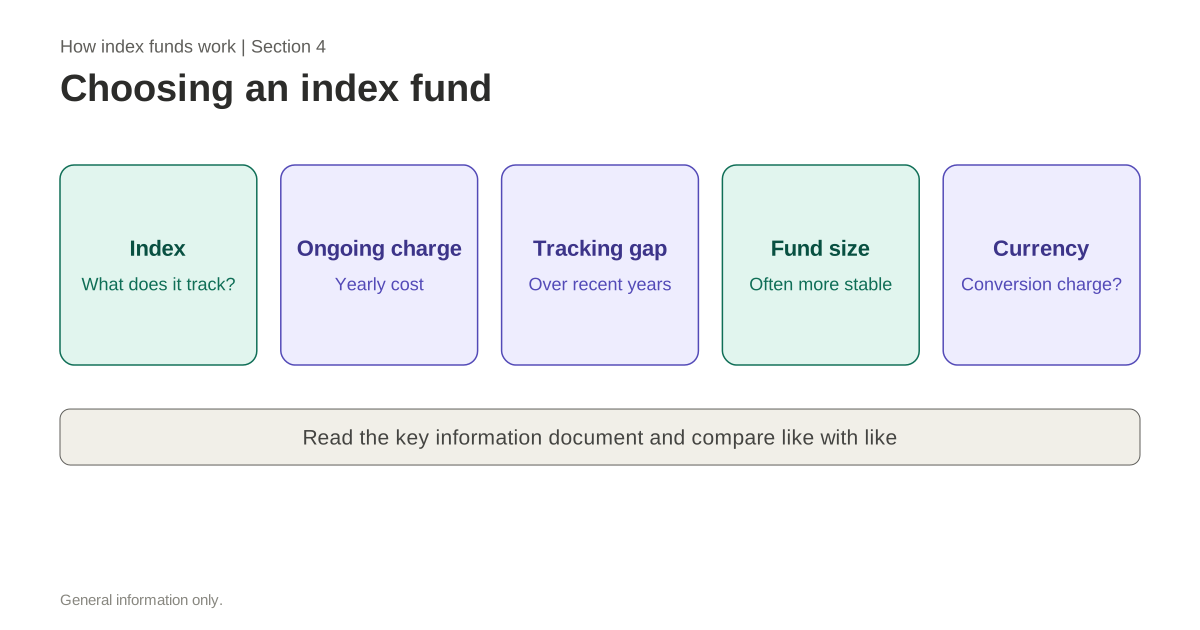
Start by checking which index the fund tracks, and whether that index matches what you want to own. Look at the ongoing charge, the tracking difference and the fund's size. A larger fund is often more stable, though size alone does not guarantee quality. Check the currency of the units and whether you will pay a conversion charge to buy them.
Read the fund's key information document, which should explain its objective, its risks and its costs in standard terms. Compare similar funds using the same figures, rather than judging by name.
Using index funds over time
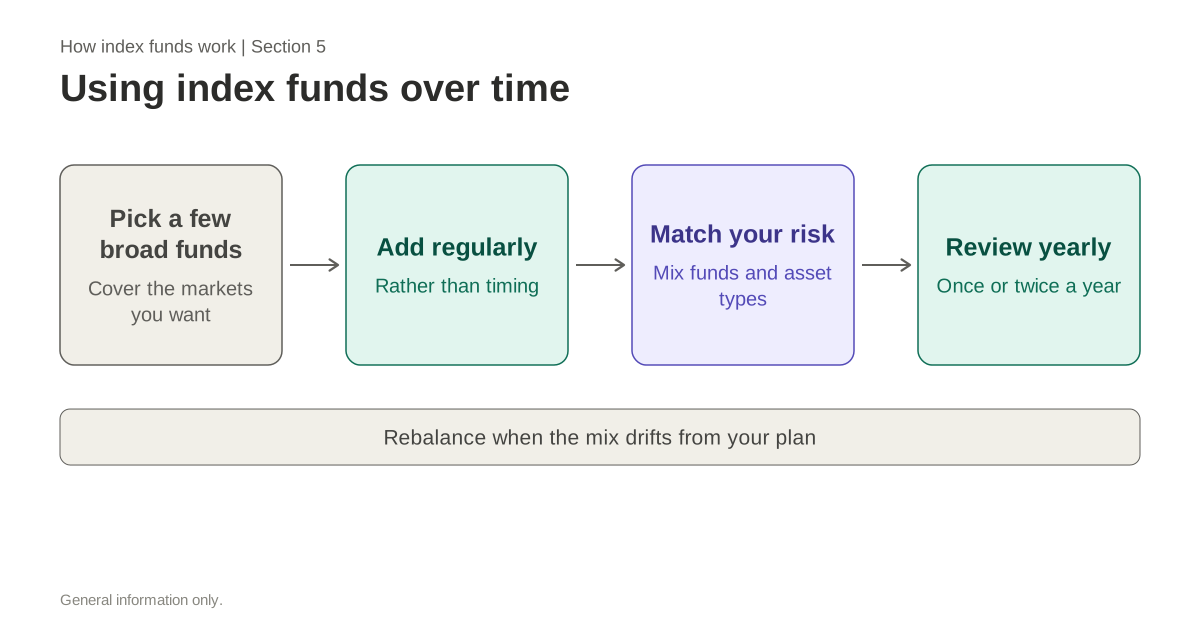
Many investors hold a small number of index funds, covering the broad markets they want exposure to, and add to them regularly. Some combine funds covering different countries or asset classes to match their risk level. The mix should reflect your goals and how long you can leave the money invested.
Review the holdings once or twice a year, and check that the balance still matches your plan. The article on rebalancing explains how to bring a portfolio back to its target after markets have moved.
Costs versus benefits
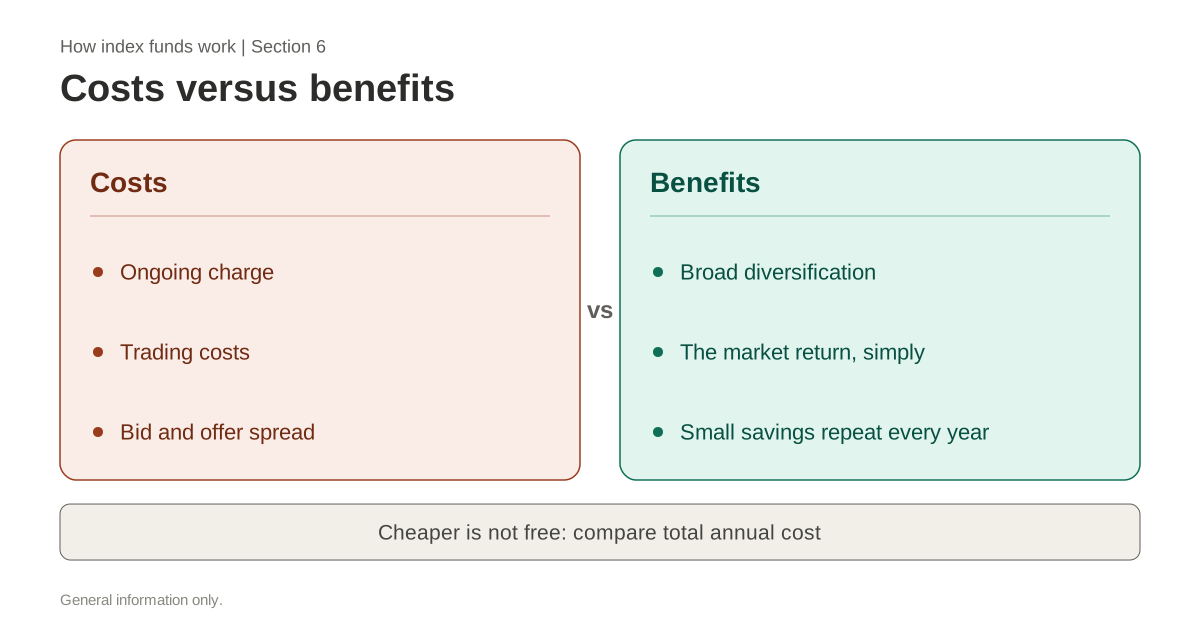
Index funds are cheaper, but they are not free. Trading costs, the bid and offer spread, and the ongoing charge all reduce what you keep, even if the fund tracks its index closely. Compare the total annual cost of each option, and remember that a small saving on charges is most valuable when it is repeated every year for a long period.
A quick check before you buy
Before buying any index fund, confirm four things: the index it follows, the ongoing charge, the tracking difference over the last few years, and the currency of the units. Those four facts tell you what you are buying, what it will cost you and how faithfully it does its job.
Choosing the index carefully
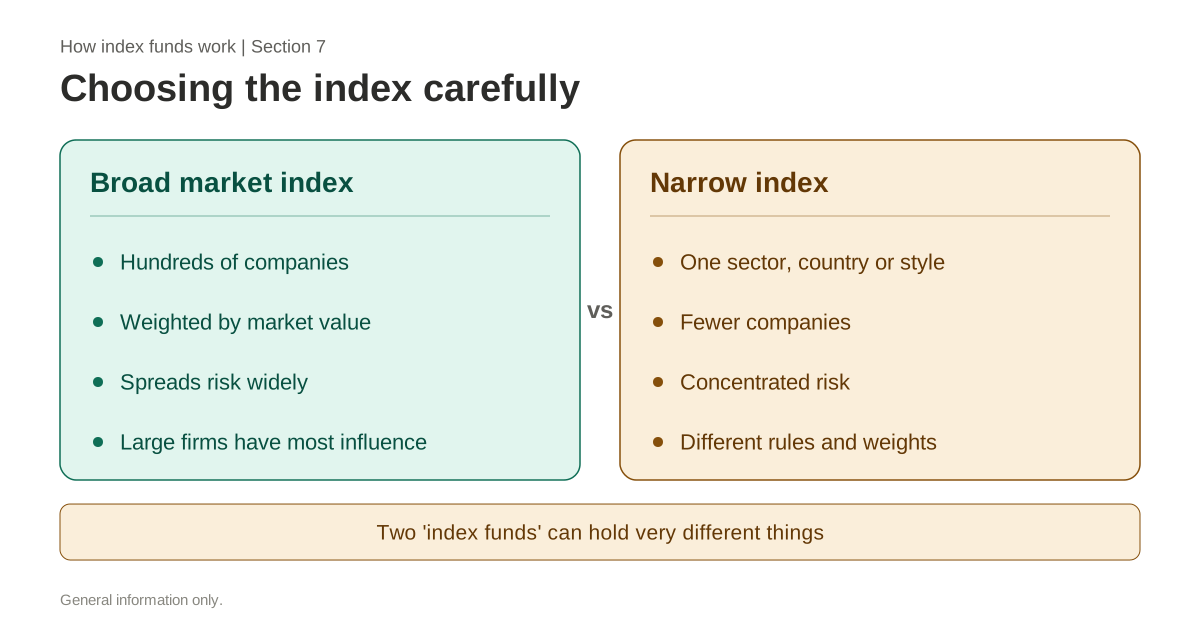
Two funds can both be called index funds and still hold very different things. One may track a broad national market, while another tracks a narrow sector or a particular investment style. Before buying, read the index name and its rules, and ask how often it changes and how it weights its holdings. Weighting by market value gives larger companies more influence, which can matter during periods when a few large firms dominate the market.
Index funds in a plan
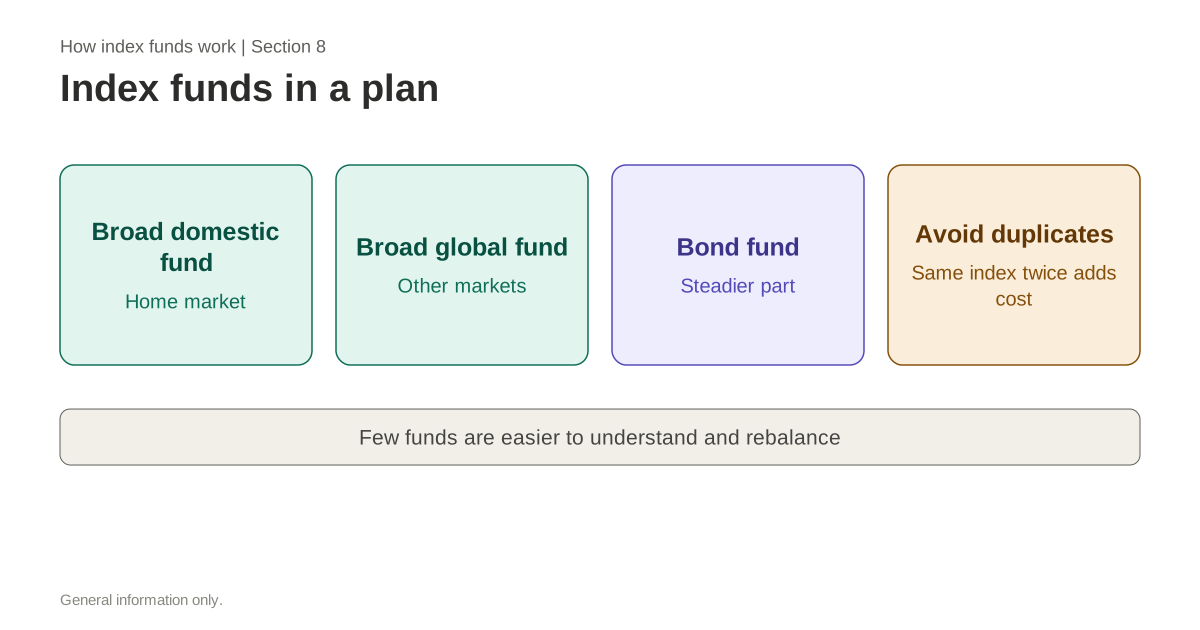
An index fund is a building block. Many investors combine a broad domestic fund with a broad international fund and a bond fund, adjusting the mix to their goals. Keeping the number of funds small makes the portfolio easier to understand and to rebalance. Avoid buying several funds that track the same index, because it adds cost without adding diversification.
The bottom line
An index fund offers a simple, low-cost way to own a broad market and accept its return. It is not free of risk, and it will fall when the market falls. Used as part of a clear plan, with attention to costs and diversification, it is a practical foundation for many long-term investors.
Frequently asked questions
Are index funds always cheaper than actively managed funds?
Usually, because they do not need expensive research. Costs still vary between index funds, so compare the ongoing charge and tracking difference of similar products before choosing.
Can an index fund lose money?
Yes. It holds the same investments as the index, so it falls when those investments fall. Broad funds can recover over time, but there is no guarantee of recovery within any specific period.
What is tracking difference?
It is the gap between the fund's return and the index's return over a period. A small gap is normal because of costs. A large or growing gap suggests the fund is not following its index efficiently.
Do I need more than one index fund?
Not always. A single broad fund can give wide diversification. Some investors add funds covering other countries or asset types to match their goals and spread risk further.