A credit score is a number that summarises how reliably you have repaid borrowing in the past. Lenders use it to decide whether to offer credit and on what terms. Not every country uses credit scores, and where they exist, the scale, the agencies and the rules differ. The general principles, however, are similar almost everywhere.
This article explains what a credit score measures, the factors that influence it, and how to manage it without making decisions that cost you more in the long run.
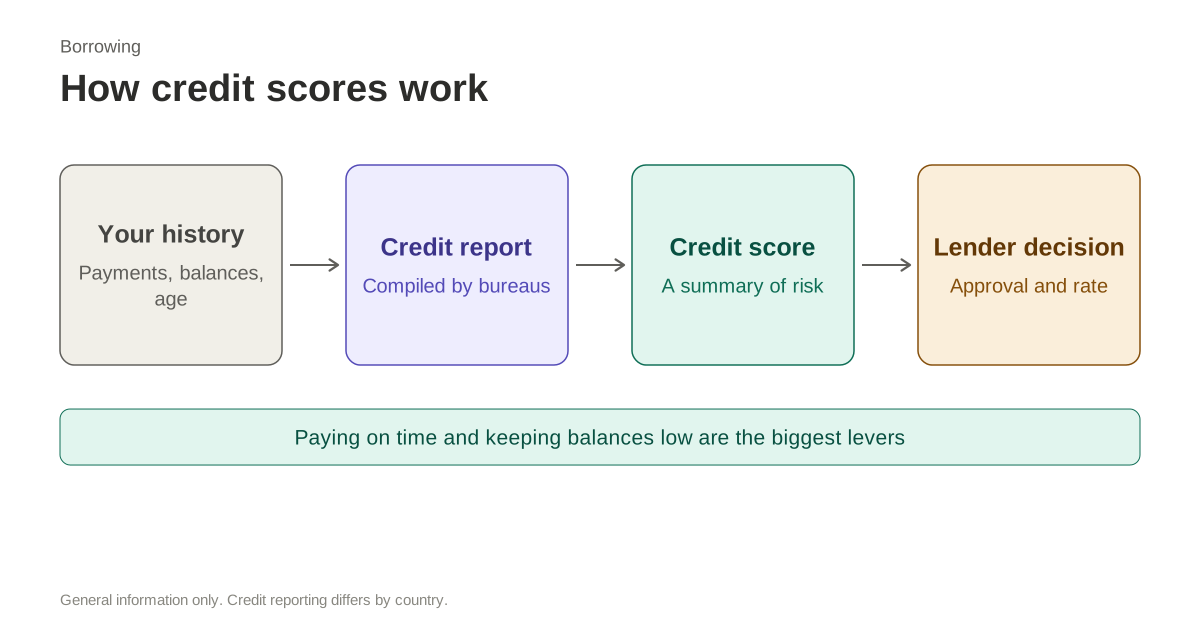
What a score measures
A credit score estimates the risk that you will fail to repay a loan. It is calculated from information in your credit report, which lists your accounts, balances, payment history and some public records. Scoring models weigh this information to produce a number, and different lenders may use different models or versions of the same model.
The score is a prediction, not a judgement of your character. It reflects patterns in the data, and it can change as new information is added. Because it is a snapshot of your recent history, it can improve or fall over time.
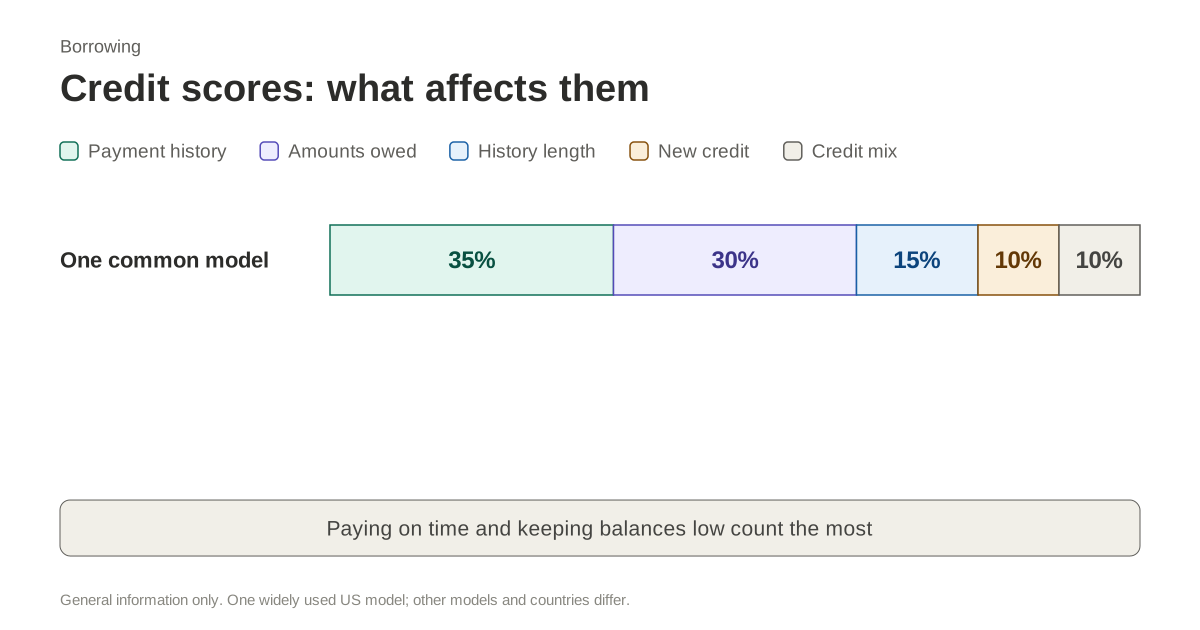
The main factors
Payment history is usually the most important factor. Paying on time, every time, is the strongest signal of reliability. A single missed payment can lower a score, and repeated late payments do more damage.
The amount you owe also matters. Scoring models often look at the share of available credit you are using, known as utilisation. A card near its limit can look riskier than one with a large unused balance, even if the account is paid on time. Keeping balances low relative to limits generally helps.
The length of your credit history counts as well. A longer record of well-managed accounts gives a lender more evidence. Opening many new accounts in a short period can reduce the average age of your accounts and may lower the score temporarily, because each application can leave a mark on your report.
Finally, the mix of credit types can play a role, as can recent applications. A mix of accounts that you handle responsibly is generally viewed positively, but it is the payment record that matters most.
Check your report
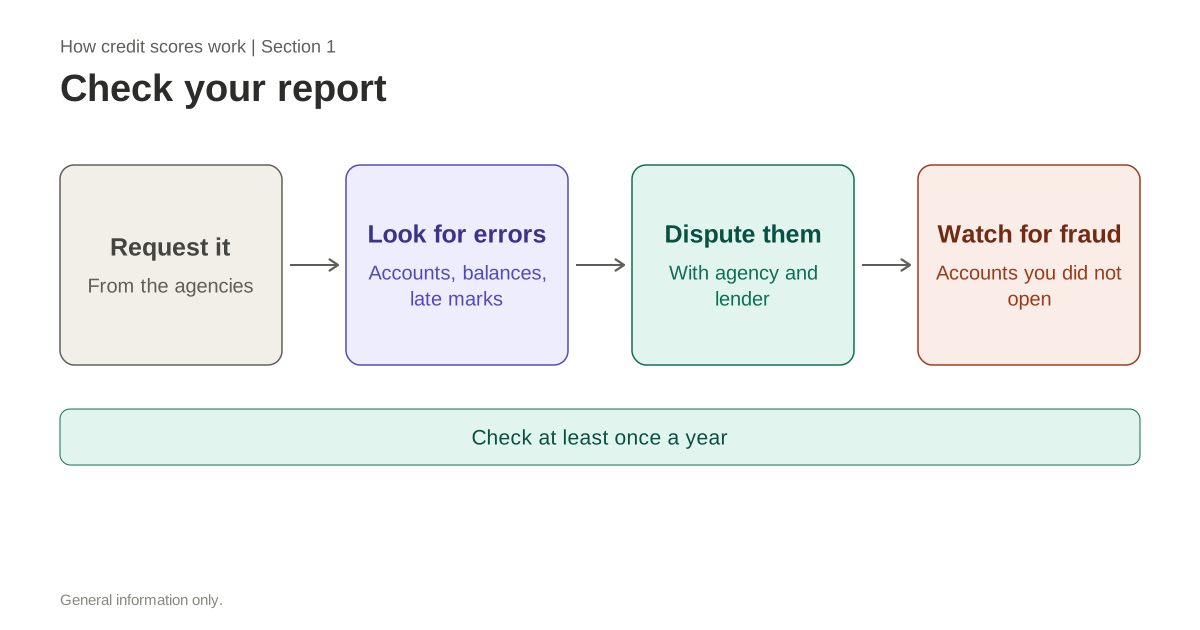
Most countries allow you to request your credit report from the agencies that operate there. Reviewing it lets you spot errors, such as an account you do not recognise, a balance that is wrong, or a late payment that was actually made on time. Errors can be disputed with the agency and the lender, and correcting them can improve your position.
Check your report at least once a year. Look for fraud as well, because identity theft often shows up first as an account you did not open.
Why scores matter
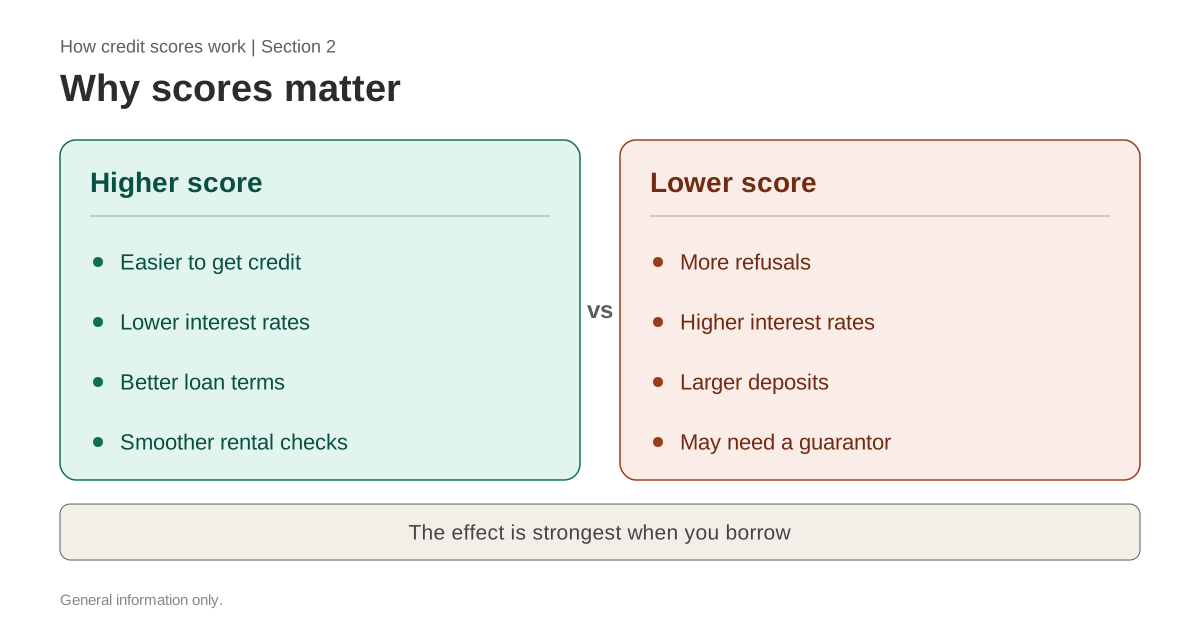
A higher score usually makes it easier to get credit, and it can lead to lower interest rates and better terms. A lower score can mean refusals, higher rates, larger deposits or requirements such as a guarantor. In some situations, such as renting a home or applying for certain services, a credit check may also influence the outcome.
The effect of a score is strongest when you borrow. If you rarely borrow and pay everything in full, a score matters less in daily life, but it still reflects your record if you need credit later.
Building a record
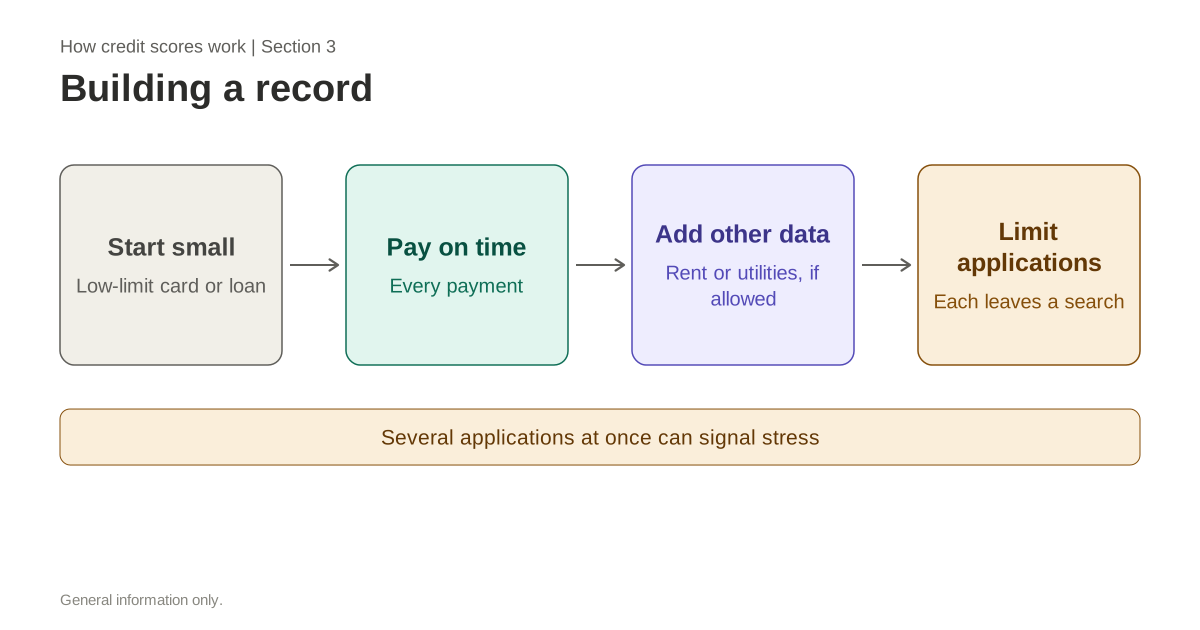
If you have little or no credit history, the usual approach is to start with a small product that you can manage comfortably, such as a low-limit card or a loan from a reputable provider, and to make every payment on time. Some countries also allow you to add rent or utility payments to your report, which can help people with a thin file.
Avoid applying for lots of credit at once. Each application can create a search on your report, and several in a short time may signal financial stress to lenders.
Repairing a damaged record
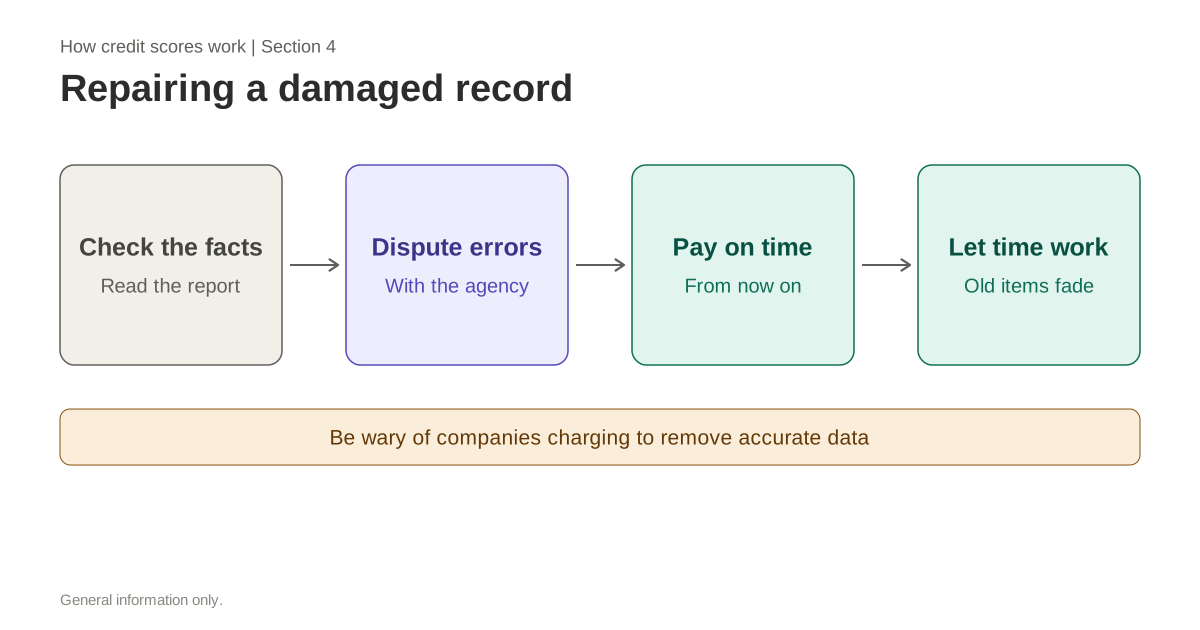
If your record has problems, start by checking the facts. Dispute any error with the agency. For genuine negative items, the effect usually fades over time as older information drops off the report and newer positive history builds up. Paying on time from now on is the most reliable way to recover.
Be wary of companies that promise to remove accurate information from your report for a fee. You are usually able to do the same work yourself, and you should check what any service offers before you pay.
Using the score sensibly
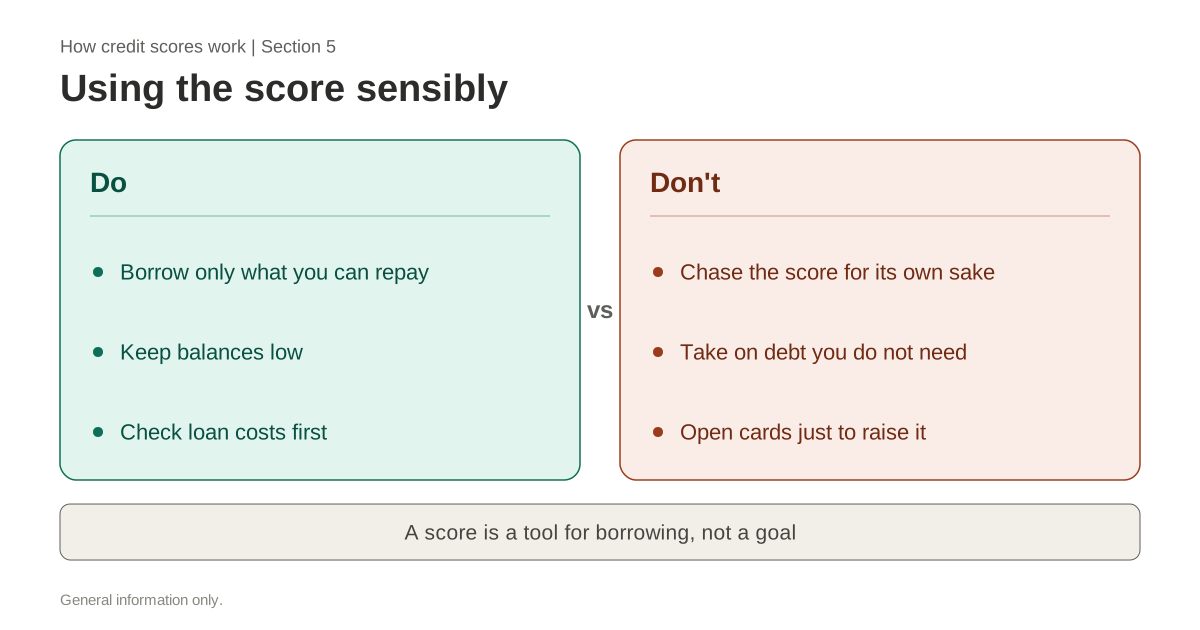
A credit score is a tool for borrowing, not a goal in itself. It is worth keeping in good shape, but it should not drive you to take on debt you do not need. Borrowing only what you can repay is the best way to protect your score and your finances.
If you want to understand how a specific loan would affect your budget, use a loan calculator to see the monthly payment and total interest before you apply.
Credit reports versus scores
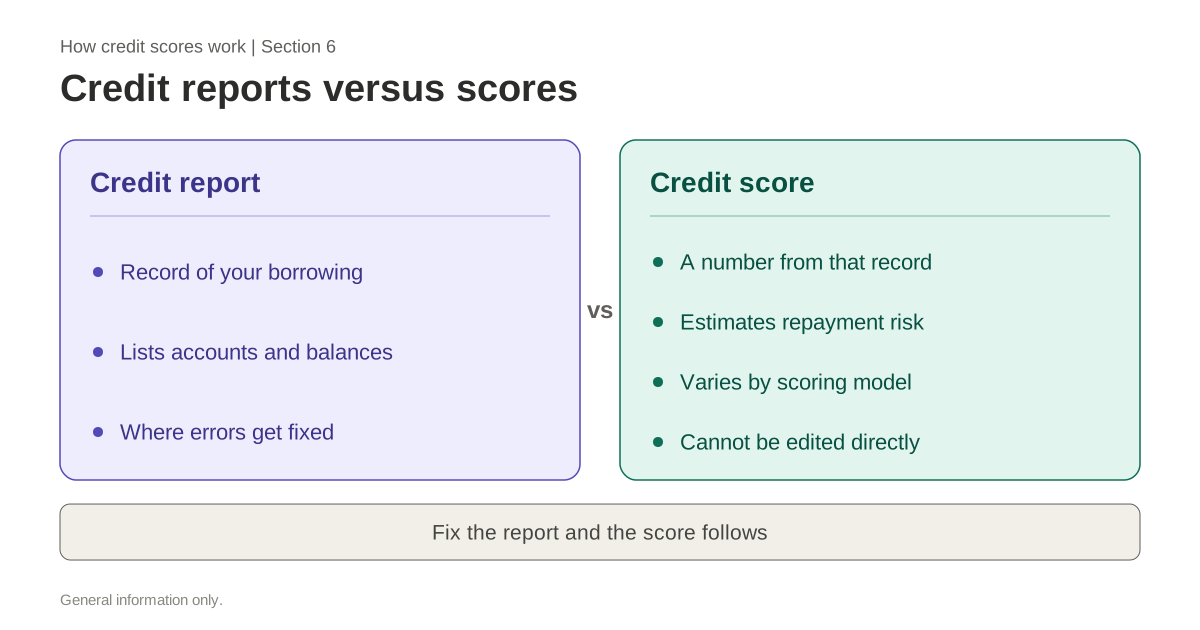
A credit report is the record of your borrowing history. A credit score is a number calculated from that record. The report lists your accounts, balances, payment history and some public records. The score summarises the risk, and different scoring models may produce different numbers from the same report.
This distinction matters when something looks wrong. You correct errors in the report, and the score then updates. You cannot change the score directly. Understanding this helps you focus on the information that scoring models use, such as your payment history and balances.
Common myths
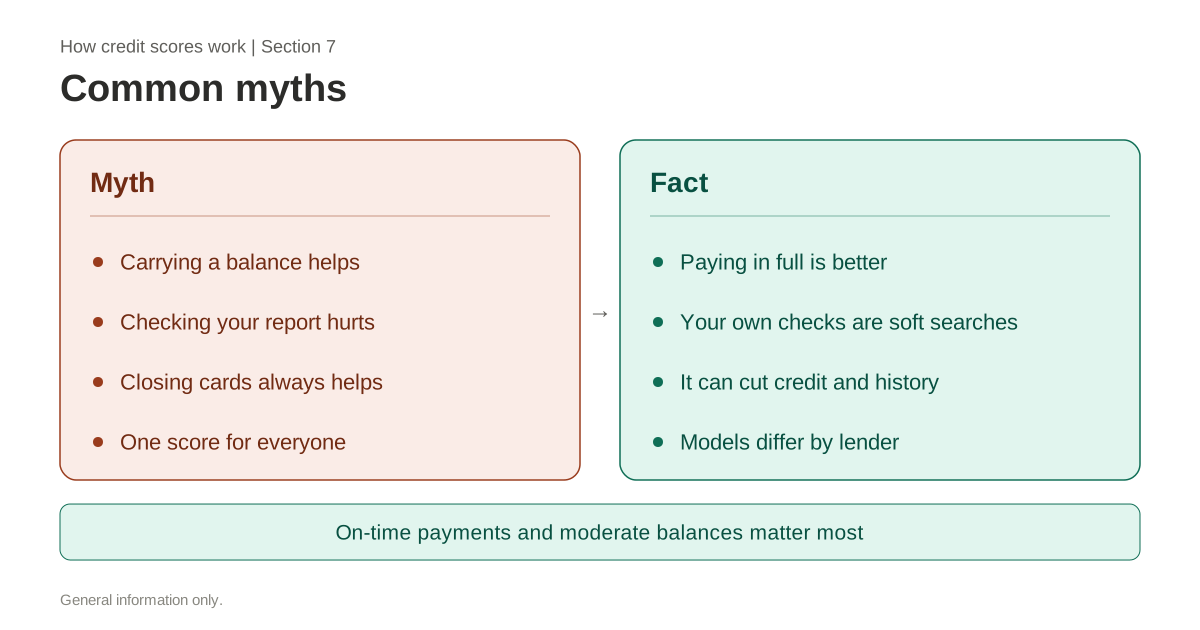
One myth is that carrying a small balance on a card improves your score. In fact, paying in full each month is generally better, because you avoid interest and keep utilisation low. Another myth is that checking your own report lowers your score. A personal check is usually recorded differently from an application for credit.
A third myth is that closing a card always helps. Closing a card can reduce your available credit and shorten your history. Focus on what scoring models value most: on-time payments, moderate balances and a reasonable mix of accounts.
The bottom line
Credit scores reward reliable repayment, low balances and a steady record. Pay every bill on time, keep balances low, check your report for errors, and avoid unnecessary applications. Over time, those habits matter more than any single trick.
Frequently asked questions
Is there one credit score everyone uses?
No. Different countries, agencies and lenders use different scores and models. The principles are similar, but the number you see may not match the one a lender uses.
Does checking my own credit score lower it?
Checking your own report is usually recorded as a soft search and does not affect your score. Applications for credit from lenders are different, and each one can have a small effect.
How long does a bad mark stay on my record?
The time limit depends on the country and the type of item. Many negative items fade after several years, and their effect lessens as positive history builds. Check the rules where you live.
Should I close old credit cards to improve my score?
Not usually. Closing an old card can reduce your available credit and shorten your average account age, both of which can lower a score. Keep it open if it has no fee, and use it occasionally.