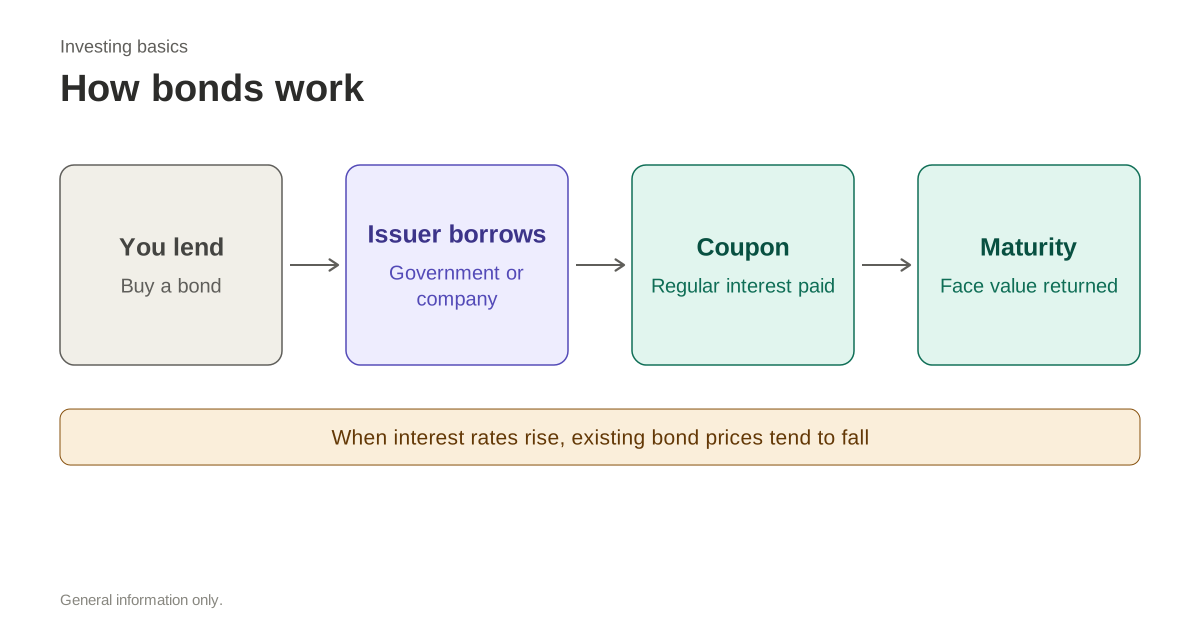
A bond is a loan that you make to a government or a company. In return, the borrower promises to pay interest, usually at regular intervals, and to repay the amount borrowed, known as the principal or face value, on a set date. Bonds are a core part of many investment portfolios because their income is usually more predictable than that of shares, though they carry their own risks.
This article explains the main features of a bond, how its price moves, and what you should check before buying one. It is general information, not a recommendation.
The main features
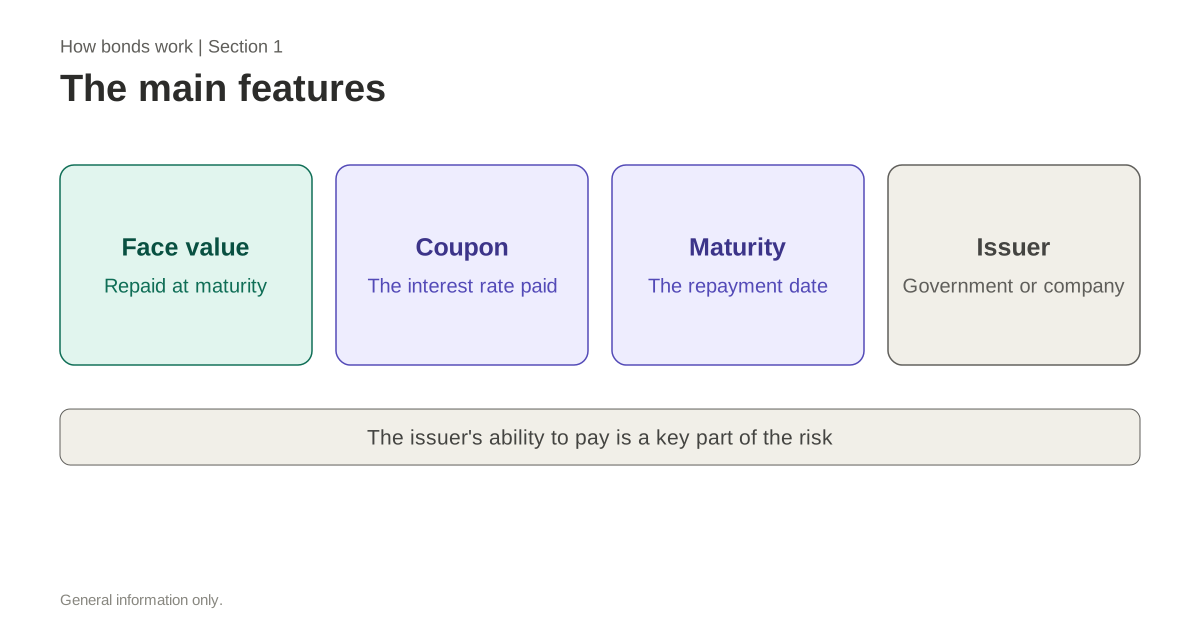
Every bond has a few key terms. The face value is the amount repaid at maturity. The coupon is the interest rate the bond pays, usually as a percentage of face value. The maturity date is when the principal is repaid. Some bonds pay coupons twice a year, while others pay monthly or pay all the interest at maturity.
The issuer is the borrower, which might be a national government, a local authority or a company. The issuer's ability to pay is one of the most important factors in a bond's risk.
Why price and yield move in opposite directions
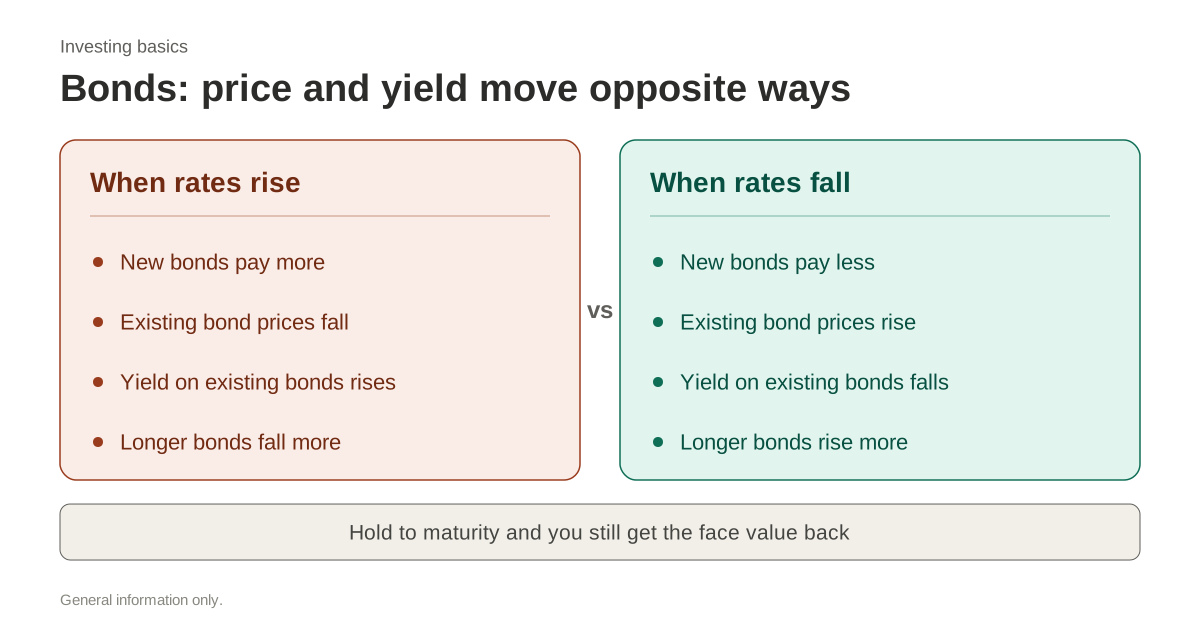
A bond's coupon is fixed when it is issued, but its market price changes as interest rates change. If new bonds are issued with higher rates, existing bonds with lower coupons become less attractive, so their prices fall. If rates fall, existing bonds with higher coupons become more valuable, and their prices rise.
The yield to maturity measures the total return you would earn if you bought the bond at its current price and held it to maturity. When the price falls, the yield rises, and when the price rises, the yield falls. This inverse relationship is central to how bonds behave.
Interest rate risk
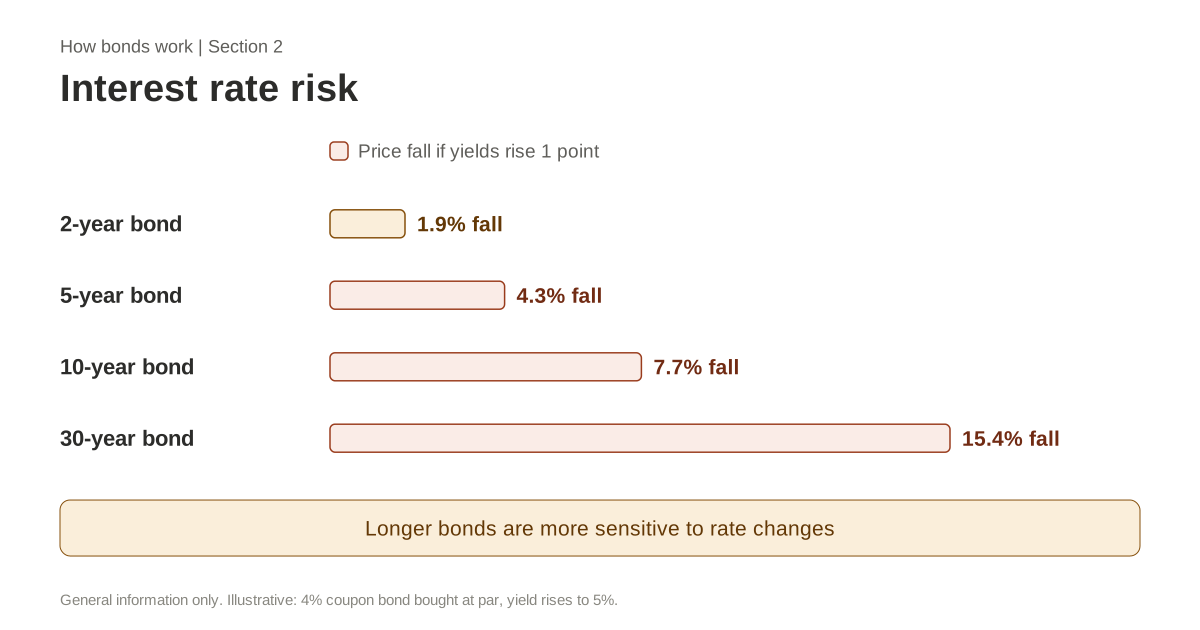
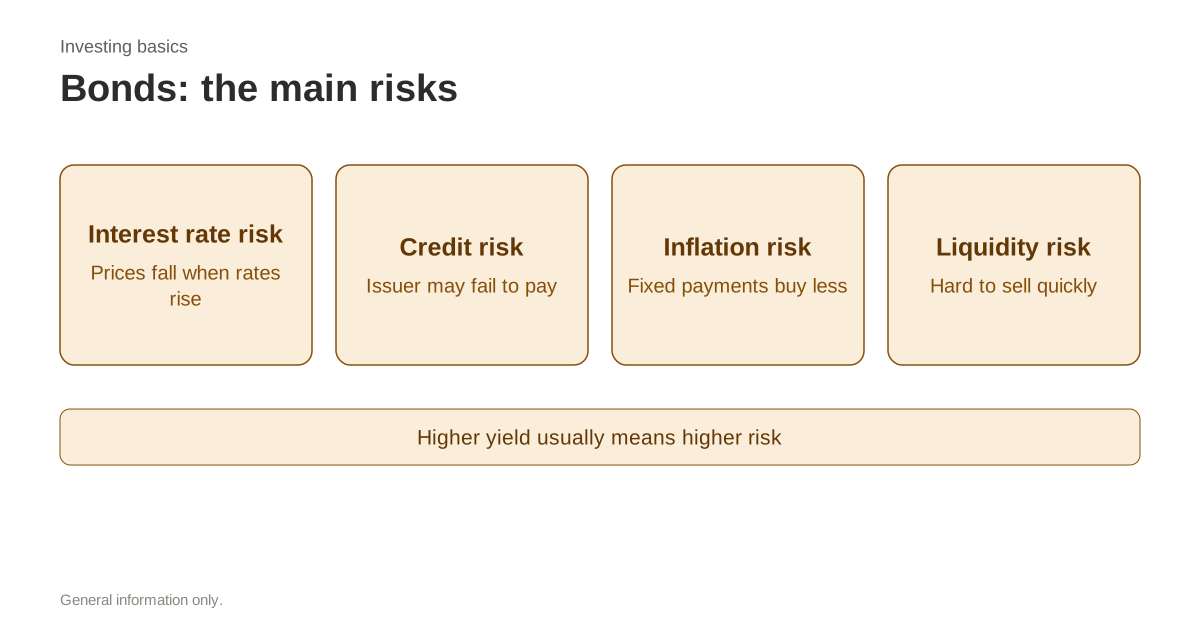
Interest rate risk is the chance that rising rates reduce a bond's market price. Longer-maturity bonds are generally more sensitive to rate changes than shorter ones, because their fixed payments are locked in for longer. If you sell before maturity, you may receive less than you paid, even though the bond will still repay its face value if the issuer does not default.
If you hold a bond to maturity and the issuer pays in full, interest rate movements along the way affect the market value but not the final repayment. That is one reason some investors buy bonds intending to hold them until they mature.
Credit risk
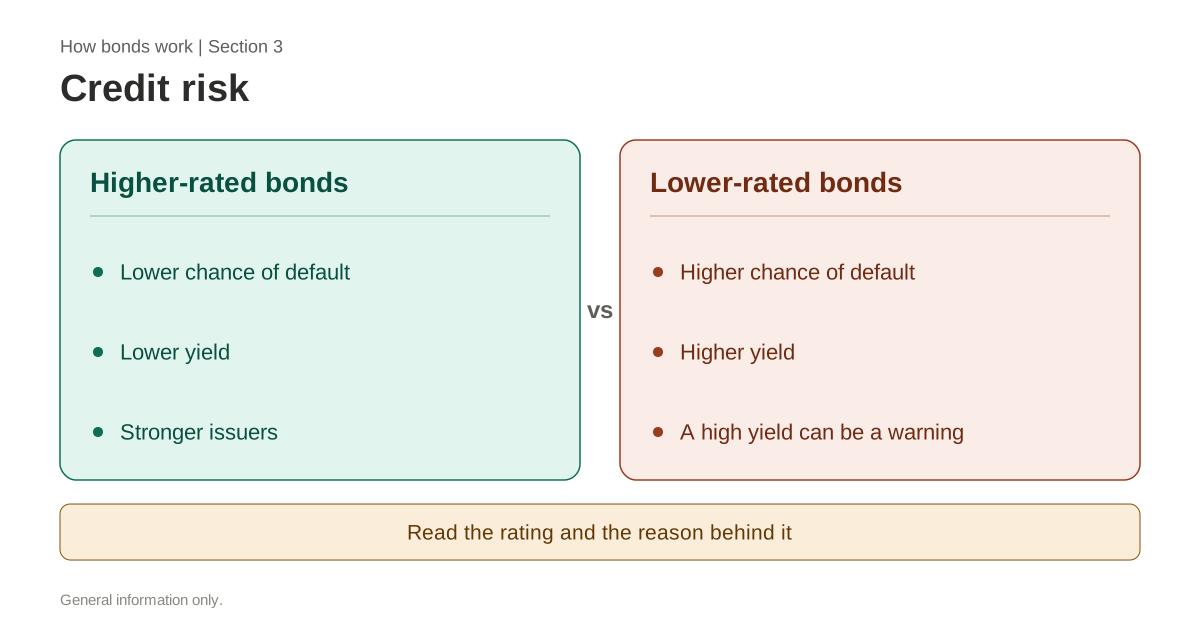
Credit risk is the chance that the issuer fails to pay interest or to repay the principal. Governments and large companies are rated by credit agencies, and the ratings give a rough guide to their ability to pay. Higher-rated bonds usually offer lower yields, because the risk of default is smaller. Lower-rated bonds pay more to compensate for the greater risk.
Read the issuer's rating and the reason for it, and check whether the bond is secured or subordinated. A high yield can be a warning sign rather than a bargain.
Inflation risk
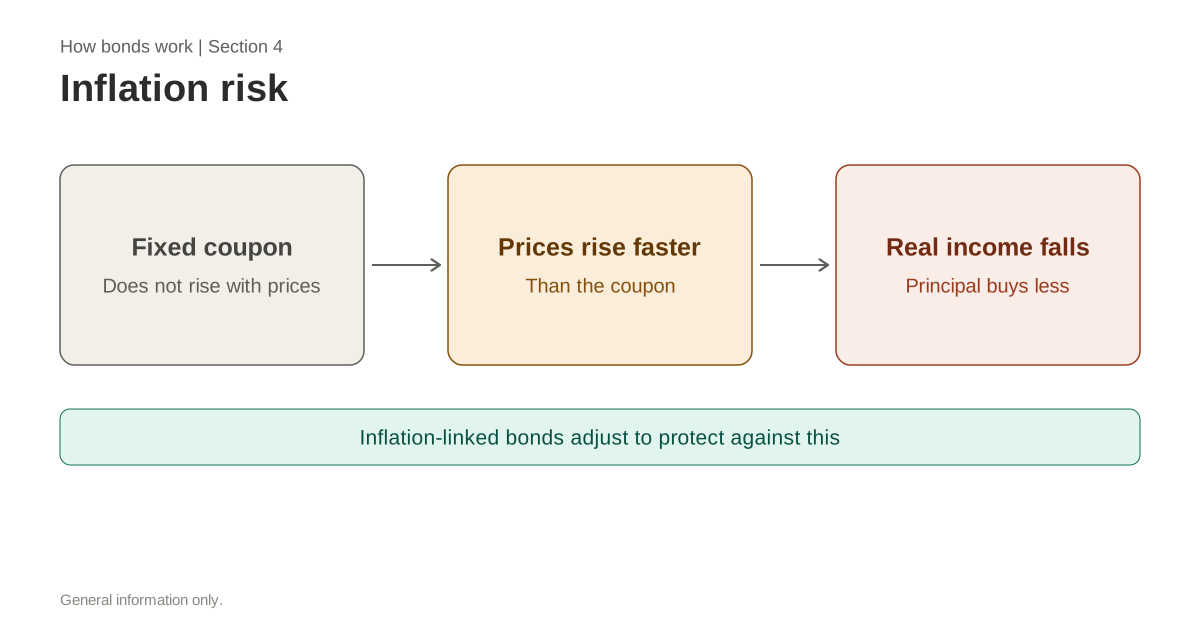
Fixed coupons do not rise with inflation. If prices rise faster than the coupon, the real income from the bond falls, and the principal repaid at maturity buys less. Inflation-linked bonds, where they are available, adjust the principal or the payments to protect against rising prices. Check whether a bond is inflation-linked before assuming it protects you.
Costs and taxes
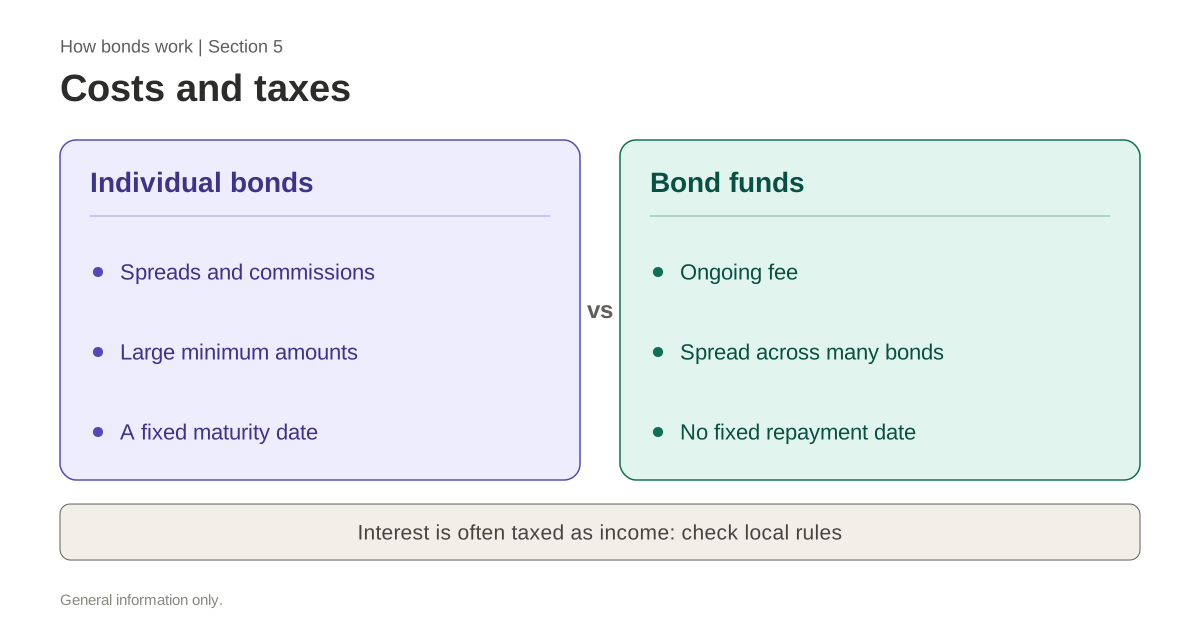
Bonds can be bought directly or through funds. Buying individual bonds may involve spreads, commissions and minimum investment amounts, which can be large relative to small holdings. Funds spread the risk across many bonds but charge an ongoing fee and do not mature in the same way, so their value can move without a fixed repayment date.
Interest from bonds is often taxed as income, and the rules depend on your country and the type of bond. Check the tax treatment before you invest.
How bonds fit into a plan
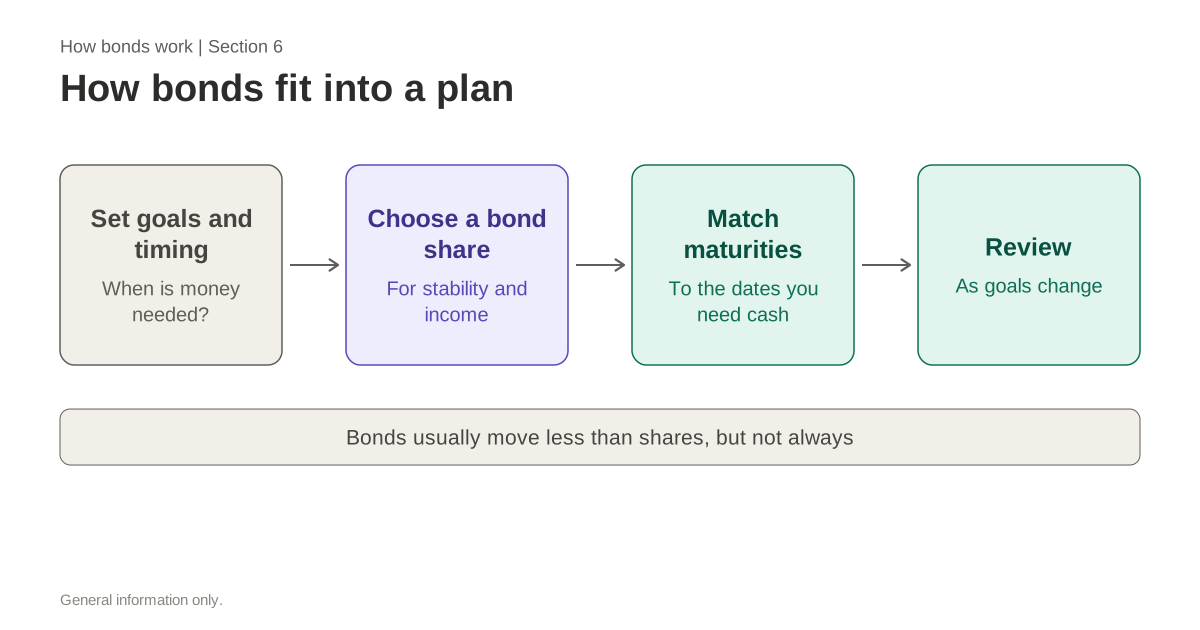
Bonds are often used to add stability and income to a portfolio. They tend to move less than shares, though not always, and their steady interest can help reduce the overall volatility of a mixed portfolio. The right share of bonds depends on your goals, your time horizon and your tolerance for losses.
Think about when you will need the money. Bonds that mature when you need the cash can reduce the risk of selling at a loss. Funds with no maturity date may be more flexible, but they carry the risk that prices move against you when you need to withdraw.
Bonds and everyday money
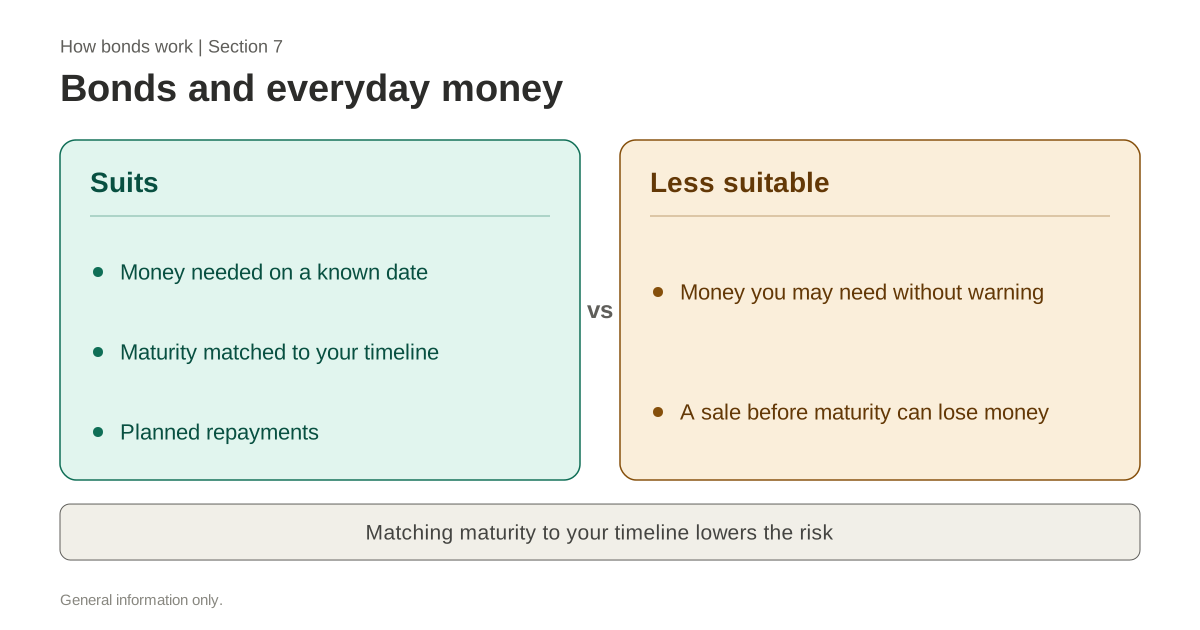
Bonds can suit money you expect to need on a known date, because the maturity date lets you plan around a fixed repayment. They are less suitable for money you may need without warning, because a sale before maturity can produce a loss if prices have fallen. Matching the bond's maturity to your timeline is one of the simplest ways to reduce that risk.
Bond ladders
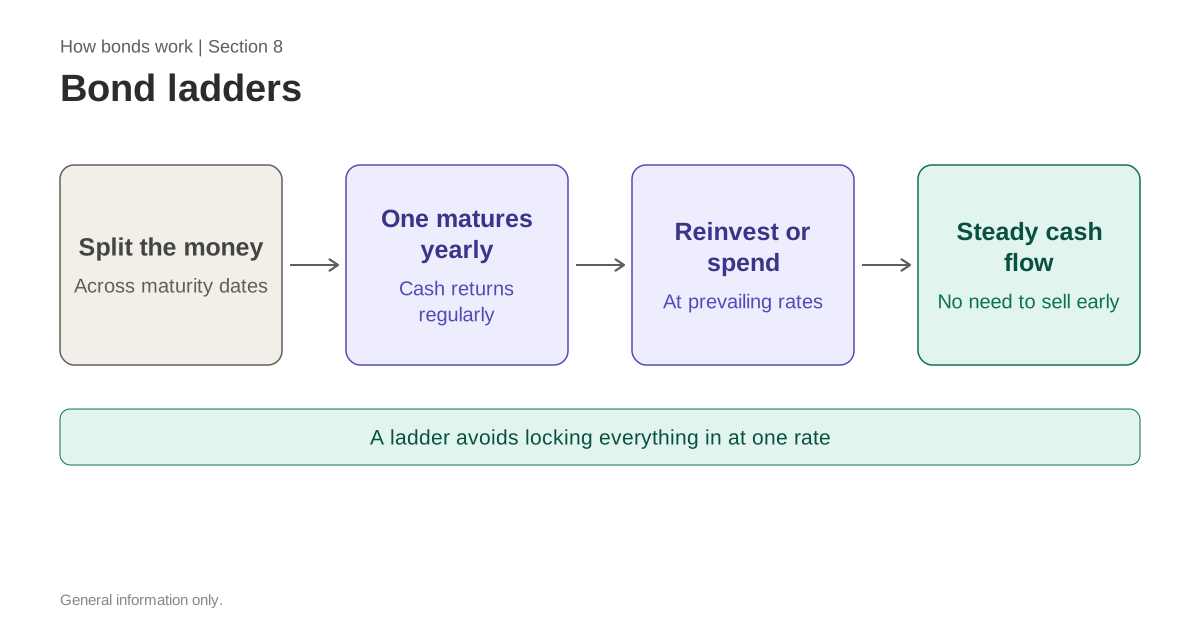
A bond ladder spreads money across bonds with different maturity dates, so that part of the portfolio matures each year. As each bond matures, the money can be reinvested at prevailing rates, or used for a planned expense. Ladders reduce the risk of locking all your money in at one rate, and they give a regular flow of cash without needing to sell bonds before maturity.
Reading a bond's risk
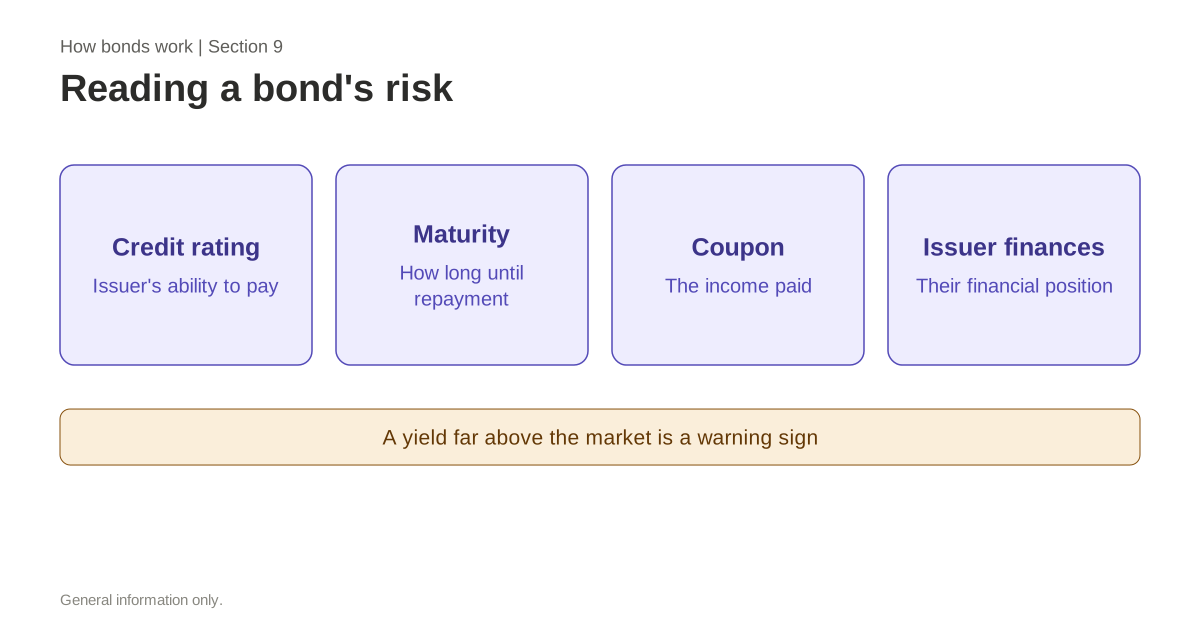
Check the credit rating, the maturity, the coupon and the issuer's financial position. Compare the yield with similar bonds to see whether the extra return is compensation for extra risk. Be cautious of bonds that offer a yield far above the rest of the market, because they often carry a higher chance of default or other problems that are not obvious at first glance.
The bottom line
A bond is a loan that pays interest and repays principal, but its market value moves with interest rates, and its payments can be eroded by inflation. Understand the coupon, the maturity, the yield and the credit quality before you buy, and match the bond's term to the date you need the money.
Frequently asked questions
Are bonds safer than shares?
Generally they are less volatile than shares, but they are not risk-free. Their prices can fall when interest rates rise, and an issuer can default. The level of risk depends on the issuer and the maturity.
Why does a bond's price fall when interest rates rise?
Because newer bonds pay higher coupons, making older bonds with lower coupons less attractive. Their market price must fall until their yield matches the current level.
What is the difference between coupon and yield?
The coupon is the fixed interest rate set when the bond is issued. The yield is the return you earn at the price you pay, which changes as the market price changes.
Can I lose money on a bond I hold to maturity?
If the issuer pays in full, you get the face value back, but inflation can reduce its purchasing power and the issuer may default. Selling before maturity can also produce a loss if prices have fallen.