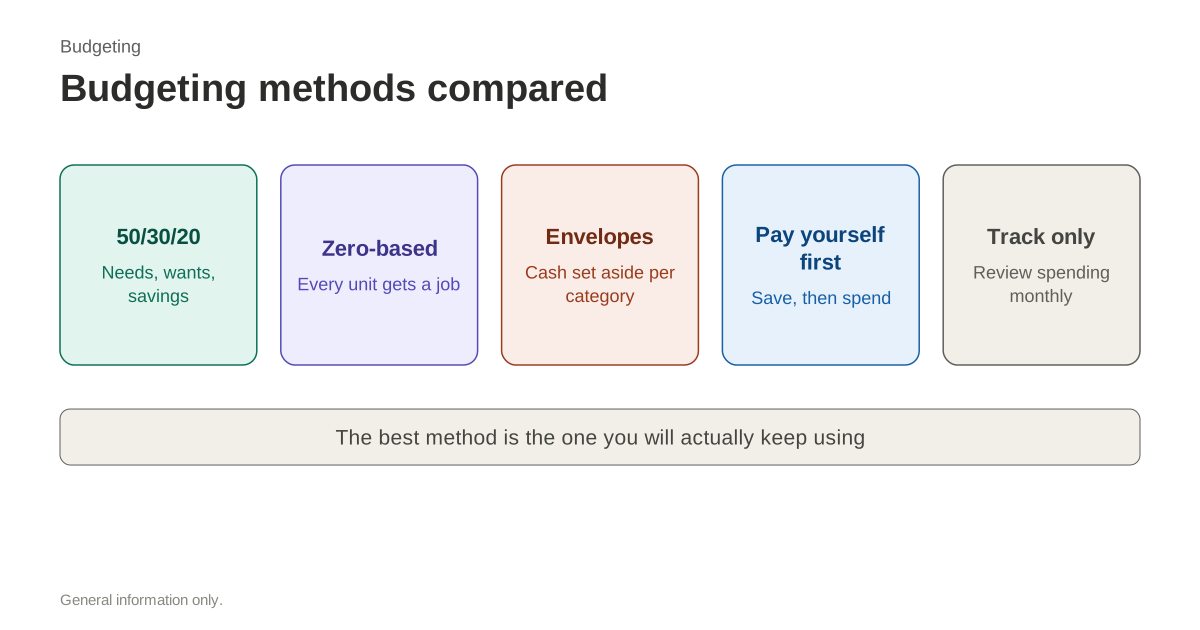
A budget is a plan for your money. It tells you what you expect to earn, what you expect to spend and what you will save before the month begins. There is no single correct way to budget, and the right method depends on how much detail you want, how variable your income is and how much time you are willing to spend on tracking.
This article compares five popular methods. Each one can work well for the right person, and each has a weakness that is worth knowing before you choose.
The percentage split
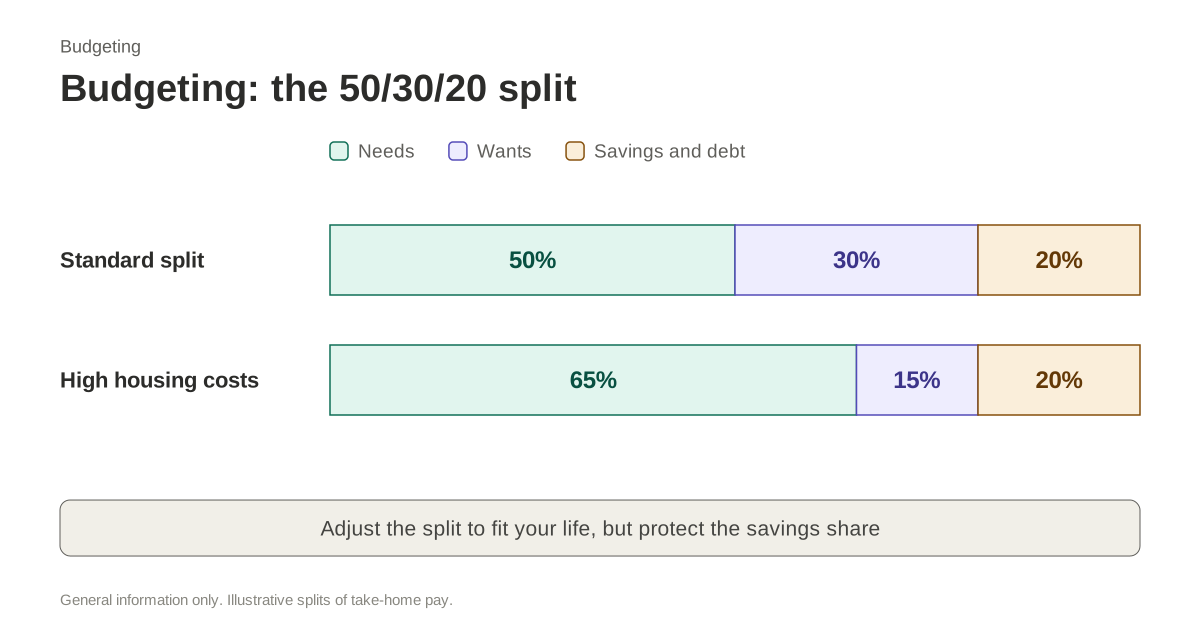
The simplest approach divides your take-home income into a few broad groups. A common version allocates half to needs, a fifth to savings and debt repayment, and the rest to wants. Other versions use different percentages to fit different goals and incomes.
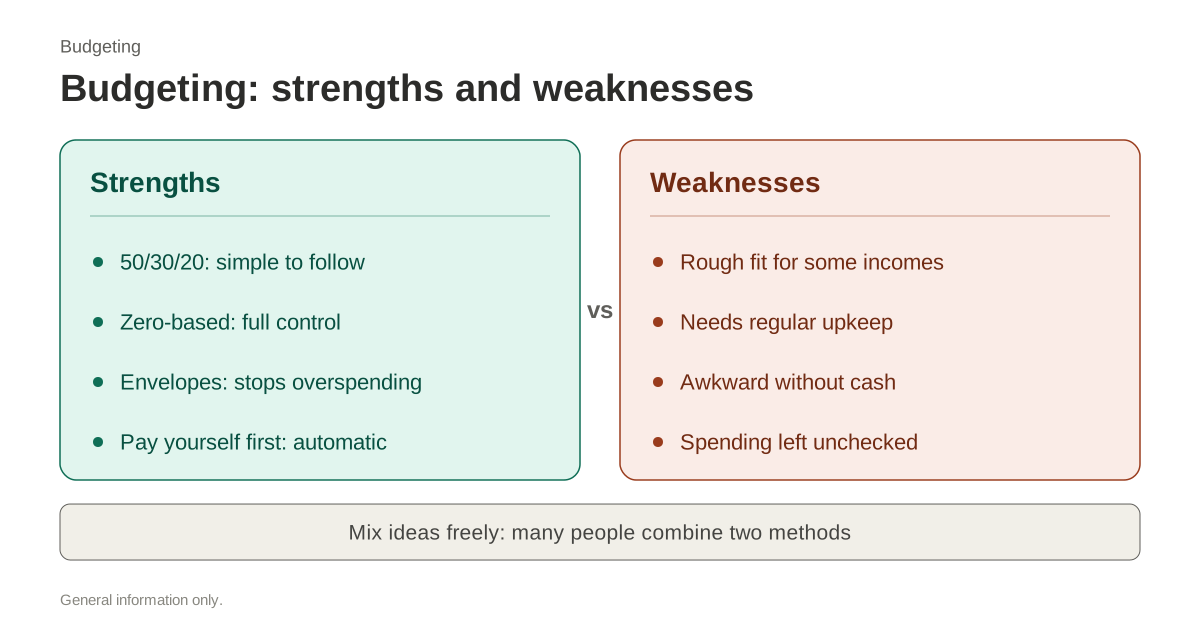
The strength of this method is simplicity. You only need to know your income and roughly where it goes. The weakness is that it can hide problems. Housing might take most of the needs share, leaving no room for the rest, and the percentages may not suit a high-cost area or a low income.
Zero-based budgeting
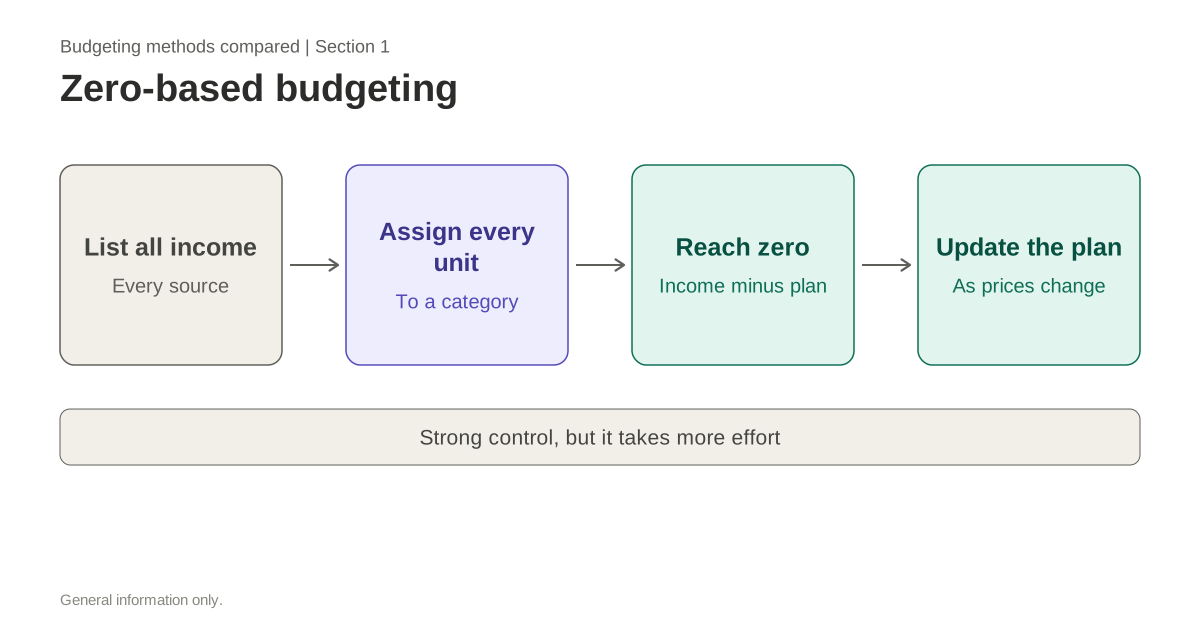
With a zero-based budget, every unit of income is given a job. You list all income, then assign each amount to a category, such as rent, food, debt, savings and entertainment, until nothing is left unallocated. The total income minus the total planned spending is zero.
This method gives you strong control and makes trade-offs visible. It takes more effort, because you must plan each category and update the plan as prices change. It works best for people with irregular income who want to know exactly how much each month can cover.
The envelope method
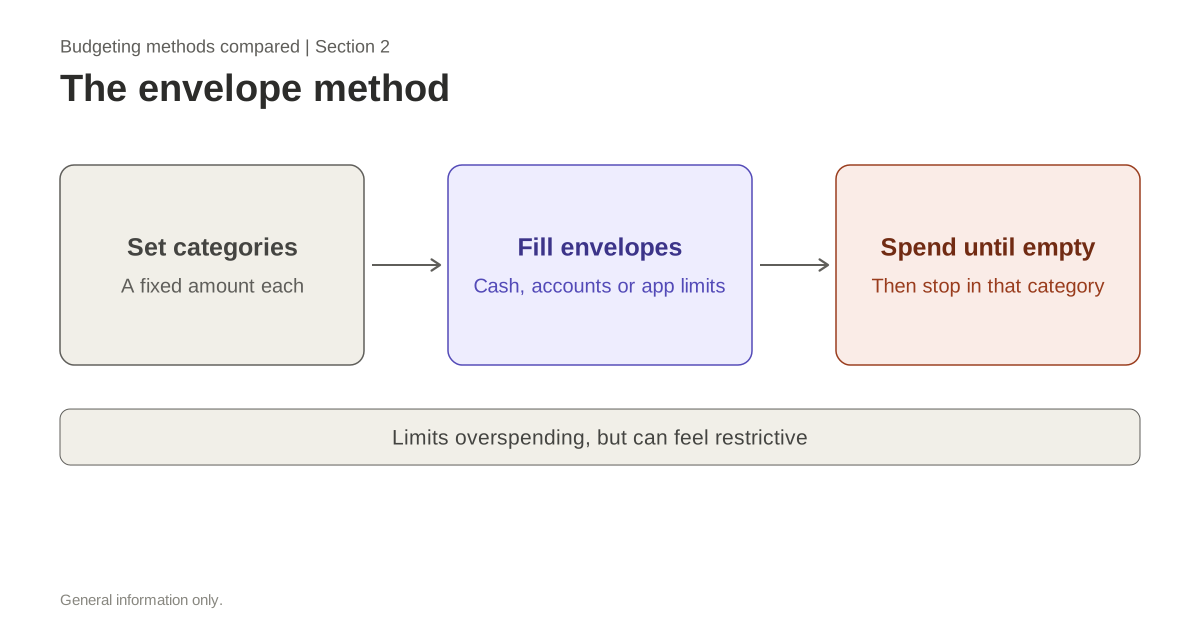
In the envelope method, you divide your spending money into categories at the start of the month. Each category has a fixed amount, which you spend from until it runs out. Physical cash envelopes are the traditional version, but the same idea works with separate bank accounts or a spending limit in a banking app.
The strength of this approach is that it limits overspending in areas where it is easy to drift, such as dining out or shopping. The weakness is that it is less flexible for bills and can feel restrictive if the limits are set too low.
Tracking every expense
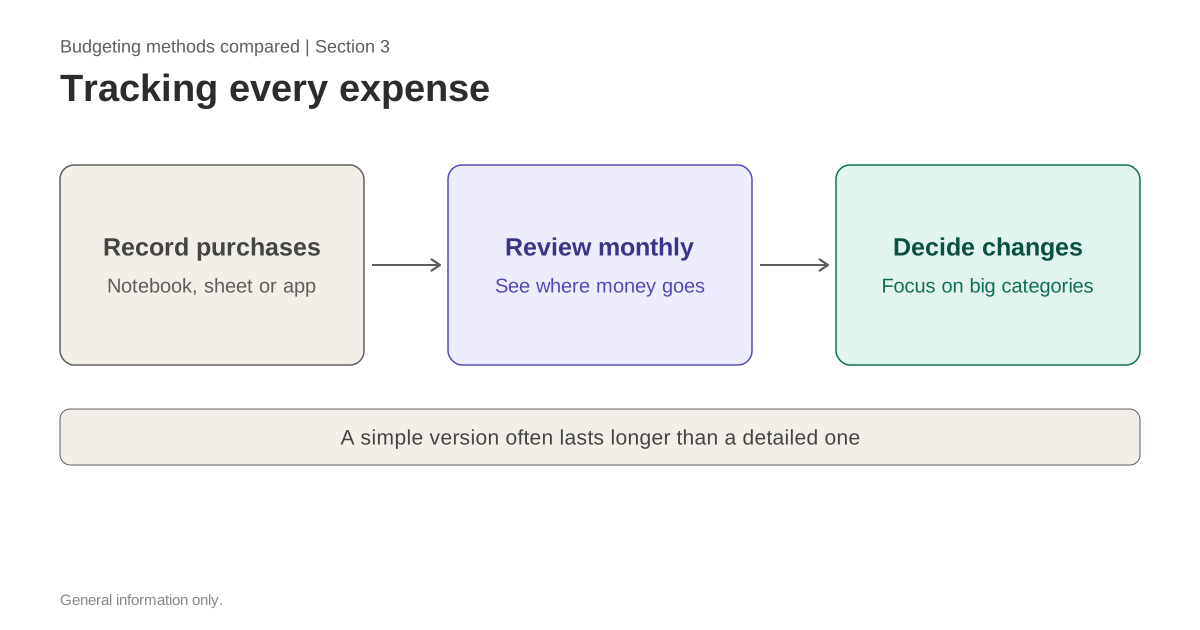
Some people prefer to record every purchase and review the total at the end of each month. Tracking can be done in a notebook, a spreadsheet or a banking app that categorises transactions automatically. The aim is to see where money goes, then decide what to change.
Tracking is very informative, but it can become a chore. Many people find they stop after a few months. A simple version that focuses on the largest categories often works better than a detailed record of small purchases.
Paying yourself first
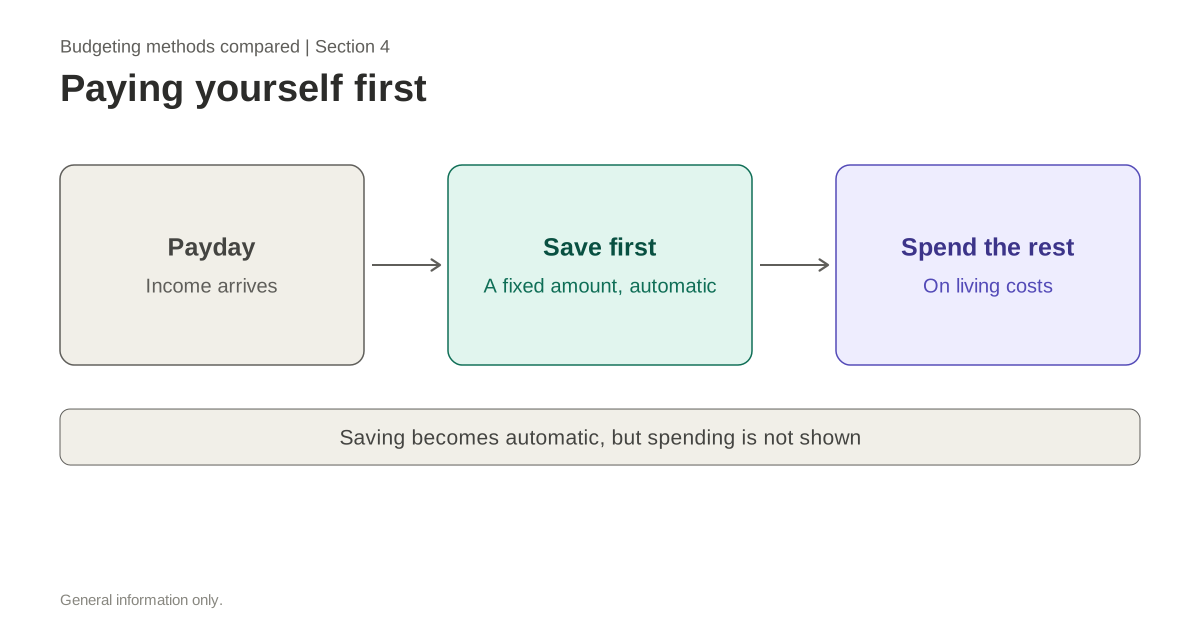
This method puts savings and debt repayment at the top of the plan. As soon as you are paid, a fixed amount moves to savings or to extra debt payments. You then spend the rest on living costs, without monitoring each category.
The strength is that saving becomes automatic, which helps people who struggle to save from what is left over. The weakness is that it does not show where spending goes, so overspending can build up if the remaining money is not managed at all.
Choosing a method
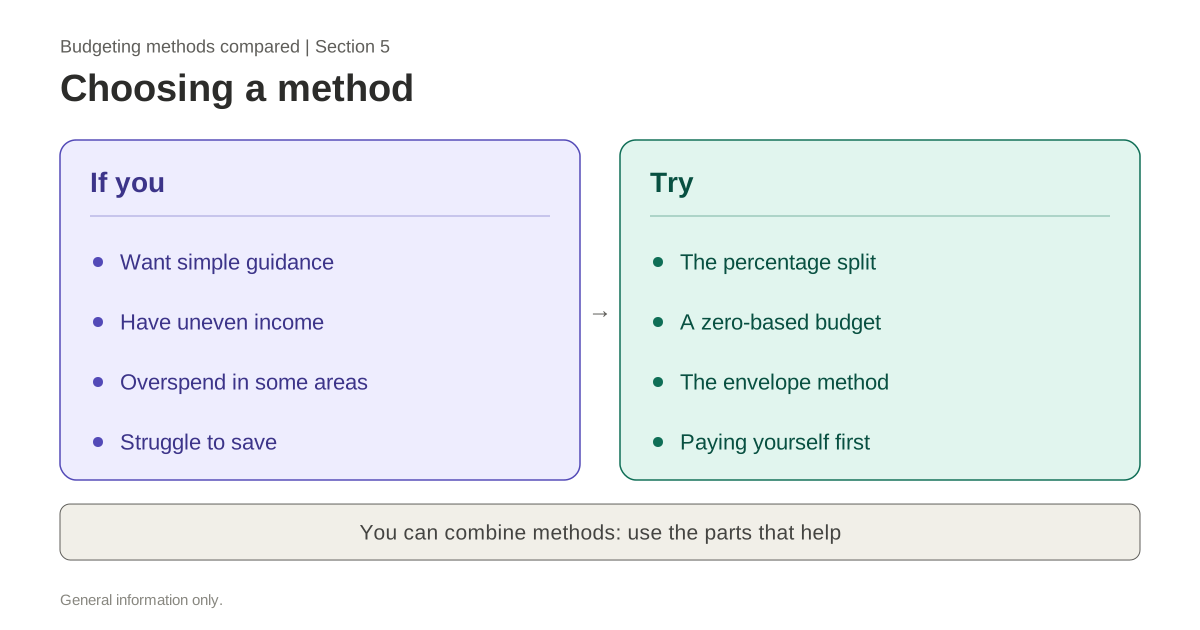
Think about how much detail you want and how stable your income is. If you want simple guidance, the percentage split is a good start. If you have an uneven income or tight margins, zero-based budgeting or the envelope method gives more control. If your main problem is saving, paying yourself first can make the biggest difference with the least effort.
You can also combine methods. Many people pay themselves first, then use a simple split for everything else. The method is a tool, so use the parts that help you and drop the parts that do not.
Start with three numbers
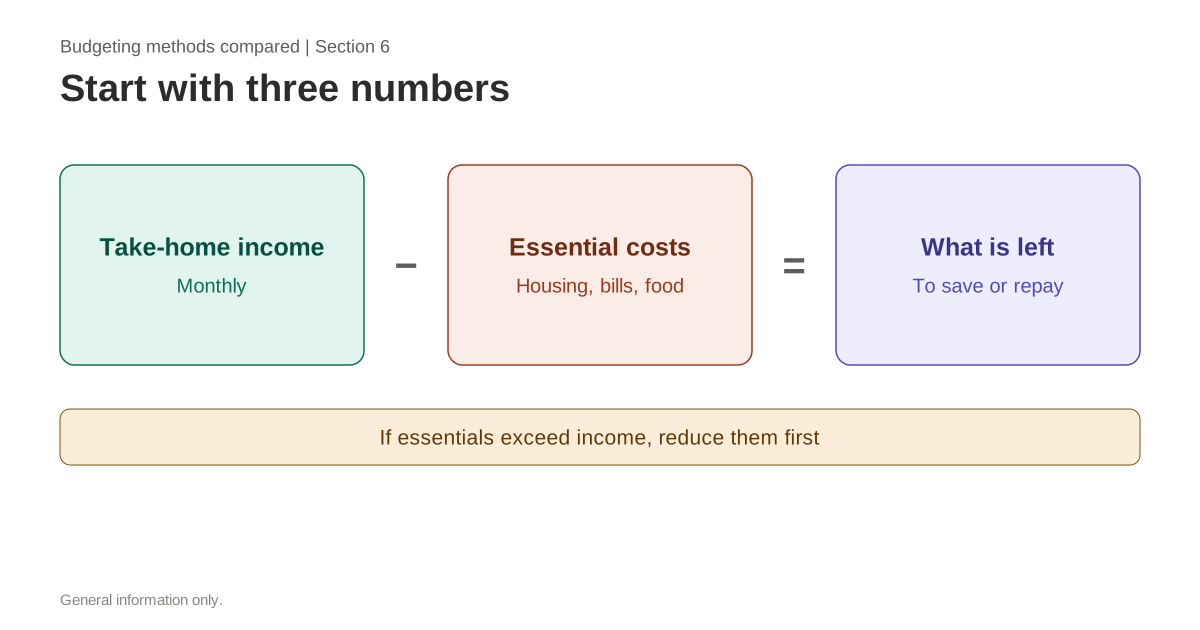
Whichever method you choose, begin with three figures: your monthly take-home income, your essential costs, and the amount you want to save or repay each month. Your essential costs are the non-negotiable bills, such as housing, utilities, food and transport. If essentials take more than your income, the first job is to reduce them.
Use our budget calculator to see what is left after your categories. Compare the result with the numbers you expected, then adjust.
Review and adjust
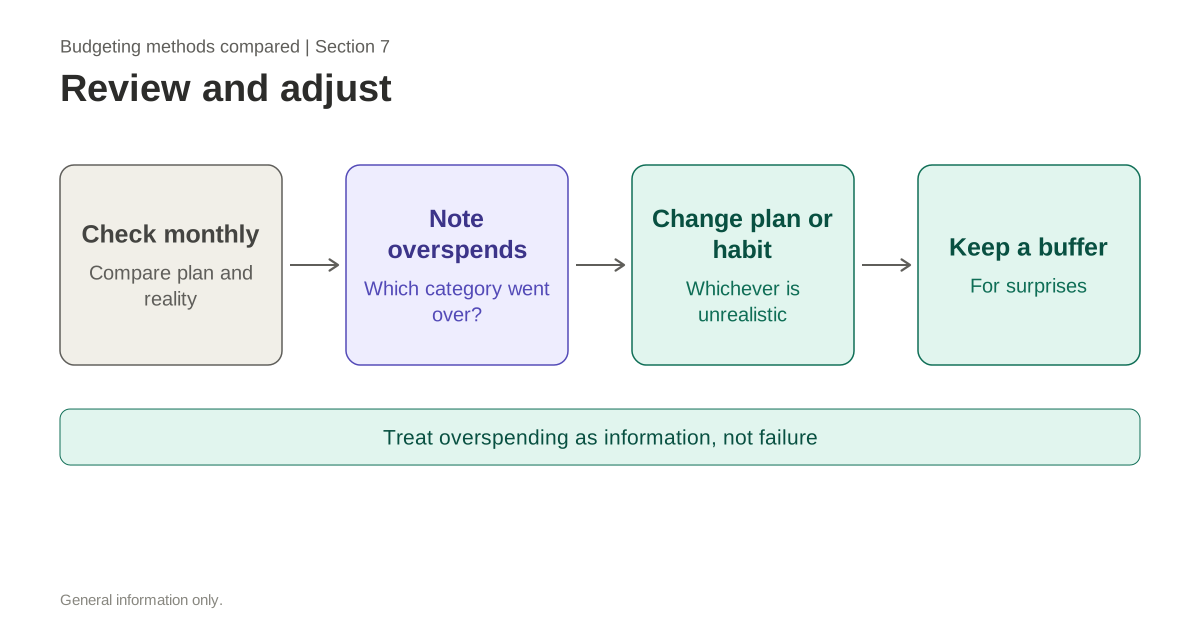
A budget that is never reviewed quickly becomes fiction. Check it at least once a month. Note which categories went over, and decide whether the plan or the spending should change. Prices, income and goals all shift over time, so update the budget when something important changes.
Be realistic. A budget with no room for ordinary life is hard to keep, and people often give up after one bad month. Build in a small margin for surprises, and treat occasional overspending as information rather than failure.
Adapting a method to your life
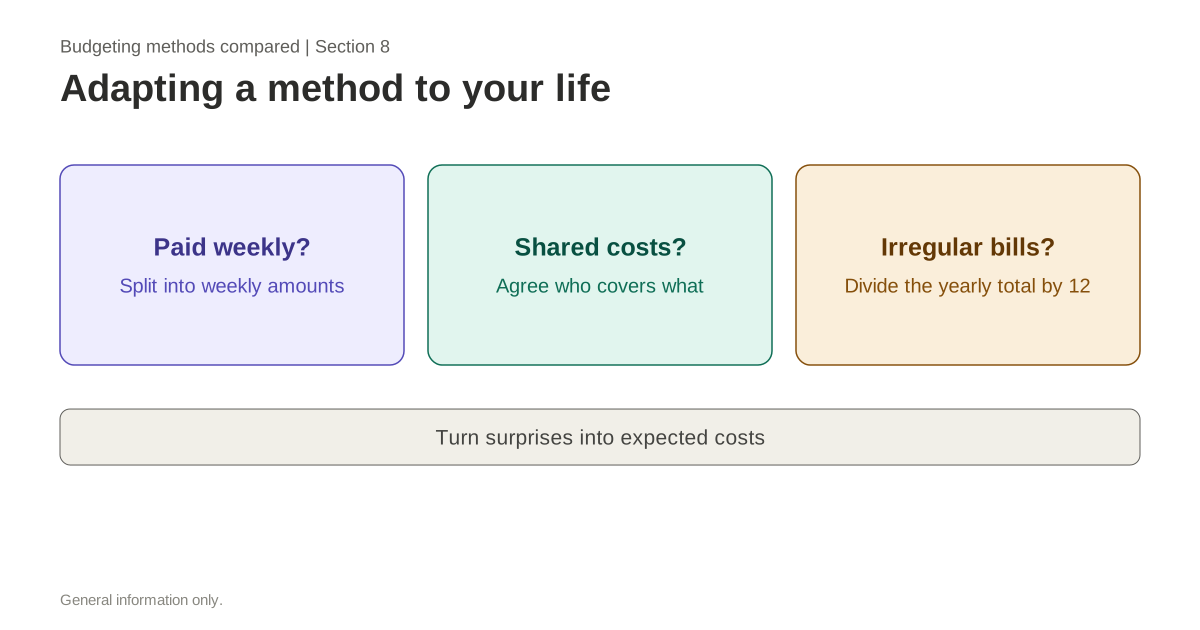
No method works without adjustment. If you are paid weekly, a monthly plan may feel awkward, so split your budget into weekly amounts for bills that come out of each paycheque. If you share costs with someone else, agree on which categories each of you covers and how any surplus will be used.
It also helps to plan for irregular costs, such as annual insurance, school fees, gifts or car maintenance. Divide the yearly total by twelve and set that amount aside each month. This turns surprises into expected costs and prevents one large bill from wrecking the plan.
Common budgeting mistakes
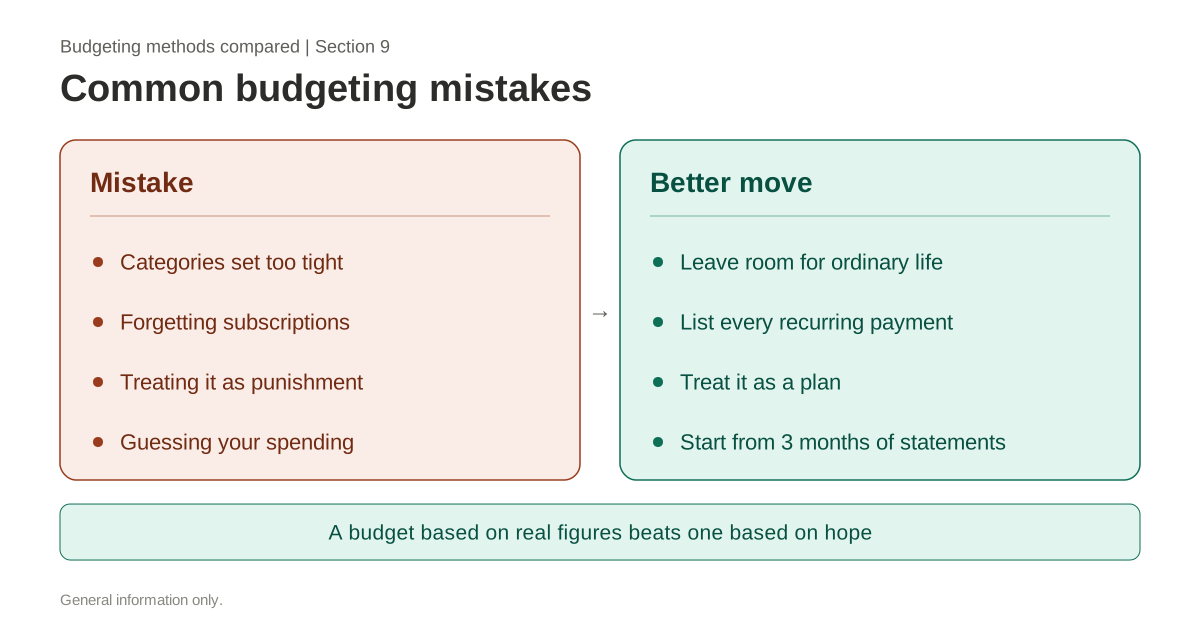
A frequent mistake is to set categories that are too tight, which leads to failure within a few weeks. Another is to forget small recurring payments, such as subscriptions, which can add up to a surprising total. A third is to treat the budget as a punishment rather than a plan, which makes it easy to abandon after one overspend.
Be honest about your current spending before you set limits. Look at the last three months of statements, and use them as the starting point. A budget based on real figures is far more useful than one based on hopes.
The bottom line
Budgeting is about awareness and choice, not restriction for its own sake. Pick the method that matches your income, your habits and the amount of time you can give, then review it regularly. A simple plan that you follow is far more useful than a detailed plan you abandon.
Frequently asked questions
Which budgeting method is best for beginners?
The percentage split is usually the easiest to start with because it needs only a few numbers. Once you understand where your money goes, you can switch to a more detailed method if you need more control.
What is zero-based budgeting?
It is a method where every unit of income is assigned to a category until nothing is left unplanned. Income minus planned spending equals zero, which makes trade-offs very clear.
Do I need to track every purchase?
Not always. Tracking the largest categories is often enough to make good decisions. Detailed tracking helps some people, but many find it hard to keep up for long.
What should I do when I overspend?
Look at which category went over and why. Adjust the plan or the spending for the next month, and build a small buffer so that one unexpected cost does not undo the whole budget.